Table of Contents
Sand Dune Science for Travelers 9 Geological Wonders Revealed
You look at the desert.
You see a pile of sand.
It looks simple.
It looks like a motionless blanket of gold.
But this is an illusion.
The desert is alive with physics.
It is a chaotic warzone of wind and gravity.
Every single grain is fighting a battle.
For the casual tourist, it is a photo backdrop.
But for the curious mind, it is a laboratory.
Sand Dune Science for Travelers is not just for geologists.
It is for anyone who wants to understand what they are standing on.
When you understand the science, the view changes.
You stop seeing a hill.
You start seeing a moving wave of rock.
You realize that the dune you are climbing was not there last year.
It might not be there next year.
We are going to dig deep.
We will look at the microscopic and the massive.
We will explain why sand sings.
We will explain how a dune can trap a car.
This is the hidden story of the landscape.
The Birth of a Grain of Sand
It starts with a rock.
Maybe it was a granite mountain.
Maybe it was a quartz vein in a volcano.
Wind and rain attacked this rock for millions of years.
They broke it down.
They shattered it into smaller pieces.
Water carried these pieces down rivers.
The pieces tumbled and crashed.
They smoothed each other out.
Finally, they reached a dry basin.
The water evaporated.
What was left was sediment.
This is the beginning of Sand Dune Science for Travelers.
Most desert sand is silica.
It is quartz.
It is incredibly hard.
It scores a 7 on the Mohs hardness scale.
This is why it survives.
Softer minerals like limestone turn to dust.
They blow away as fine powder.
But quartz remains.
It becomes the gritty, golden grain you feel.
Sometimes, the sand is red.
This means there is iron oxide.
It is literally rust.
The older the sand, the redder it is.
The iron has had more time to oxidize.
White sand is different.
It might be made of gypsum or calcium carbonate.
Black sand comes from volcanoes.
Every color tells a geological history.
When you pick up a handful, you hold history.
You hold millions of years of erosion.
The Physics of Wind and Movement
How does the sand move?
It does not just fly.
There is a specific physics to it.
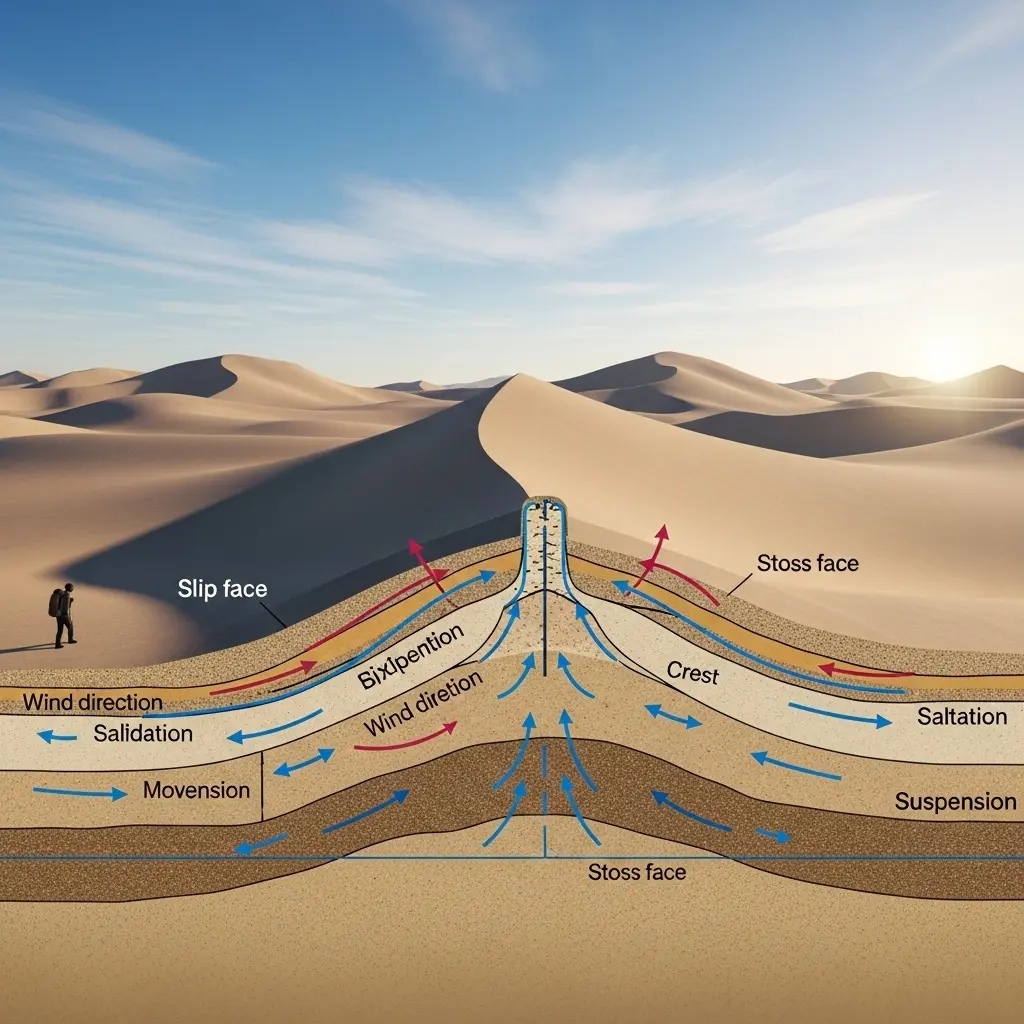
It is called “saltation.”
This comes from the Latin word for “jump.”
The wind lifts a grain.
It carries it for a short distance.
Gravity pulls it down.
It hits the ground with force.
It acts like a billiard ball.
It knocks other grains into the air.
This chain reaction creates a cloud of movement.
It is a carpet of jumping sand.
Sand Dune Science for Travelers studies this flow.
Only the finest dust goes high into the air.
This is called “suspension.”
This dust can travel across oceans.
The heavier grains just roll.
This is called “creep.”
They are too heavy to fly.
But the bombardment from jumping grains pushes them.
They inch forward slowly.
This is how a massive dune migrates.
It rolls over itself.
It is like a tank tread made of rock.
The wind pushes the back of the dune.
The sand falls down the front.
The entire structure moves forward.
It can move meters in a year.
It can bury roads.
It can swallow entire villages.
The Anatomy of a Dune
A dune is not a random pile.
It has a strict shape.
It has a “stoss” side.
This is the side facing the wind.
It has a gentle slope.
The wind pushes grains up this slope.
Then there is the “slip face.”
This is the steep side.
It faces away from the wind.
It is always at a specific angle.
This is the “angle of repose.”
For dry sand, this is about 34 degrees.
If it gets steeper, it collapses.
It creates an avalanche.
Sand Dune Science for Travelers relies on this angle.
This is what makes dune bashing possible.
Drivers go down the slip face.
It feels like falling.
But the sand controls the fall.
The crest is the top edge.
It is where the wind speeds up.
It creates a sharp line.
It is the meeting point of the stoss and the slip face.
Understanding this anatomy helps you navigate.
If you are lost, look at the dunes.
They tell you the prevailing wind direction.
They are nature’s compass.
The Four Main Types of Dunes
Not all dunes are the same.
The shape depends on the wind.
It depends on the amount of sand.
1. Barchan Dunes
These are crescent-shaped.
They look like a “C”.
The horns of the crescent point downwind.
They form where sand is scarce.
They form where wind blows from one direction.
They are the fastest moving dunes.
They are the nomads of the desert.
2. Transverse Dunes
These are long ridges.
They look like waves in the ocean.
They form where sand is plentiful.
They form perpendicular to the wind.
They can stretch for kilometers.
They create a sea of sand.
3. Linear Dunes
These are straight lines.
They are parallel to the wind.
They form when wind comes from two directions.
These winds meet and squeeze the sand.
They form long highways of sand.
Some are hundreds of kilometers long.
4. Star Dunes
These are the giants.
They look like pyramids or stars.
They have arms going in all directions.
They form where wind comes from everywhere.
The wind changes with the seasons.
Instead of moving, these dunes grow up.
They pile higher and higher.
They are the tallest dunes on Earth.
Sand Dune Science for Travelers highlights these as landmarks.
They do not migrate much.
They are the permanent skyscrapers of the desert.
The Phenomenon of Singing Sands
Some dunes make noise.
It is a low hum.
It sounds like a cello or a low-flying plane.
This is a rare phenomenon.
It creates a booming sound.
It happens when sand avalanches.
Sand Dune Science for Travelers is still investigating this.
Theories suggest it is about friction.
The grains must be very round.
They must be very rich in silica.
They must be a specific size.
When they slide against each other, they vibrate.
The air between them resonates.
It amplifies the sound.
The dune acts like a giant speaker.
You can trigger it.
Slide down a steep face on your butt.
Push the sand with you.
If the conditions are right, it will roar.
It is a ghostly sound.
Ancient legends said it was spirits.
They said it was djinns talking under the sand.
Science tells us it is frequency and friction.
It requires dry sand.
Humidity kills the sound.
The water makes the grains stick.
They cannot vibrate freely.
So, this only happens in the driest deserts.
The Role of Moisture and Cohesion
Sand seems dry.
But beneath the surface, there is moisture.
Water plays a huge role.
It acts as glue.
It creates surface tension between grains.
This is called “cohesion.”
Sand Dune Science for Travelers explains why this matters.
It changes how you drive.
Wet sand is hard.
It is easy to drive on.
It supports the weight of the car.
Dry sand is loose.
It flows like water.
Cars sink in it.
This is why morning safaris are different.
The dew from the night makes the sand firm.
By afternoon, the sun evaporates the dew.
The sand becomes soft.
It becomes treacherous.
Plants rely on this internal moisture.
A dune can hold water like a sponge.
Rain sinks in quickly.
It is protected from evaporation by the top layer of dry sand.
Roots dive deep to find this wet layer.
This hidden reservoir keeps the ecosystem alive.
It is why you see green bushes on yellow hills.
Ecosystems of the Sand Sea
The desert is not dead.
It is a specialized ecosystem.
Animals here are engineers.
They use Sand Dune Science for Travelers for survival.
The Sandfish Skink is a lizard.
It does not walk on sand.
It swims through it.
It dives beneath the surface to escape heat.
Its scales are polished smooth.
This reduces friction against the quartz.
The Camel is another marvel.
Its feet are wide pads.
They spread the weight.
This prevents sinking.
This is the same principle as deflating tires.
Insects have long legs.
This keeps their bodies away from the hot surface.
Some beetles collect water from fog.
They stand on their heads.
Dew condenses on their backs and rolls into their mouths.
Plants have shallow, wide roots.
They catch the rain before it sinks too deep.
Or they have taproots that go down 30 meters.
Life here fights for every drop.
It fights against the shifting ground.
If a plant gets buried, it grows faster.
It races the accumulation of sand.
The Chemistry of Sand Colors
We mentioned colors briefly.
But the chemistry is fascinating.
The Empty Quarter is famous for red sand.
This is hematite coating.
It is iron oxide (Fe2O3).
The sand in Dubai has different shades.
Closer to the coast, it is paler.
This is because of marine shells.
Crushed seashells mix with the quartz.
They add calcium carbonate.
This makes the sand whiter and cooler.
Sand Dune Science for Travelers notes this temperature difference.
Red sand gets hotter.
Dark minerals absorb solar radiation.
White sand reflects it.
This affects tire pressure.
Hotter sand expands the air in your tires.
It also makes the air between sand grains expand.
This makes the sand “fluffier.”
It is harder to drive on.
In volcanic areas, sand is green or black.
Green sand contains olivine.
Black sand contains basalt.
The color tells you the origin of the grain.
It tells you how far it has traveled.
Red sand has traveled a long way or sat for a long time.
White sand is usually younger.
Geological Time and Erosion
Dunes are temporary.
In geological time, they are fleeting.
They are constantly being destroyed and rebuilt.
Sand Dune Science for Travelers looks at the long game.
A dune field might become sandstone.
If the climate changes, it gets wet.
Minerals cement the grains together.
It turns into rock.
Zion National Park was once a desert.
The cliffs there are petrified dunes.
You can see the layers.
They are called “cross-bedding.”
They show the angle of the slip face from millions of years ago.
Wind is the architect.
But water is the destroyer.
A flash flood can wash away a dune in hours.
It moves more sediment in a day than wind does in a year.
The desert is a balance of these forces.
It is a cycle of construction and destruction.
We are just visiting during a specific moment.
The Physics of Dune Bashing
Why do we deflate tires?
It is physics.
It is about “ground pressure.”
A fully inflated tire cuts like a knife.
It has a small contact patch.
All the car’s weight is on a small area.
It pushes the sand grains apart.
The car sinks.
When you deflate, the tire flattens.
It becomes a track.
The weight is spread out.
The pressure per square inch drops.
The sand grains are not pushed apart.
They are compressed together.
They form a solid surface.
Sand Dune Science for Travelers explains momentum.
You need speed to climb.
Gravity is pulling you back.
Friction is slowing you down.
The sand is absorbing your energy.
If you stop on a slope, you are stuck.
You cannot start again.
The wheels will just spin.
They will dig a hole.
You have to back down and try again.
It is a dance with Newton’s laws.
You use gravity to go down.
You use momentum to go up.
You use centrifugal force to turn on the bowl of a dune.
It is applied physics in a 4×4.
Human Impact and Conservation
Dunes are fragile.
We think of them as tough.
But they are easily scarred.
Tire tracks can last for decades.
In some deserts, tracks from WWII are still visible.
Why?
Because the surface has a “crust.”
It is a thin layer of bacteria and lichen.
It is called the “cryptobiotic soil.”
It holds the sand together.
It prevents erosion.
When a tire breaks this crust, the sand blows away.
It creates a wound in the landscape.
Sand Dune Science for Travelers advocates for responsible driving.
We must drive in designated areas.
We must let the dunes heal.
Wind will eventually fix the shape.
But the biology takes longer to return.
Over-tourism can destroy the vegetation.
If the plants die, the dunes move faster.
They become dangerous.
They encroach on roads and cities.
Sustainable tourism is about minimizing this damage.
It is about respecting the geology.
Companies like https://htdesertsafari.com/ train drivers on this.
They follow specific tracks.
They avoid the vegetation zones.
They respect the science of the sand.
How to Read the Sand
A traveler can learn to read the signs.
Look at the ripples.
They are mini-dunes.
They run perpendicular to the wind.
They tell you how the air is moving today.
Look at the shadow.
It tells you the steepness.
If the shadow is sharp, the edge is sharp.
Be careful.
Look at the color.
If it is dark, it might be wet.
If it is very bright, it is soft.
Sand Dune Science for Travelers is a survival skill.
If you are walking, walk on the crest.
It is firmer.
Walking on the slip face is exhausting.
For every step up, you slide two steps back.
Look for “nebkas.”
These are small dunes formed around bushes.
They are stable.
They often have shade.
They are good places to rest.
Reading the sand keeps you safe.
It helps you find your way.
The Global Sand Crisis
It sounds crazy.
But the world is running out of sand.
Not desert sand.
Construction sand.
Desert sand is too round.
Wind polishes it into spheres.
It does not lock together.
You cannot make concrete with it.
It is useless for building skyscrapers.
Concrete needs river sand.
River sand is jagged.
It locks together like puzzle pieces.
Sand Dune Science for Travelers distinguishes these types.
This is why Dubai imports sand for construction.
It has endless sand, but the wrong kind.
This highlights how unique desert sand is.
It is physically different from beach sand or river sand.
It is shaped by air, not water.
This roundness is why it flows so well.
It is why it acts like a liquid.
Conclusion
The desert is a masterpiece of physics.
It is a gallery of geological art.
Sand Dune Science for Travelers opens your eyes.
It transforms a simple trip into an expedition.
You understand the wind.
You respect the grain.
You see the history in the color.
The dunes are not just heaps of dirt.
They are moving, singing, living entities.
They are formed by the same laws that shape Mars.
They are ancient and yet brand new every morning.
When you book a safari, you are entering this world.
You are interacting with these forces.
So, the next time you are on a dune.
Pick up a handful of sand.
Look at it closely.
Think about the journey of that grain.
Think about the wind that brought it there.
That is the true magic of the desert.
It is the magic of science.
Frequently Asked Questions
1. What is Sand Dune Science for Travelers?
Sand Dune Science for Travelers is the simplified study of aeolian (wind) processes, geology, and physics that shape desert landscapes, tailored for tourists. It breaks down complex geological concepts like saltation, angle of repose, and mineral composition into easy-to-understand explanations. It aims to enrich the travel experience by explaining why the desert looks and behaves the way it does. It turns a sightseeing trip into an educational journey, helping travelers appreciate the natural forces at play during their safari or hike.
2. Why is desert sand not used for construction?
This is a classic question in Sand Dune Science for Travelers. Desert sand grains are eroded by wind. They tumble against each other for millions of years. This makes them perfectly round and smooth, like marbles. When you mix them with cement, they do not lock together. They slip. This creates very weak concrete that would collapse. Construction sand comes from rivers. River sand is angular and jagged. These sharp edges lock together, creating a strong bond. Therefore, even desert cities import sand for building.
3. How do sand dunes move?
Dunes move through a process of erosion and deposition. The wind pushes sand grains up the gentle slope (the stoss side). When they reach the top (the crest), they fall down the steep side (the slip face) due to gravity. As sand is removed from the back and added to the front, the whole dune inches forward. This migration can be significant. Some dunes move several meters a year, burying anything in their path. It is a slow-motion wave of rock rolling across the landscape.
4. What causes the “Singing Sand” phenomenon?
The “singing” or booming of sands is a rare acoustic event. It requires specific conditions. The sand grains must be round and contain silica. The sand must be extremely dry. When a sand avalanche is triggered, the grains slide against each other. This friction creates a vibration. If the grains are uniform in size, the vibration resonates, amplifying the sound. It sounds like a low hum or a loud boom. It is the desert’s natural music, created purely by friction and physics.
5. Why are tires deflated before driving on dunes?
Deflating tires increases the surface area of the rubber in contact with the sand. In physics terms, it reduces the ground pressure (PSI). A fully inflated tire acts like a narrow blade, cutting into the soft sand and causing the car to sink. A deflated tire acts like a wide snowshoe, allowing the car to “float” on top of the surface. This flotation is essential for maintaining momentum and control. Without it, even the most powerful 4×4 would get stuck immediately.
6. Are all sand dunes the same shape?
No, Sand Dune Science for Travelers identifies several distinct types. The shape depends on wind direction and sand supply. “Barchan” dunes are crescents formed by wind from one direction. “Star” dunes have multiple arms and form where wind blows from all directions. “Linear” dunes are long, straight ridges formed by opposing winds. “Transverse” dunes look like ocean waves and form perpendicular to the wind. Each shape tells a story about the local weather patterns.
7. Why is some sand red and some white?
The color comes from the mineral content and age. Red sand is coated in iron oxide, which is essentially rust. This implies the sand has been exposed to the air for a very long time, allowing oxidation to occur. It is often found in older deserts or inland areas. White sand is often made of calcium carbonate from crushed seashells or limestone. It is usually found closer to the coast and is geologically younger. Black or green sands indicate volcanic origins, containing minerals like basalt or olivine.
8. Can sand dunes store water?
Yes, surprisingly. While the surface is bone dry, the interior of a dune can hold moisture for a long time. The dry top layer acts as an insulator, preventing the water below from evaporating. When it rains, the water sinks and is trapped in the pores between grains. This is why you often see bushes or trees growing on dunes. Their roots extend deep into the dune to tap into this hidden water source. It is a critical survival mechanism for desert flora.
9. What is the “Angle of Repose”?
The angle of repose is the steepest angle at which a granular material can be piled without slumping. For dry sand, this is approximately 34 degrees. This is a constant in Sand Dune Science for Travelers. The slip face of a dune will always be at this angle. If the wind adds more sand and makes it steeper, gravity will cause a mini-avalanche to restore the 34-degree slope. This predictable angle is what allows drivers to slide down the face of a dune safely.
10. How does vegetation affect dunes?
Vegetation stabilizes dunes. Plants act as anchors. Their roots hold the sand together, and their stems slow down the wind. This causes sand to pile up around the plant, forming a “nebka” or shadow dune. If the vegetation is removed (by overgrazing or off-road driving), the dune becomes active and starts moving again. Conservation efforts often involve planting local shrubs to stop dunes from encroaching on roads or settlements. Vegetation is the only thing stopping the desert from wandering.
11. What is “Saltation”?
Saltation is the primary way sand moves. It is a bouncing motion. The wind lifts a grain, carries it a short distance, and drops it. When it hits the ground, it impacts other grains, knocking them into the air. This chain reaction creates a cloud of hopping sand close to the ground. It is too heavy to stay in the air like dust, so it bounces along. This process is what shapes the dunes and erodes rocks (sandblasting) at ground level.
12. Is it safe to walk on dunes?
Generally, yes, but there are risks. Sand Dune Science for Travelers advises caution. Walking on the slip face is exhausting and can lead to dehydration or heat exhaustion quickly. In the summer, the sand temperature can be hot enough to burn skin. There is also the risk of getting lost, as dunes look identical. It is best to stick to the crests (the tops) where the sand is firmer and visibility is better. Always carry water and stay oriented.
13. How does https://htdesertsafari.com/ use this science?
Operators like this use the science for safety and experience. Their drivers understand the physics of the sand to prevent accidents. They know when the sand is too soft to drive. They know which dune shapes are safe to cross. They also use this knowledge to educate guests. Guides explain the formation of the landscape, adding value to the tour. They respect the environmental science to ensure their operations do not destroy the delicate dune ecosystem.
14. What is a “Fossil Dune”?
A fossil dune is a sand dune that has turned into rock over millions of years. Through a process called lithification, minerals dissolved in water cement the sand grains together. The result is sandstone. You can still see the original layers and wind patterns frozen in the rock. This is known as cross-bedding. Fossil dunes provide a geological record of ancient wind patterns and climates. They are common in places like Zion National Park or parts of the UAE coast.
15. Why does the desert get so cold at night?
Sand is a poor retainer of heat. It has low specific heat capacity. During the day, it absorbs solar energy and gets very hot. But as soon as the sun sets, that heat radiates back into the atmosphere very quickly. Because the air is dry (low humidity), there are no water vapor clouds to trap the heat like a blanket. So, the temperature plummets. Sand Dune Science for Travelers reminds you to bring a jacket, even if it is 40°C during the day.
16. What is “Cryptobiotic Soil”?
This is a biological crust found on the surface of some stable sands. It is made of cyanobacteria, lichens, and mosses. It is invisible or looks like a dark stain. It is vital because it glues the sand grains together, preventing erosion. It also fixes nitrogen in the soil for plants. It is extremely fragile. One footstep or tire track can destroy a crust that took decades to grow. Protecting this soil is a key part of desert conservation.
17. How do external links like https://dubaidesertsafarie.com/ help travelers?
These platforms connect travelers with operators who navigate these geological wonders daily. They offer packages that allow people to experience the dunes firsthand. By using reputable aggregators or operators, tourists ensure they are with drivers who understand the terrain. These sites often provide safety information and tour details that reflect the varying conditions of the desert, which change based on the season and weather patterns discussed in the science of dunes.
18. What is the difference between a dune and a drift?
A dune is a hill of sand built by the wind. It has a specific shape and structure (stoss and slip face). A drift is a more general accumulation of sand. It piles up against an obstacle like a rock or a wall. It does not necessarily have the rhythmic shape or the ability to migrate independently like a dune. Drifts are usually smaller and formed by local obstructions, while dunes are large-scale features formed by regional wind patterns.
19. Can dunes be dangerous for cars?
Yes, extremely. Apart from the risk of rolling over, there are “witch’s eyes” or drop-offs. These are deep holes hidden behind a dune crest. If a driver goes too fast without checking, the car can fall into the hole, causing severe damage. There is also the risk of getting stuck in “soft pockets” of uncompacted sand. Understanding the terrain and reading the shadows is crucial. This is why self-driving in the deep desert is not recommended for beginners.
20. Why is “Sand Dune Science for Travelers” a necessary perspective?
It deepens the appreciation of the environment. Instead of just consuming the landscape as a thrill, the traveler connects with it. They understand the fragility and the power of the desert. It promotes sustainable tourism. When you know that a dune is a living, moving system, you are less likely to leave trash or destroy vegetation. It transforms the tourist from a passive observer into an informed explorer. It adds intellectual value to the aesthetic beauty of the safari.