Table of Contents
Desert Mental Health Benefits 11 Shocking Ways Sand Cures Stress
The modern world is loud.
It is chaotic.
It is demanding.
We live in a state of constant alert.
Notifications ping on our phones.
Traffic horns blare in the street.
Deadlines pile up on our desks.
Our brains are not designed for this.
They are designed for nature.
This mismatch causes stress.
It causes anxiety.
It leads to burnout.
We often seek therapy in offices.
We take medication.
But sometimes, the best pharmacy is the outdoors.
Specifically, the desert.
Desert Mental Health Benefits are profound.
They are measurable.
Scientists are beginning to understand why.
The barren landscape is not empty.
It is full of psychological nutrition.
A trip to the dunes is not just a vacation.
It is a reset button for your nervous system.
We are going to explore this deeply.
We will look at the chemicals in your brain.
We will look at the psychology of vastness.
Here is why the sand is the sanity you need.
The Power of Absolute Silence
Silence is rare.
True silence is almost extinct in cities.
Even in a quiet room, there is a hum.
There is the refrigerator.
There is the distant traffic.
Your brain processes this noise constantly.
It takes energy to filter it out.
In the deep desert, silence is heavy.
It is absolute.
When you stop the car, it hits you.
The wind stops.
The birds stop.
There is nothing.
This triggers a reaction in the brain.
It allows the auditory cortex to rest.
It lowers your blood pressure.
It reduces the production of cortisol.
Cortisol is the stress hormone.
High levels of cortisol kill brain cells.
The Desert Mental Health Benefits start with this drop.
Your body realizes it is safe.
The “fight or flight” mode disengages.
You enter a “rest and digest” state.
This is where healing happens.
People often cry when they first hear it.
They are not sad.
They are relieved.
The pressure of noise is gone.
Visual Minimalism and Brain Rest
Look at a city street.
There are signs.
There are colors.
There are moving cars and people.
Your eyes dart around constantly.
Your brain has to identify every object.
It is exhausting.
This is called “directed attention fatigue.”
The desert is different.
It is minimalist.
It is visually simple.
There are only two main colors.
Blue sky.
Yellow sand.
The curves are soft.
There are no sharp angles.
There is no text to read.
This gives your visual cortex a break.
It is “soft fascination.”
You can look without focusing.
Your gaze becomes panoramic.
This widens your awareness.
It calms the mind instantly.
Desert Mental Health Benefits include this visual detox.
It is like cleaning a cluttered desk.
Your thoughts become clearer.
You can focus on what matters.
The clutter of life fades away.
The simplicity of the landscape creates simplicity in the mind.
The Adrenaline and Dopamine Cycle
Depression is often a lack of feeling.
It is a numbness.
You need a shock to the system.
Dune bashing provides this.
It is a controlled danger.
The car tips over the edge.
Your stomach drops.
Your heart races.
This releases adrenaline.
It wakes up your nervous system.
Then, you realize you are safe.
The driver laughs.
The car stabilizes.
Your brain releases dopamine.
Dopamine is the pleasure chemical.
It is the reward molecule.
It floods your brain with joy.
This cycle breaks the numbness.
It forces you to be in the moment.
You cannot worry about your email while falling down a dune.
You are fully present.
This is a form of mindfulness.
It is aggressive mindfulness.
But it works.
It resets your emotional baseline.
Companies like https://htdesertsafari.com/ understand this flow.
They balance the thrill with the calm.
They know you need the spike to feel the peace.
The Perspective of Vastness
Psychologists call it “Awe.”
It is the feeling of being small.
In the city, you feel big.
Your problems feel huge.
Your deadline feels like the end of the world.
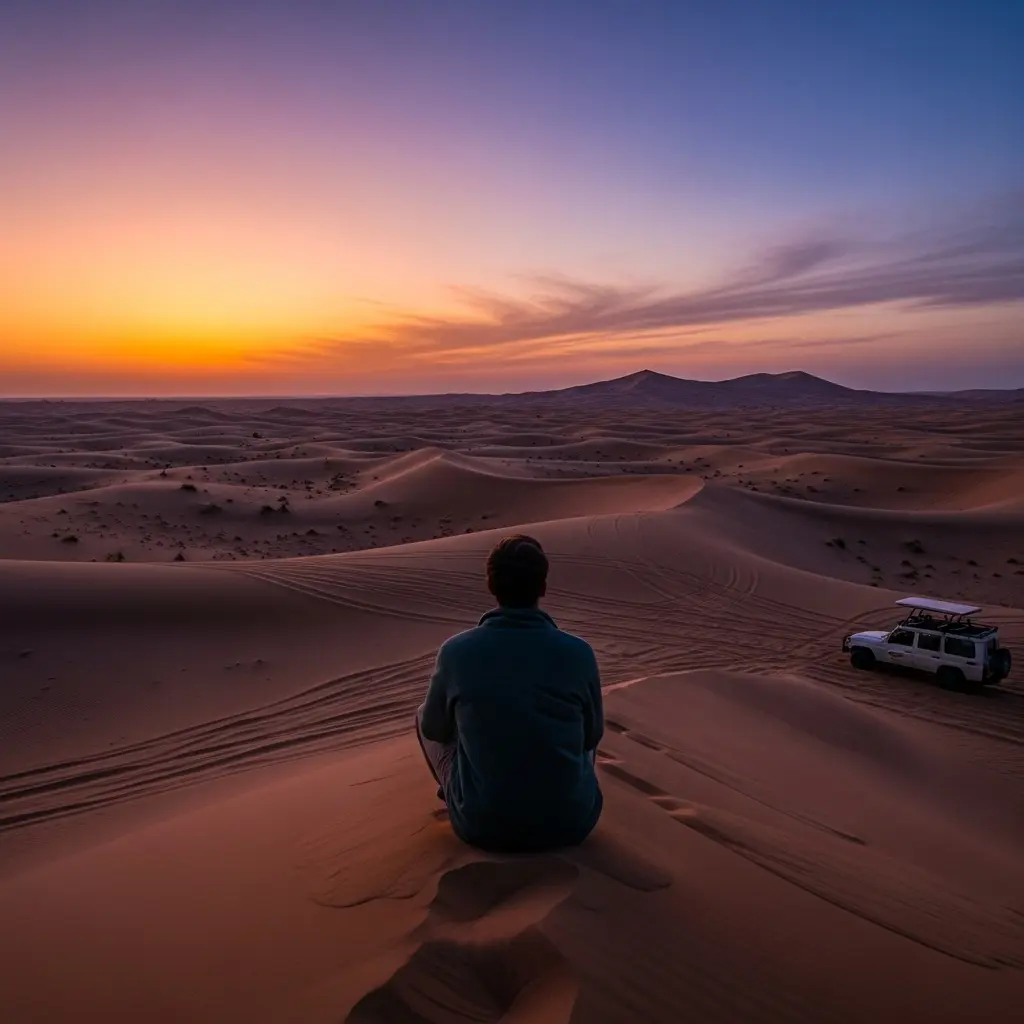
Then you stand on a dune.
You see the horizon stretching for miles.
You see the massive sky.
You realize how small you are.
You realize how small your problems are.
This is a key part of Desert Mental Health Benefits.
It is a perspective shift.
It is humbling.
But it is not humiliating.
It is liberating.
If you are small, your mistakes are small.
The pressure lifts off your shoulders.
The desert has been here for millions of years.
It will be here for millions more.
Your stress is temporary.
This realization is powerful therapy.
It is hard to hold onto ego in the sand.
The landscape demands humility.
And humility brings peace.
Sunlight and Serotonin
We live indoors.
We work in offices.
We lack natural light.
This messes up our chemistry.
It leads to Seasonal Affective Disorder (SAD).
It lowers our serotonin.
Serotonin is the mood stabilizer.
Low serotonin leads to anxiety and depression.
The desert is bathed in light.
It is high-intensity, full-spectrum light.
Just 20 minutes in this light changes your brain.
It boosts serotonin production.
It makes you feel happier naturally.
It also regulates your melatonin.
Melatonin controls sleep.
Bright days lead to dark nights.
This fixes your circadian rhythm.
You sleep better after a safari.
You wake up more refreshed.
The Desert Mental Health Benefits continue while you sleep.
It is a biological reset.
Vitamin D is also produced.
This boosts your immune system.
A healthy body supports a healthy mind.
You feel stronger.
You feel more alive.
The Digital Detox Effect
We are addicted to screens.
We check our phones 100 times a day.
We are terrified of missing out.
In the deep desert, the signal fades.
At first, this causes panic.
You check for bars.
There are none.
Then, you accept it.
You put the phone away.
This is the digital detox.
It breaks the dopamine loop of social media.
You stop comparing yourself to others.
You stop reading bad news.
You start looking at the people around you.
You start talking.
Real conversations happen.
You connect with your family.
You connect with strangers.
This social connection is vital for mental health.
Loneliness is a killer.
Screens create loneliness.
The desert creates community.
Sitting around a campfire is primal.
It is how humans bonded for thousands of years.
We share food.
We share stories.
We feel belonging.
This heals the social fractures in our minds.
Physical Exertion and Endorphins
A safari is not just sitting in a car.
You walk on the sand.
Walking on sand is hard work.
It requires more energy than walking on pavement.
You climb the dunes.
Your muscles burn.
Your lungs work harder.
This physical activity releases endorphins.
Endorphins are natural painkillers.
They are natural mood elevators.
They create the “runner’s high.”
But you get it from walking.
Exercise burns off the excess cortisol.
It releases the tension in your muscles.
Many of us carry stress in our shoulders.
We carry it in our jaws.
The movement loosens this tension.
Sandboarding is another workout.
Climbing back up the hill is tough.
But it is fun.
Play is important for adults.
We forget how to play.
We are too serious.
Desert Mental Health Benefits include rediscovering play.
Sliding down a hill is childish.
And that is the point.
It taps into your inner child.
It brings pure, unadulterated joy.
Connection to Nature and Grounding
There is a theory called “Earthing.”
It suggests we need physical contact with the ground.
Modern shoes insulate us.
In the desert, you often take your shoes off.
You feel the warm sand.
You feel the texture of the earth.
This is grounding.
Psychologically, it makes you feel stable.
You are connected to the planet.
Nature Deficit Disorder is real.
Kids have it.
Adults have it.
We are starved of nature.
Being in the desert feeds this hunger.
You see beetles.
You see tracks of lizards.
You see the resilience of life.
It inspires you.
If a plant can survive here, you can survive your week.
It teaches resilience.
It teaches adaptation.
Companies like https://royaldesertadventures.ae/ emphasize this connection.
They show you the flora and fauna.
They help you understand the ecosystem.
This understanding builds respect.
It builds a relationship with the world.
You feel less isolated.
You are part of a bigger system.
The Color Therapy of Gold and Blue
Colors affect emotion.
Hospitals are painted green or blue for calm.
Fast food joints are red for hunger and speed.
The desert palette is specific.
Gold and yellow are warm colors.
They are associated with hope.
They are associated with energy.
They stimulate the nervous system gently.
They make you feel optimistic.
Blue is the color of calm.
It lowers heart rate.
It is the color of the mind.
The contrast between the gold sand and blue sky is perfect.
It balances energy with calm.
It is visually satisfying.
At sunset, the colors shift.
They become orange and purple.
Purple is the color of introspection.
It encourages deep thought.
It encourages meditation.
The Desert Mental Health Benefits are painted across the sky.
Watching the sunset is a meditation.
You watch the light change.
You watch the day end.
It gives closure.
It signals to your brain that the work is done.
It is time to rest.
Overcoming Fear and Anxiety
Many people are afraid of the desert.
They are afraid of the heat.
They are afraid of getting stuck.
Going on a safari faces these fears.
You trust the driver.
You trust the vehicle.
You step out of your comfort zone.
When you survive the dune bash, you feel powerful.
You conquered the fear.
This builds confidence.
It builds self-efficacy.
If you can handle the desert, you can handle the meeting.
You can handle the difficult conversation.
It toughens the mind.
Controlled exposure to stress makes you resilient.
It is like a vaccine for anxiety.
You learn that fear is just a feeling.
It is not a fact.
You learn to breathe through it.
You learn to enjoy the ride.
This transfer of confidence is real.
You go back to the city standing taller.
The Night Sky and Cosmic Connection
Night in the city is grey.
Night in the desert is black.
The stars are blinding.
You can see the Milky Way.
You can see satellites moving.
This brings back the feeling of Awe.
But deeper.
It connects you to the universe.
You ponder the big questions.
Why are we here?
What is life about?
This philosophical thinking is healthy.
It moves you away from petty worries.
It moves you away from materialism.
You don’t care about your new car when looking at a galaxy.
You care about existence.
This is spiritual health.
It feeds the soul.
Desert Mental Health Benefits peak under the stars.
It is quiet.
It is dark.
It is beautiful.
Many people find clarity here.
They make big life decisions.
They decide to change jobs.
They decide to get married.
The clarity of the air leads to clarity of thought.
It is a vacuum for confusion.
Post-Trip Afterglow
The benefits do not end when you leave.
There is an “afterglow.”
Your cortisol levels stay low for days.
Your sleep remains better.
The memories act as a mental anchor.
When you are stressed later, you can remember the silence.
You can visualize the dunes.
This visualization calms you down.
It is a mental safe space.
You have banked the peace.
You can withdraw it when you need it.
Regular trips increase this reserve.
It creates a habit of relaxation.
Your brain learns how to switch off.
It becomes easier to relax in the future.
You have trained your nervous system.
You have shown it a different way to be.
Why You Need To Go Now
You might think you are too busy.
That is exactly why you need to go.
If you think you don’t have time for a break, you need a break.
The desert is waiting.
It does not judge.
It does not demand.
It just exists.
And in its existence, it offers a cure.
It offers a space to breathe.
It offers a space to be.
Don’t wait for the breakdown.
Prevent it.
Use the sand as medicine.
Use the sun as a doctor.
Go to the dunes and heal.
The Chemical Breakdown of a Safari
Let’s look at the science simply.
Here is what happens to your hormones.
| Hormone | Effect in City | Effect in Desert | Result |
| Cortisol | High (Chronic Stress) | Lowers Significantly | Reduced Anxiety, Better Heart Health |
| Dopamine | Low/Spiking (addiction) | Steady Release (Joy) | Sustained Happiness, focus |
| Serotonin | Suppressed (Indoors) | Boosted (Sunlight) | Mood Stability, Depression fight |
| Endorphins | Low (Sedentary) | High (Activity) | Pain relief, Euphoria |
| Melatonin | Disrupted (Screens) | Regulated (Day/Night) | Deep, restorative sleep |
Social Bonding and Oxytocin
We mentioned social connection.
There is a chemical for that too.
Oxytocin.
It is the “cuddle hormone.”
It is the “trust hormone.”
When you share an adventure, you release oxytocin.
When you laugh with friends in the car, you release it.
When you sit close by the fire, you release it.
This strengthens relationships.
Strong relationships are the number one predictor of happiness.
A safari is a bonding accelerator.
You go through intense emotions together.
You share a unique experience.
This creates a shared memory.
Couples often feel closer after a trip.
Families fight less.
The shared awe unites them.
The shared thrill unites them.
Desert Mental Health Benefits are collective.
They heal the group dynamic.
Resources like https://dubaidesertsafarie.com/ offer family packages.
They know the value of this bonding.
They create spaces for interaction.
They remove the distractions.
They let the oxytocin flow.
The Art of Doing Nothing
In the West, we are obsessed with “doing.”
We define ourselves by our productivity.
The desert teaches the art of “being.”
The Italians call it il dolce far niente.
The sweetness of doing nothing.
You sit on a carpet.
You drink tea.
You watch the sand.
You are not producing anything.
You are not achieving anything.
And that is okay.
That is necessary.
Your brain needs idle time.
It is during idle time that creativity strikes.
It is when the subconscious solves problems.
If you are always busy, the creative voice cannot be heard.
The desert provides the silence for it to speak.
You might have your best idea on a dune.
Not because you tried.
But because you stopped trying.
You let your mind wander.
And the desert is a great place to wander.
Breaking the Routine
Routine is comfortable.
But it can be deadening.
It puts the brain on autopilot.
New experiences build new neural pathways.
This is neuroplasticity.
A safari is a novel experience.
The terrain is new.
The food is new.
The activities are new.
This stimulates the brain.
It keeps the mind young.
It prevents cognitive decline.
Desert Mental Health Benefits include brain training.
Navigation challenges the brain.
Balance challenges the brain.
New smells challenge the brain.
It wakes up dormant areas.
It makes you feel sharper.
You return to your routine with a fresh eye.
You might see solutions you missed before.
You have shaken up the snow globe.
Emotional Release
Sometimes we hold onto grief.
We hold onto anger.
The desert is a safe place to release it.
You can scream into the wind.
No one will hear you.
You can run until you drop.
You can cry behind sunglasses.
The vastness absorbs the emotion.
It does not reflect it back.
It is a container for your pain.
Many people use the desert for this catharsis.
They leave their burdens in the sand.
They bury their worries.
Metaphorically and literally.
It is a cleansing ritual.
You leave lighter than you arrived.
Conclusion
The evidence is clear.
The desert is not just a tourist trap.
It is a clinic.
It is a sanctuary.
It combines physical, chemical, and psychological therapy.
It does this naturally.
It does this quickly.
Desert Mental Health Benefits are accessible to everyone.
You do not need a prescription.
You just need a booking.
In a world that is driving us crazy, the desert keeps us sane.
It reminds us of our roots.
It connects us to the earth.
It quiets the noise.
So, for your next vacation, don’t just choose a hotel.
Choose a therapy session with nature.
Choose the dunes.
Your brain will thank you.
Your heart will thank you.
And you will find the peace you have been looking for.
Frequently Asked Questions
1. Can a desert safari really help with clinical anxiety?
While it is not a replacement for professional medical treatment, a desert safari can significantly alleviate symptoms of anxiety. The reduction in sensory overload, the lowering of cortisol levels due to silence, and the grounding effect of nature all work to calm the nervous system. The physical activity burns off anxious energy. Many sufferers report a “quieting of the mind” that lasts for days or weeks after the trip. It provides a temporary but powerful respite from the triggers of daily life.
2. How does the lack of Wi-Fi improve my mental state?
The lack of Wi-Fi forces a “digital detox.” When you are constantly connected, your brain is in a state of “continuous partial attention.” You are never fully present. This increases stress and lowers focus. Disconnecting breaks the dopamine addiction loop of checking for notifications. It forces you to engage with your immediate surroundings and the people with you. This deepens social bonds and allows your brain to enter a state of deep relaxation that is impossible when you are anticipating the next email.
3. Is the adrenaline from dune bashing good for stress?
Yes, in the right context. Chronic stress (work pressure) is bad because it is low-level and constant. Acute stress (like a rollercoaster or dune bashing) is short and intense. Resolving this acute stress (surviving the ride) triggers a massive release of endorphins and dopamine. It is a cathartic release. It “flushes” the system. It creates a feeling of euphoria and relief that counteracts the heavy, dragging feeling of chronic stress. It makes you feel alive and energized rather than drained.
4. What is the best time of day for mental health benefits?
The late afternoon leading into sunset is ideal. You get the benefits of bright light therapy (boosting serotonin) followed by the calming visual therapy of the sunset. The “Golden Hour” provides a warm, soothing light that is psychologically comforting. The transition into the “Blue Hour” signals the body to prepare for rest. Companies like https://saharadesertsafaridubai.com/ usually time their tours to maximize this window, ensuring you get the full spectrum of light therapy.
5. Why do I feel so tired but happy after a safari?
This is “good tired.” In the city, you are often “mentally exhausted but physically restless.” After a safari, you are physically tired from the heat, the movement, and the fresh air. Your body has done work. Your brain has received a lot of healthy stimulation (light, awe, novelty). This combination leads to deep, restorative sleep. The happiness comes from the dopamine and endorphin cocktail released during the day. It is a state of satisfied exhaustion, which is very healthy.
6. Can just sitting in the desert be beneficial?
Absolutely. This is a practice similar to mindfulness meditation. By sitting still and observing the dunes, the wind, and the sand patterns, you engage in “soft fascination.” This restores your directed attention capacity. You don’t need to be running around to get the benefits. The silence alone lowers your blood pressure. Many people book private safaris just to sit in isolation and read or think. It is a valid and powerful form of therapy.
7. How does the sun help with depression?
Sunlight enters the eyes and stimulates the retina, which signals the brain to produce serotonin. Serotonin is a neurotransmitter that regulates mood. Low levels are linked to depression. The desert sun is intense and abundant. Even a short exposure can significantly boost serotonin production. Additionally, sunlight on the skin produces Vitamin D, which has been linked to mood regulation and immune health. It is a natural antidepressant.
8. Is it safe for people with high stress to do the scary activities?
Generally, yes, but it depends on the individual. The “fear” in a safari is controlled. You are in a safe vehicle with a professional. This allows you to experience the thrill without real danger. This can be empowering. However, if someone has severe panic attacks or heart conditions, they should skip the extreme dune bashing and opt for a gentle drive. The goal is “eustress” (good stress), not distress. Operators can customize the drive to be smoother if requested.
9. Why is “Desert Mental Health Benefits” a focus here?
Because mental health is a growing global crisis. People are looking for holistic and natural ways to feel better. Travel is no longer just about sightseeing; it is about wellness. By understanding the Desert Mental Health Benefits, you can plan your trip with intention. You treat the vacation as an investment in your sanity. It shifts the narrative from “wasting money on a trip” to “investing in health.”
10. How does https://htdesertsafari.com/ support wellness?
This operator focuses on the quality of the experience. They ensure the vehicles are comfortable and the guides are friendly. A stressful tour operator defeats the purpose. By handling all the logistics smoothly, they remove the “travel stress.” They take you to the best spots for silence and views. They allow you to focus on the experience while they handle the details. Their focus on customer satisfaction ensures a positive emotional outcome.
11. What is the “Awe” effect?
Awe is a distinct emotion. It is the feeling of being in the presence of something vast that transcends your understanding of the world. The desert provides this through its sheer scale and age. Psychological research shows that experiencing awe makes people more generous, more cooperative, and less self-focused. It shrinks the ego. It quiets the nagging inner voice of self-criticism. It creates a sense of connection to the greater whole.
12. Does the color of the sand matter?
Psychologically, yes. Yellow and gold are warm, stimulating colors associated with happiness and energy. They can lift a low mood. Red sand (like in Liwa) is grounding and intense. The blue sky provides a cooling balance. This natural color palette is visually harmonious. It lacks the jarring, clashing colors of a city environment (neon signs, concrete grey). This visual harmony is processed by the brain as safety and order, leading to relaxation.
13. How does a safari help with sleep issues?
Modern sleep issues are often caused by blue light from screens and a lack of natural daylight contrast. A day in the desert exposes you to bright natural light, which sets your biological clock. Then, the darkness of the desert night triggers melatonin production much earlier and stronger than in a lit city room. The physical fatigue from the heat and activity also increases “sleep pressure.” Most people report sleeping like a baby after a desert trip.
14. Why is silence so important for the brain?
The brain is constantly processing sound, even when you sleep. It monitors the environment for threats. In a noisy city, this monitoring system never shuts down. This leads to chronic cognitive load. In the deep silence of the desert, the brain finally gets the signal that there is no threat. It stops the constant monitoring. This allows resources to be redirected to repair and memory consolidation. It is a true physiological rest.
15. Can I go alone for mental health?
Yes, solo travel to the desert is very popular for introspection. Being alone allows you to fully immerse in the silence without having to talk to anyone. You can meditate, write, or just be. It creates a powerful sense of independence and self-reliance. However, for safety, you should always book with a reputable tour company like https://royaldesertadventures.ae/ rather than driving alone. They can provide a private car so you get the solitude with the safety net.
16. What is “Earthing” or “Grounding”?
Earthing is the practice of making direct skin contact with the surface of the Earth. Proponents believe that the Earth has a negative electrical charge that can neutralize free radicals in the body. While the science is debated, the psychological effect is undeniable. Walking barefoot on the warm sand makes you feel physically connected to the place. It brings your attention out of your head (thoughts) and into your body (sensation). This is a core technique for managing anxiety.
17. How does the desert foster creativity?
Creativity requires a relaxed mind and a lack of distraction. The “Theta state” of the brain, often achieved during daydreaming or light meditation, is where ideas happen. The monotonous, repetitive patterns of the dunes (fractals) induce this state. The lack of urgent notifications allows the mind to wander freely. Many artists and writers retreat to the desert to break through creative blocks because the empty landscape provides a blank canvas for the mind.
18. Why use external links like https://dubaidesertsafarie.com/?
Using established portals helps you find the right type of therapy. Not all safaris are the same. Some are loud parties; others are quiet nature tours. By researching through these links, you can find the package that suits your mental health needs. If you want silence, you don’t want a Hummer party tour. You want a private morning drive. These websites help you filter and choose the experience that will provide the relaxation you seek.
19. Is the heat bad for stress?
Extreme heat can be stressful, but moderate warmth is relaxing. Heat causes vasodilation (widening of blood vessels), which lowers blood pressure and relaxes muscles. It mimics the effect of a sauna. It induces a lethargic, relaxed state. Of course, hydration is key. Dehydration causes anxiety. So, as long as you drink water, the warmth of the desert acts as a muscle relaxant and a mood soother.
20. How long do the benefits last?
The immediate chemical boost (dopamine/endorphins) lasts for a few hours to a day. The reduction in cortisol and the reset of the circadian rhythm can last for several days or even a week. The psychological shift (perspective/awe) can last a lifetime if integrated properly. The memory of the silence becomes a tool you can use forever. Whenever you are stressed, you can close your eyes and return to that dune. It becomes a permanent resource in your mental toolkit.