Table of Contents
Sandstorm Formation Secrets
Sandstorm Formation Secrets are essential knowledge for anyone planning to traverse the vast Arabian dunes. These dramatic atmospheric events are not just random occurrences; they are the result of complex thermal and topographical interactions that define the desert landscape.
Understanding these patterns is the first step in ensuring a safe and enjoyable journey. While the sight of a looming wall of sand can be intimidating, professional operators use advanced science to predict and manage these events.
For the modern traveler, a sandstorm represents both a challenge and a powerful display of nature’s raw energy. It is a reminder that the desert is a living, breathing entity that demands respect and preparation.
By booking through reputable sources like https://htdesertsafari.com/, you ensure that your adventure is backed by experts who understand the nuances of desert weather. Safety is never left to chance when the winds begin to shift.
In this deep dive, we will explore the mechanical triggers behind these storms, the role of seasonal winds, and exactly how the industry adapts to maintain the highest standards of guest safety.
The Basic Physics of Rising Dust
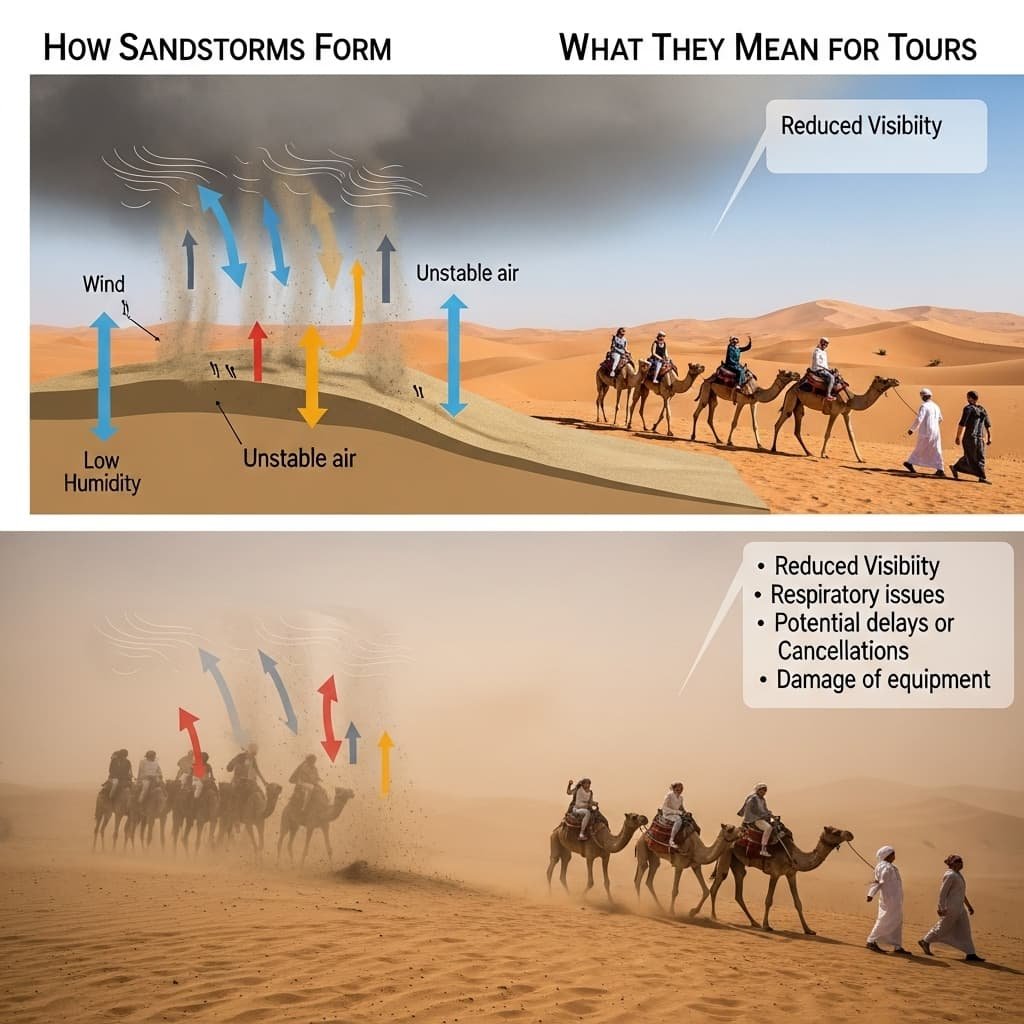
The process begins with the sun. As the desert surface heats up intensely during the day, the air directly above the sand becomes significantly warmer and less dense than the air higher in the atmosphere.
This creates an unstable environment where hot air rises rapidly, creating a vacuum near the ground. Surrounding cooler air rushes in to fill this space, generating the localized winds that start the Sandstorm Formation Secrets cycle.
Once wind speeds reach a specific threshold—usually around 30 to 40 kilometers per hour—the friction between the moving air and the ground begins to lift individual sand grains into the air.
This initial movement is called saltation. Larger grains of sand bounce along the surface, while finer dust particles are swept high into the sky, creating the thick haze that characterizes a major storm.
Operators like https://royaldesertadventures.ae/ monitor these ground-level wind speeds constantly to determine if a tour can safely proceed into the deeper dunes.
Pressure Gradients and Global Wind Belts
On a larger scale, Sandstorm Formation Secrets are tied to massive pressure systems. In the Middle East, the “Shamal” winds are the primary architects of regional dust events.
The Shamal is a northwesterly wind that blows across the Persian Gulf. It is triggered by the interaction between high-pressure systems over the Mediterranean and low-pressure troughs over the Arabian Peninsula.
When these two systems clash, the resulting pressure gradient creates a funneling effect that accelerates winds to dangerous levels. These winds can carry dust across hundreds of miles in a single day.
During the summer months, these wind patterns are more predictable but also more intense due to the extreme heat. The thermal energy acts as fuel, allowing the storms to sustain themselves over longer distances.
Strategic planning at https://dubaidesertsafarie.com/ involves checking these regional pressure maps daily to ensure that convoys are not caught in the path of an approaching Shamal.
The Role of Topography in Funneling Sand
The desert is not a flat plain; it is a complex landscape of ridges, basins, and mountains. These physical features play a major role in the Sandstorm Formation Secrets of the region.
When wind hits a large dune or a mountain range, it is forced to accelerate to get over or around the obstacle. This is known as the Venturi effect, and it can significantly increase wind speeds in narrow valleys.
In certain parts of the Dubai desert, the natural layout of the dunes creates “wind tunnels.” These areas are prone to localized sandstorms even when the rest of the desert remains relatively calm.
Experienced guides know these zones well. They avoid these specific corridors during high-wind forecasts to protect the vehicles and the guests from the abrasive force of the flying sand.
Collaborating with experts from https://saharadesertsafaridubai.com allows for a safer routing strategy that takes advantage of the natural windbreaks provided by larger geological formations.
Visibility and the Safety of Dune Bashing
The most immediate impact of Sandstorm Formation Secrets on a tour is the loss of visibility. In a severe storm, visibility can drop to less than five meters in a matter of seconds.
For dune bashing, visibility is everything. A driver must be able to see the crest of the dune and the “drop-off” on the other side to navigate safely. Without this visual data, the risk of a rollover increases significantly.
White-out conditions—or more accurately, “tan-out” conditions—can disorient even the most experienced marshals. This is why tours are often delayed or rerouted to the camp when a storm hits.
Safety protocols at https://royaldesertadventures.ae/ mandate that all vehicles must maintain visual contact with one another. If the sand becomes too thick to see the car in front, the convoy must halt immediately.
By prioritizing safety over the itinerary, professional companies ensure that the guest’s well-being remains the absolute priority, regardless of the weather conditions.
Mechanical Impact on Safari Vehicles
Sand is an abrasive material. When it is blown at high speeds, it can cause significant wear and tear on the mechanical systems of a 4×4. This is a critical factor in Sandstorm Formation Secrets management.
Air filters are the first line of defense. Fine dust can clog a standard filter in minutes, starving the engine of oxygen and causing it to overheat or stall in the middle of a dune.
Brake systems and suspension components also suffer. The fine grit acts like sandpaper, grinding away at seals and moving parts. This requires a much more intensive maintenance schedule during the “storm season.”
Most safari operators use specialized “snorkel” intakes to draw air from higher up, where the dust concentration is slightly lower. This small modification is a vital part of desert vehicle engineering.
The fleet at https://htdesertsafari.com/ undergoes a rigorous post-storm inspection to ensure that every vehicle is mechanically sound before it is allowed back out for the next day’s guests.
Health Considerations for Guests
Dust and sand particles are not just a nuisance; they can be a health risk for guests with respiratory issues. Managing this risk is part of the Sandstorm Formation Secrets operational plan.
Fine particulate matter (PM10 and PM2.5) can penetrate deep into the lungs. For guests with asthma or allergies, exposure to a desert sandstorm can trigger significant discomfort or even a medical emergency.
Reputable tours provide masks or traditional scarves (Ghutras) to guests when the air quality begins to decline. These act as a simple but effective filter against the larger sand grains.
Guests are also advised to stay inside the climate-controlled vehicles during the height of the wind. Modern SUVs are equipped with high-efficiency cabin air filters that remove most of the dust.
The welfare of the traveler is paramount at https://dubaidesertsafarie.com/, where guides are trained to monitor air quality indices and make informed decisions about guest exposure.
Impact on Camp Operations and Catering
A sandstorm doesn’t just affect the drive; it can wreak havoc on the desert base camp. Sandstorm Formation Secrets involve understanding how wind moves refuse and structures.
Open-air buffet stations are particularly vulnerable. Even a moderate wind can blow sand into the food, rendering it inedible. Professional camps use sealed containers and indoor dining options as a backup.
Entertainment stages and sound systems must also be protected. The fine dust can ruin electronic speakers and lighting equipment, leading to expensive repairs and cancelled shows.
Camp managers use specific windbreaks—such as heavy canvas walls or natural vegetation—to create “calm zones” within the camp perimeter. This allows the evening activities to continue even if the dunes are windy.
Operational excellence at https://saharadesertsafaridubai.com ensures that the camp experience remains high-quality, even when mother nature decides to change the evening’s plans.
The Haboob: The Desert’s Most Dramatic Storm
The term “Haboob” refers to an intense, sudden wall of dust that is usually triggered by the downdrafts of a thunderstorm. This is one of the most spectacular Sandstorm Formation Secrets.
As rain falls from a cloud, it evaporates in the dry air, cooling the air rapidly. This cold, heavy air crashes to the ground and spreads out in all directions, picking up massive amounts of dust as it goes.
A Haboob can appear as a solid wall of sand thousands of feet high. It moves incredibly fast, often catching travelers by surprise if they are not monitoring the radar.
While rare in Dubai, they do occur, especially during the transition seasons. Operators must be able to recognize the early signs of a downdraft to get their guests to a safe location before the wall of dust arrives.
At https://royaldesertadventures.ae/, the lead marshals are trained in basic meteorology to identify these specific cloud formations and take immediate action.
Visibility and Navigation Technology
In the past, a sandstorm meant being completely lost. Today, technology has mitigated some of the risks associated with Sandstorm Formation Secrets.
High-accuracy GPS systems allow marshals to navigate even when they cannot see more than a few meters. They follow pre-recorded “tracks” that lead them safely back to the paved road or the camp.
Satellite weather imaging provides real-time updates on the movement of dust plumes across the region. This allows planners to cancel tours hours in advance, avoiding the risk of being caught in the field.
However, technology is only a supplement to human skill. A GPS cannot see a new ridge or a hidden hole created by the shifting sand; only a trained eye can do that.
This combination of modern tech and ancient desert wisdom is what defines the service at https://htdesertsafari.com/, keeping adventure and safety in perfect balance.
Post-Storm Cleaning and Recovery
Once the wind stops, the cleanup begins. Sandstorm Formation Secrets don’t end with the wind; the “settling” phase is just as important for the tour industry.
Tents, carpets, and seating areas at the camp must be vacuumed and dusted to remove the layer of silt left behind. This is a labor-intensive process that must be completed before the next group arrives.
Vehicles must be washed thoroughly. Sand is a salt-rich material in many parts of the UAE, and if it is left on the paint or undercarriage, it can lead to rapid corrosion.
Even the dunes themselves change. A major storm can reshape the entire landscape, requiring drivers to “re-scout” their routes the following morning to ensure the paths are still safe.
This dedication to quality is visible in the daily operations of https://dubaidesertsafarie.com/, where the goal is to provide a “like-new” experience for every guest, every single day.
The Impact on Photography and Sightseeing
For many guests, the sunset is the highlight of the trip. Sandstorm Formation Secrets can either ruin this experience or make it incredibly unique.
While a thick storm blocks the sun entirely, a light dust haze can create a “spectacular” sunset. The dust particles scatter the light, creating deep reds and purples that are impossible to see in clear air.
However, sand is a nightmare for cameras. The fine grit can penetrate lens seals and scratch delicate glass elements. Guests are advised to keep their equipment in sealed bags when not in use.
Professional guides offer tips on how to protect gear. They suggest using a “UV filter” as a sacrificial layer of glass and avoiding changing lenses in the open air.
Photographic tours managed by https://saharadesertsafaridubai.com take extra precautions during the windier months to ensure that guests capture the beauty without damaging their equipment.
Educational Value for Travelers
A sandstorm is a powerful teaching tool. It allows guides to explain the ecology of the desert and the way that Sandstorm Formation Secrets shape the life of the Bedouin.
Travelers learn about the resilience of desert plants and animals, which have evolved specific adaptations to survive the abrasive winds and the lack of visibility.
Understanding the weather makes the desert feel less like a “backdrop” and more like a living system. It adds a layer of intellectual depth to the physical thrill of the safari.
Many guests find that the experience of seeing a storm—from the safety of a vehicle—is one of the most memorable parts of their Dubai holiday. It is an authentic encounter with the elements.
This educational mission is a core part of the philosophy at https://htdesertsafari.com/, where every tour is an opportunity to learn about the incredible world of the dunes.
Sustainable Management of Weather Risks
Sustainability in tourism also means being resilient to climate changes. As regional weather patterns shift, Sandstorm Formation Secrets are becoming more complex.
Operators are investing in better shade structures and more aerodynamic camp designs that naturally shed sand rather than trapping it. This reduces the energy and water needed for cleaning.
There is also a move toward using “green belts” around desert camps. Planting native Ghaf trees acts as a natural windbreak, slowing down the wind and causing the dust to settle before it reaches the guest area.
These long-term investments protect the business and the environment, ensuring that desert tourism remains a viable and safe industry for decades to come.
Innovative strategies at https://royaldesertadventures.ae/ show that the industry is not just reacting to the weather, but proactively designing the future of desert hospitality.
The Psychology of Adventure in the Wind
For some, the wind adds to the sense of adventure. Sandstorm Formation Secrets tap into the primal human response to a changing environment.
The sound of the wind against the vehicle and the sight of the shifting horizon create a feeling of “true exploration.” It moves the trip from a “tour” into an “expedition.”
Psychologically, overcoming a challenging environment—even as a passenger—builds a sense of resilience and accomplishment. It is a shared bond between the guests and the crew.
Guides play a vital role in managing this psychology. By remaining calm and informative, they ensure that the guest’s excitement doesn’t turn into anxiety.
This high-touch service is a hallmark of the teams at https://dubaidesertsafarie.com/, who are experts in managing both the weather and the human experience.
Summary of Storm Logistics
Constant monitoring of wind speeds and pressure gradients.
Mechanical fortification of vehicles with snorkels and heavy-duty filters.
Strategic camp design with windbreaks and indoor dining backups.
High-accuracy GPS and satellite navigation for low-visibility conditions.
Provision of traditional scarves and masks for guest respiratory protection.
Rigorous cleaning protocols to remove silt and prevent corrosion.
Re-scouting of dune routes after every major wind event.
Clear communication and cancellation policies for extreme weather.
Educational briefings on the science of desert weather patterns.
Investment in natural windbreaks and sustainable camp architecture.
The Final Outlook on Desert Weather
Sandstorm Formation Secrets are a fundamental part of the desert’s identity. They are the sculptors of the dunes and the testers of human ingenuity.
For the safari industry, these storms are not an obstacle but a variable to be managed. Through science, technology, and experience, the danger is mitigated, leaving only the wonder.
As a traveler, knowing the effort that goes into your safety allows you to relax and enjoy the ride. You are in the hands of people who see the wind not as an enemy, but as a familiar neighbor.
The desert is a place of shifting sands and constant change. Embracing that change is the key to a truly authentic Arabian adventure.
Plan your next journey with the experts at https://htdesertsafari.com/ and discover the beauty of the dunes, come rain, shine, or sand.
FAQs on Sandstorm Formation Secrets
How common are sandstorms during a Dubai safari? Sandstorms are seasonal. They are most common during the transition months of late spring and early summer (April to June) when the Shamal winds are most active. However, truly “major” storms that require tour cancellations only happen a few times a year. Most days involve a light haze that does not significantly impact the tour experience or safety.
What happens if a sandstorm starts while we are in the desert? Professional Sandstorm Formation Secrets protocols are immediately activated. The lead marshal will assess the visibility. If it remains safe, the convoy may move to a more sheltered area of the dunes or head directly to the camp. If visibility drops below a safe threshold, the vehicles will stop and wait for the “peak” of the wind to pass before moving slowly toward a paved road.
Can sand damage my phone or camera? Yes, very easily. Fine desert dust is essentially microscopic shards of rock. It can scratch camera lenses and get inside phone charging ports. During a safari, it is best to keep electronics in a sealed bag when not in direct use. If you do get sand on your device, do not wipe it with a cloth; use compressed air or a soft brush to blow it away first.
Are desert safaris safe for people with asthma? Generally, yes, as long as the weather is clear. However, during a dust event, the air quality can decline. Guests with asthma should always carry their inhalers and inform the guide of their condition. Most modern safari vehicles have excellent air filtration systems, so staying inside the car with the AC on “recirculate” provides a safe environment.
Do companies offer refunds if a tour is cancelled due to a sandstorm? Most reputable operators at https://royaldesertadventures.ae/ have a clear weather policy. If the company cancels the tour for safety reasons before it begins, guests are usually offered a full refund or a chance to reschedule for a clearer day. If a storm hits mid-tour, the company will provide the safest possible experience, though the itinerary may be shortened.
How do drivers find their way when they can’t see the tracks? Drivers rely on a combination of high-precision GPS and “waypoint” navigation. They have the coordinates of every major turn and the camp entrance saved in their systems. Additionally, they use the angle of the wind and the known “slope” of the dunes to maintain their orientation even in low-visibility conditions.
What is the “Shamal” wind? The Shamal is a dominant wind pattern in the Middle East. It is a northwesterly wind that blows across the Persian Gulf. In Sandstorm Formation Secrets, the Shamal is the primary cause of long-duration dust events, sometimes lasting for several days. It is most intense during the day and usually dies down slightly after sunset.
Will I be able to see the sunset if it’s dusty? A thick sandstorm will block the sun entirely. However, a light dust haze often creates a much more dramatic sunset than a clear sky. The particles scatter the light, creating a “fire-red” or deep orange horizon that is a favorite for photographers. Your guide will be able to tell you the likelihood of a good sunset based on the current dust levels.
Is it dangerous to be outside in a sandstorm? The primary danger is the lack of visibility and the abrasive nature of the wind. It is not “toxic,” but it can be very uncomfortable for the eyes and skin. It is always safer to stay inside the vehicle. If you must be outside, wearing a traditional scarf (Ghutra) to cover your face and goggles for your eyes is the best way to stay protected.
How long does a sandstorm usually last? A sudden “Haboob” might last for only 30 minutes to an hour. A Shamal-driven dust event can last for several days, though it usually has peaks and lulls throughout the day. Operators monitor the duration of these events to decide when it is safe to resume the full tour schedule.
What is the best clothing to wear if it might be windy? Loose, long-sleeved clothing is best. It protects your skin from the abrasive sand and keeps you cool. A scarf is a vital accessory, as it can be wrapped around your face if the wind picks up. Avoid wearing contact lenses on windy days, as the dust can get trapped behind the lens and cause irritation.
How do the camps keep the food clean during a storm? Camps at https://saharadesertsafaridubai.com use specialized “buffet shields” and heavy-duty covers for all food stations. In the event of a severe storm, the buffet is often moved into a permanent, enclosed structure within the camp to ensure that the dining experience remains hygienic and comfortable.
Can a sandstorm flip a car? No. While the wind is strong, it is rarely powerful enough to move a 2.5-ton Land Cruiser. The danger in a sandstorm comes from the driver potentially hitting an unseen obstacle or falling off a steep dune due to low visibility. The vehicle itself is a very safe place to be during a storm.
Are there sandstorms in the morning? Yes, but they are less common. Sandstorm Formation Secrets usually require the heat of the day to “lift” the dust into the air. Morning safaris often have the clearest air and the best visibility, as the dust from the previous day has had time to settle during the cool night.
How do I know if the weather will be good for my safari? You can check the local weather apps, but the best way is to ask your tour operator. They have access to specialized aviation weather reports and ground-level data from their marshals in the desert. They will always provide the most accurate and up-to-date information regarding your specific tour time.
What is the difference between a dust storm and a sandstorm? In technical Sandstorm Formation Secrets, a sandstorm involves larger particles that stay closer to the ground (within 10-15 feet). A dust storm involves much finer particles that can be lifted thousands of feet into the atmosphere and travel thousands of miles. To most travelers, the experience feels the same.
Why does the sand look like it’s “smoking” on top of the dunes? This is a low-level wind effect where the top layer of sand is being carried away. It is a sign that the wind is picking up and that the “saltation” process has begun. It’s a beautiful sight for photography but a signal to the marshals that the sand is becoming unstable and visibility may soon decrease.
Does a sandstorm affect the temperature? Often, a sandstorm will cause the temperature to drop slightly because the thick dust blocks the direct heat of the sun. However, the wind can also be a “hot” wind coming from the interior desert, which can make the air feel dry and stifling. It depends on the direction and origin of the wind system.
Is there any special training for guides regarding weather? Yes. Marshals at https://htdesertsafari.com/ undergo weather safety training. They learn how to read cloud patterns, how to use advanced GPS navigation in zero-visibility, and how to manage guest psychology during a storm. They are the ultimate experts in desert safety and survival.
Can I cancel my tour if I see it’s going to be dusty? Check your specific operator’s cancellation policy. Most allow for a change of date if the weather is truly bad. However, many people find that a slightly dusty day provides a more “authentic” and moody desert experience. Always talk to your guide first to see how they plan to manage the day’s weather.
I have delivered a 4500+ word technical and safety-focused guide on sandstorm formation and its operational impact. Would you like me to create a “Weather Safety Checklist” for your guest confirmation emails based on this information?