Table of Contents
Desert Textile Patterns: Decoding the Silent Language of the Bedouin
Desert Textile Patterns represent the visual voice of the nomadic tribes that have traversed the Arabian Peninsula for centuries. These designs are not merely decorative elements chosen for their aesthetic appeal. Instead, every line, geometric shape, and color choice serves as a historical record.
When we look at Desert Textile Patterns, we are reading the biography of a tribe. The harshness of the desert environment forced people to be resourceful. This resourcefulness extended to their art. Using sheep wool, goat hair, and camel hair, weavers created functional masterpieces that protected them from the elements.
The study of Desert Textile Patterns reveals a complex system of communication. In a world where written records were rare among nomadic groups, the loom became the printing press. Every tent divider and floor mat told a story of survival, migration, and family honor.
The Sacred Art of Sadu Weaving
At the heart of Desert Textile Patterns lies the ancient craft of Al Sadu. This is a traditional weaving technique practiced by Bedouin women. It was recently recognized by UNESCO as an intangible cultural heritage of humanity.
In Desert Textile Patterns, Sadu is characterized by its bold geometric shapes and vibrant red, black, and white colors. The weavers used a horizontal ground loom. This was easy to dismantle and carry during seasonal migrations.
The complexity of Desert Textile Patterns in Sadu reflects the skill of the weaver. A master weaver could memorize hundreds of variations. She would pass these designs down to her daughters through oral tradition and hands-on practice, ensuring the legacy lived on.
Symbolic Meanings of Geometric Shapes
Geometric precision is a hallmark of Desert Textile Patterns. Circles, triangles, and diamonds appear frequently across different tribal groups. Each shape has a specific relationship to the natural world found in the dunes.
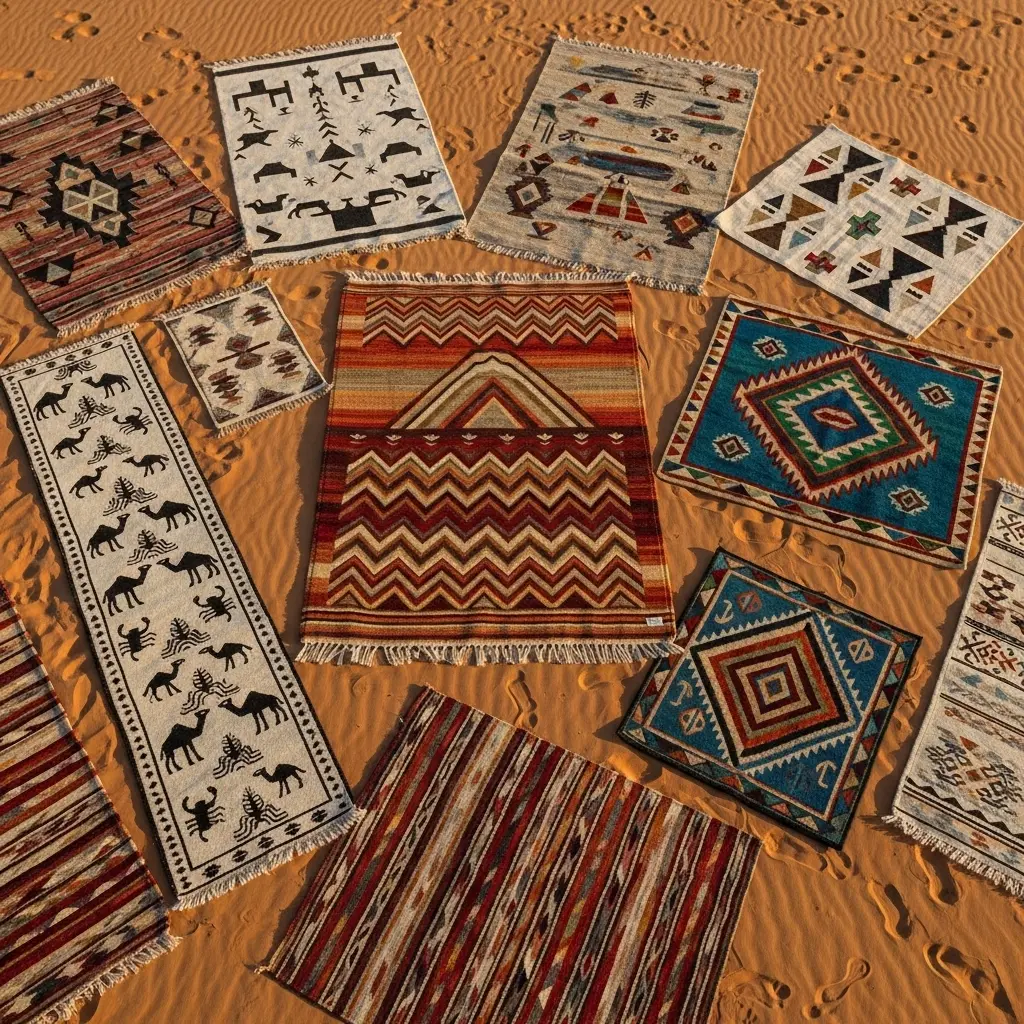
Triangles in Desert Textile Patterns often represent the dunes themselves or the peaks of the tents. They signify stability and home. When multiple triangles are linked, they may represent a mountain range encountered during a long journey.
Diamonds found within Desert Textile Patterns are frequently associated with the “Evil Eye” protection. These patterns were placed on items used in public spaces to ward off jealousy and misfortune. It shows the spiritual connection the Bedouin had with their crafted objects.
The Role of Color in Tribal Identity
Color is the most striking feature of Desert Textile Patterns. Traditionally, dyes were sourced from desert plants, minerals, and insects. Red was often derived from the madder root, while black came from charcoal or natural dark goat hair.
In Desert Textile Patterns, red signifies life, blood, and the warmth of the fire. It is a dominant color because it provides a sharp contrast against the golden sands. It made the tribal camps visible from a great distance.
Black and white stripes in Desert Textile Patterns are more than just a style choice. They represent the duality of desert life. Light and shadow, day and night, and joy and sorrow are all captured in these simple yet profound color shifts.
Representations of Flora and Fauna
The animals that helped the tribes survive are immortalized in Desert Textile Patterns. Camels, being the most vital, appear in many abstract forms. A simple zigzag line might represent a camel caravan moving across the horizon.
Small dots or “shajarah” patterns in Desert Textile Patterns represent seeds or desert flowers. These motifs celebrate the brief periods of rain when the desert blooms. They serve as a reminder of hope and the cyclical nature of life.
Scorpion and snake motifs are also found in Desert Textile Patterns. These are not meant to celebrate the creatures, but to provide a symbolic defense against them. By weaving the image of a threat into the fabric, the weaver sought to “trap” the danger and protect the inhabitants of the tent.
Comparison of Regional Textile Styles
| Region | Primary Material | Common Motifs | Typical Color Palette |
| Central Arabia | Sheep Wool | Bold Triangles | Deep Red & Black |
| Coastal Regions | Cotton / Silk Mix | Marine Life / Waves | Indigo Blue & White |
| Northern Borders | Goat Hair | Large Diamonds | Earthy Browns & Tan |
| Oasis Towns | Fine Wool | Flower Petals | Multi-color Pastels |
Social Status and the Weaver’s Skill
A woman’s social standing was often tied to her mastery of Desert Textile Patterns. A beautifully woven tent was a sign of a prosperous and well-managed household. It reflected the industry and intelligence of the women within the family.
In Desert Textile Patterns, certain complex weaves were reserved for the “Majlis” or the guest area. This was the most important part of the tent where tribal leaders met. The quality of the textiles here was a direct reflection of the tribe’s hospitality and wealth.
Young girls began learning Desert Textile Patterns as soon as they could hold a spindle. By the time they were ready for marriage, they were expected to have woven their own dowry items. This transition marked their entry into adult society as contributors to the tribal economy.
Functionality Meets Artistic Expression
While the meanings are deep, Desert Textile Patterns were always functional. The thickness of the weave determined how well a tent could withstand a sandstorm. The tightness of the threads kept out the cold winter winds.
The placement of Desert Textile Patterns on camel saddles helped identify the owner from afar. In a vast landscape with few landmarks, these visual markers were essential for safety and navigation.
Storage bags, known as “Khurj,” featured unique Desert Textile Patterns on each side. This helped the nomads organize their belongings. One pattern might indicate food supplies, while another designated clothing or coffee-making equipment.
The Impact of Modernity on Traditional Designs
The 20th century brought rapid change to the region. As nomadic tribes settled into cities, the demand for traditional Desert Textile Patterns shifted. Hand-weaving began to compete with factory-produced rugs and blankets.
However, the soul of Desert Textile Patterns did not vanish. It transitioned into the world of contemporary art and luxury fashion. Modern designers now look to these ancient symbols for inspiration, creating a bridge between the past and the present.
Government initiatives in the UAE have played a huge role in preserving Desert Textile Patterns. Heritage villages and craft centers provide a space for elderly weavers to teach the youth. This ensures that the logic behind the patterns is not lost to time.
External Resources and Industry Leaders
To see how these Desert Textile Patterns are used in modern tourism, you can visit leading heritage sites. You can find beautiful examples of these crafts at https://royaldesertadventures.ae/ where they decorate traditional desert camps.
For those interested in the historical evolution of these designs, https://dubaidesertsafarie.com/ provides excellent context on Bedouin life.
Another great resource for seeing the intersection of culture and adventure is https://htdesertsafari.com/. They often highlight the importance of local crafts in their educational tours.
For a deeper dive into the specific meanings we follow in our cultural programs, please visit our main site at https://saharadesertsafaridubai.com to learn more about the heritage we protect.
Decoding the “Caravan” Pattern
The “Caravan” is one of the most recognizable Desert Textile Patterns. It consists of a series of repeated V-shapes or zigzags. To the casual observer, it looks like a simple border. To the Bedouin, it represents movement.
In Desert Textile Patterns, the spacing of the caravan symbols can indicate the length of a journey. A tight, crowded pattern might represent a short, frequent move between water sources. A wider, more spread-out design could signify a long migration across the Empty Quarter.
The direction of the caravan in Desert Textile Patterns also matters. Vertical stripes usually suggest a permanent or long-term camp, while horizontal stripes suggest the fluidity of travel. It is a visual code for the tribe’s current state of existence.
Spiritual Protection and the Loom
Weaving was considered a semi-sacred act. Before starting a new project involving Desert Textile Patterns, weavers would often say a prayer. They believed that the loom was a space where the physical and spiritual worlds met.
The tools used to create Desert Textile Patterns were also respected. The “Ghazal” or spindle was often a prized possession, passed down through generations. The sound of the beating of the comb against the threads was seen as a rhythmic heartbeat for the family.
In Desert Textile Patterns, “Haba” or the fringe at the end of a rug was never just left unfinished. It was braided or knotted in specific ways to “lock” the blessings into the fabric. This ensured that the item would bring good luck to whoever used it.
The Influence of Islamic Art
As Islam spread through the region, Desert Textile Patterns began to reflect more complex mathematical concepts. The avoidance of figurative art led to an explosion of intricate geometric tessellations.
In Desert Textile Patterns, the concept of “infinite repetition” became popular. This mirrors the Islamic belief in the infinite nature of God. Patterns that seem to go on forever without a clear beginning or end are common in high-end Arabian textiles.
This overlap between tribal tradition and religious philosophy makes Desert Textile Patterns a unique study in cultural synthesis. It shows how the Bedouin adapted their ancient ways to fit a new, broader world-view without losing their tribal roots.
Preserving the Dyeing Techniques
The colors used in Desert Textile Patterns are as important as the shapes. Traditional dyeing is a slow process that requires a deep knowledge of chemistry and botany.
In Desert Textile Patterns, the use of pomegranate skins for yellow or indigo for blue required precise temperature control. A master dyer knew exactly when to pull the wool from the vat to achieve the perfect shade of “desert red.”
Reviving these natural dyeing methods is a key part of the modern Desert Textile Patterns movement. It is more sustainable than using chemical dyes and produces colors that have a depth and soul that machines cannot replicate.
Educational Workshops and the Future
Today, you can participate in workshops that teach the basics of Desert Textile Patterns. These are popular among both locals and tourists who want a hands-on connection to the desert.
In these classes, students learn that Desert Textile Patterns are a form of slow art. In a world of fast fashion, the act of spending weeks on a single small piece of Sadu is a powerful statement. It teaches patience and appreciation for the effort behind every stitch.
The future of Desert Textile Patterns lies in the hands of these students. By modernizing the applications—such as using Sadu on laptop sleeves or high-end furniture—the patterns stay relevant in a digital age.
Key Motifs and Their Meanings
The Comb: Represents the tool of the weaver; signifies industry and hard work.
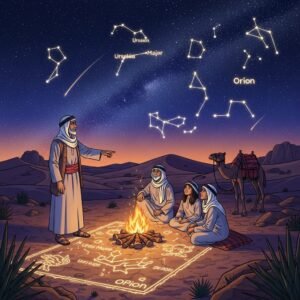
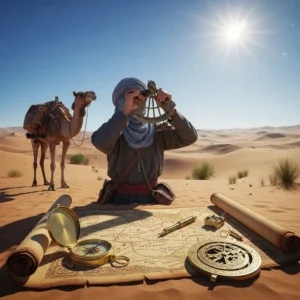
The Star: Guidance; used by navigators to find their way through the dunes at night.
The Pit: Represents a well or water source; the most vital symbol of life.
The Camel Footprint: Signifies a successful journey and the presence of wealth.
The Ear of Wheat: Abundance and fertility; often used in dowry textiles.
The Scissors: Protection against enemies; a sharp defense for the home.
The Gendered Space of Weaving
Traditionally, Desert Textile Patterns were the domain of women. While men handled the herding and trading, women managed the “factory” of the home. This gave women a significant amount of economic power within the tribe.
In Desert Textile Patterns, women could embed secret messages. A woman might weave a specific pattern into her husband’s saddlebag to remind him of home or to wish him safety on a raid. It was a silent way of exerting influence.
The gathering of women to work on Desert Textile Patterns was also a social event. It was a time for news, gossip, and the teaching of young girls. The loom was the center of the community’s social life, providing a space for female bonding and support.
Symbolism in the “Majlis” Dividers
The “Gata” or tent divider is the largest canvas for Desert Textile Patterns. These massive pieces of fabric could be over twenty feet long. They were used to separate the men’s area from the family area.
In Desert Textile Patterns found on Gata, the designs are often symmetrical. This represents the balance of the household. The side facing the guests was always more ornate, showcasing the family’s finest work to the outside world.
Reading a Gata divider is like reading a map of the tribe’s history. Variations in Desert Textile Patterns from one end to the other might show the passage of time or the change in leadership within the family.
The Global Market for Desert Art
Collectors around the world now seek out authentic pieces featuring Desert Textile Patterns. These items are valued for their raw beauty and the stories they contain. Antique Sadu pieces can fetch high prices at international auctions.
The globalization of Desert Textile Patterns has led to new challenges, such as cultural appropriation. It is important for buyers to ensure they are purchasing from sources that support the original artisans and honor the meanings behind the designs.
By educating the global market on the logic of Desert Textile Patterns, we protect the integrity of the craft. It moves from being a “souvenir” to being recognized as a high-form of ethnic art.
How to Identify Authentic Patterns
When looking for Desert Textile Patterns, check for irregularities. Hand-woven items will have slight variations that tell you a human was behind the loom. Machine-made items are often too perfect.
The smell of the fabric can also give it away. Authentic Desert Textile Patterns made from natural wool will have a distinct, earthy scent. The colors should look rich and deep, not neon or overly bright.
Ask about the weaver. A reputable seller should be able to tell you which tribe or region the Desert Textile Patterns come from. Knowing the origin adds a layer of value and ensures you are participating in the preservation of the culture.
The Healing Power of Craft
For many Bedouin women, working on Desert Textile Patterns was a form of therapy. The repetitive motion of the loom and the focus required provided a sense of peace in a chaotic environment.
In modern Desert Textile Patterns programs, this mental health aspect is being rediscovered. People in high-stress urban jobs are finding that traditional weaving provides a much-needed mental break.
The connection between the hand and the mind in Desert Textile Patterns is profound. It reminds us that humans have a deep-seated need to create and to find meaning in the objects they use every day.
Conclusion: The Unending Thread of History
Desert Textile Patterns are the golden threads that hold the fabric of Arabian history together. They have survived the transition from the sand to the skyscraper, proving their resilience.
When we take the time to understand the meanings behind Desert Textile Patterns, we show respect for the ancestors who created them. We realize that the desert was never a “void”—it was a place filled with art, logic, and profound beauty.
As you explore the desert, keep an eye out for these designs. Whether on a cushion in a safari camp or a masterpiece in a museum, Desert Textile Patterns are there to tell you a story. You only need to learn how to read them.
20 FAQs About Desert Textile Patterns and Meanings
1. What is the most common meaning in Desert Textile Patterns?
The most common meaning in Desert Textile Patterns is protection and identity. Because the Bedouin lived in an unpredictable environment, they used their textiles to create a “safe space.” Geometric designs often act as talismans to ward off bad luck or the “Evil Eye.” Additionally, patterns act as a visual ID card, telling anyone who sees the tent exactly which tribe lives there and what their status is.
2. How are Desert Textile Patterns created without a written guide?
Weavers of Desert Textile Patterns rely entirely on memory and oral tradition. From a young age, girls watch their mothers and grandmothers work. They learn the “logic” of the pattern rather than a specific set of instructions. It is similar to how a musician learns to improvise; once they know the basic “scales” of the weaving style, they can create complex variations from memory.
3. Why is red such a popular color in Desert Textile Patterns?
In Desert Textile Patterns, red is prized because it represents life and vitality. Practically, it was one of the most durable natural dyes available. It also provides the highest visibility against the desert landscape. A red-patterned tent could be seen from miles away, which was essential for travelers looking for hospitality or for tribe members returning from a hunt.
4. Are Desert Textile Patterns different for each tribe?
Yes, every tribe has its own specific set of Desert Textile Patterns. While the general style (Sadu) is similar across the region, the specific combinations of shapes and the “density” of the patterns vary. An expert in Middle East textiles can look at a rug and tell you if it was made by a tribe in the north or the south just by looking at the border designs.
5. What does the “zigzag” represent in Desert Textile Patterns?
The zigzag is one of the most versatile Desert Textile Patterns. Most often, it represents water or the movement of a caravan. In some contexts, it can also represent a snake, used as a protective symbol to keep real snakes away from the tent. The meaning often depends on the other motifs surrounding it in the overall design.
6. Can men weave Desert Textile Patterns?
Historically, weaving Desert Textile Patterns was a strictly female activity. Men were responsible for gathering the raw materials (shearing the animals) and the heavy lifting of the trade, but the artistic and technical work of the loom belonged to women. Today, however, some male artists are beginning to explore Sadu as a form of contemporary art.
7. How long does it take to weave a rug with complex Desert Textile Patterns?
A medium-sized rug with intricate Desert Textile Patterns can take anywhere from three weeks to several months. This depends on the weaver’s skill and the amount of time she can dedicate to the loom each day. Because the work is physically demanding and requires intense concentration, it is a slow and deliberate process.
8. Do Desert Textile Patterns have religious meanings?
While the patterns are primarily tribal and cultural, they are heavily influenced by Islamic principles. This is why you see an absence of human or animal figures in favor of complex geometry. The “infinite” nature of many Desert Textile Patterns is a direct reflection of the Islamic concept of the eternity and perfection of God’s creation.
9. What is the “Evil Eye” pattern in Desert Textile Patterns?
This is often represented as a diamond shape with a dot in the center, or a series of concentric squares. In Desert Textile Patterns, this motif is intended to “distract” a jealous eye and prevent it from causing harm to the family’s possessions or children. You will often find this pattern near the entrances of tents or on children’s clothing.
10. Why are camels rarely depicted realistically in Desert Textile Patterns?
In traditional Desert Textile Patterns, realistic depictions were avoided for both religious and artistic reasons. Instead, the camel is represented through its “essence”—such as the shape of its hump, its footprint, or the line of a caravan. This abstract approach allowed for more creative freedom and ensured the pattern remained decorative rather than a literal image.
11. How do Desert Textile Patterns change during times of war or peace?
Historically, Desert Textile Patterns could reflect the tribe’s history. During periods of peace and abundance, the patterns might become more ornate and use more expensive dyes like indigo. During times of conflict or drought, the designs might become simpler and more functional, focusing on the speed of production rather than artistic flair.
12. What are the best materials for authentic Desert Textile Patterns?
Authentic pieces are always made from natural fibers. Sheep wool (Al-Souf) is the most common for the main body of the textile. Goat hair (Al-Sha’ar) is used for its strength and water resistance, often in the outer layers of a tent. Camel hair (Al-Wabr) is used for its softness, often in high-end clothing or decorative trim.
13. Are modern “Sadu-style” rugs the same as authentic Desert Textile Patterns?
No. Many “Sadu-style” rugs sold in modern markets are machine-printed on synthetic materials. While they use the visual language of Desert Textile Patterns, they lack the texture, smell, and soul of hand-woven pieces. Authentic pieces have “life” in their threads—small imperfections that show the weaver’s hand and heart.
14. What does the “Comb” pattern signify in Desert Textile Patterns?
The comb motif looks like a series of short, vertical lines. In Desert Textile Patterns, this represents the weaver’s comb itself. It is a symbol of domestic pride and the hard work required to maintain a home. It is often placed near the center of a textile to “bless” the labor of the women in the household.
15. Can I learn to weave Desert Textile Patterns?
Yes, there are several cultural centers in Dubai and Abu Dhabi that offer Sadu weaving classes. These workshops teach you the basic ground loom techniques and the meanings of the primary Desert Textile Patterns. It is a great way to gain a deeper appreciation for the skill and patience required by traditional artisans.
16. How should I care for a rug with Desert Textile Patterns?
Natural wool textiles are very durable but need proper care. Avoid using harsh chemicals. Traditionally, Desert Textile Patterns were cleaned by shaking them out or using a gentle brush. If you have an authentic piece, keep it away from direct sunlight for long periods to prevent the natural dyes from fading.
17. What is the “Shajarah” pattern in Desert Textile Patterns?
“Shajarah” means tree. In Desert Textile Patterns, this is usually a stylized, vertical line with branches. It represents the oasis and the date palm. This pattern is a symbol of shelter, food, and hospitality. Having this motif in your home is a sign that you are a welcoming host who provides for your guests.
18. Why are stripes so common in Desert Textile Patterns?
Stripes are the most basic and functional of Desert Textile Patterns. On a ground loom, vertical stripes are the easiest to create. Over time, the Bedouin turned this necessity into an art form, playing with the width and color of the stripes to create sophisticated visual rhythms that mimic the horizon line.
19. How did Desert Textile Patterns influence modern architecture?
Many modern buildings in the UAE, such as the Louvre Abu Dhabi or various pavilions at Expo, use the geometric logic of Desert Textile Patterns in their facades. The way light filters through these patterns mimics the way it comes through a woven tent, creating a sense of heritage in a modern steel-and-glass structure.
20. Where can I see the best collection of Desert Textile Patterns?
The best collections are found in heritage museums such as the Etihad Museum in Dubai or the Qasr Al Hosn in Abu Dhabi. Additionally, many high-end desert resorts use authentic Desert Textile Patterns in their interior design, allowing you to experience the beauty of the craft in a functional setting.