Table of Contents
Desert Colors Change 11 Amazing Reasons The Sands Shift Daily
The desert is a trickster.
You look at a photo and see yellow.
You arrive at noon and see white.
You look out at sunset and see deep red.
The landscape seems to reinvent itself every hour.
It is never the same place twice.
This is not a hallucination.
It is physics.
It is biology.
It is the complex dance between the sun and the silica.
Most people think sand is just brown dirt.
They are wrong.
The desert is a mirror for the sky.
It is a canvas for the atmosphere.
Why do Desert Colors Change so drastically?
Why does a dune look like a soft pillow in the morning and a flat wall at noon?
We are going to explore this visual mystery.
We will dive into the science of scattering light.
We will look at the mineral content of the grains.
We will understand why artists and photographers are obsessed with this shifting spectrum.
This is the definitive look at the chameleon nature of the sands.
1. The Physics of the Angle of Incidence
It starts with geometry.
The sun does not hit the earth evenly.
It changes its angle constantly.
This is the primary driver of color.
When the sun is low, the light travels through more atmosphere.
This filters the light.
It strips away the blue wavelengths.
It leaves the red and orange wavelengths to hit the sand.
This is why Desert Colors Change to fire at sunrise.
The angle creates shadows.
Shadows define the color of the dune.
Without shadow, a dune is just a flat shape.
With shadow, it becomes a 3D object with gradients.
At low angles, the shadows are long and blue.
This blue contrasts with the orange sand.
It creates a complementary color palette.
This is pleasing to the human eye.
As the sun rises, the angle steepens.
The path through the atmosphere shortens.
More blue light gets through.
The light becomes “white.”
The shadows shrink.
The drama fades.
The physics of the angle dictates the drama of the view.
2. Rayleigh Scattering and the Atmosphere
The air is not empty.
It is full of gas molecules.
Nitrogen and oxygen scatter sunlight.
They scatter short wavelengths (blue) more than long ones (red).
This is called Rayleigh Scattering.
In the desert, the sky is massive.
It dominates the visual field.
The color of the sand is largely a reflection of the sky.
When the sky is deep blue, the shadows on the sand absorb that blue.
This is why Desert Colors Change to cool tones in the shade.
At dawn, the scattering is intense.
The light is indirect.
The sand glows with a soft, purple hue.
This is the atmosphere painting the ground.
It is a filter that wraps the entire world.
If there was no atmosphere, the sun would be a white spotlight in a black sky.
The sand would look harsh and stark.
The scattering softens the light.
It wraps the dunes in a velvet texture.
This effect is strongest in the winter.
The air is crisper.
The scattering is cleaner.
3. The Mineral Composition of the Grains
Not all sand is the same.
The chemical makeup determines the base color.
Most desert sand is quartz.
Quartz is naturally clear or white.
So why is the desert red?
It is Iron Oxide.
It is rust.
Over millions of years, trace amounts of iron cover the quartz.
This coating gives the sand its pigment.
However, this pigment reacts to light.
Under bright white light, the iron looks pale.
Under warm orange light, the iron glows.
It resonates with the red spectrum.
This causes the Desert Colors Change intensity.
In some areas, there are other minerals.
Feldspar can look pink.
Gypsum looks pure white.
Volcanic basalt makes the sand black.
In Dubai, closer to the coast, the sand is lighter.
It has crushed seashells (calcium carbonate).
Further inland, towards Liwa, it is redder.
The iron concentration is higher.
Traveling just 50 kilometers changes the palette completely.
It is a geological gradient.
4. The Magic of the Golden Hour
Photographers live for this hour.
It happens twice a day.
Just after sunrise and just before sunset.
The Kelvin temperature of the light drops to 3500K.
It is soft and warm.
The contrast is low.
The Desert Colors Change to pure gold.
This is not an exaggeration.
The silica crystals reflect the sun like millions of tiny mirrors.
Because the light is golden, the reflection is golden.
The texture of the sand becomes visible.
You can see every ripple.
The ripples create micro-shadows.
These shadows add depth and richness.
The sand looks deep and saturated.
It is a fleeting moment.
It lasts maybe 20 minutes.
Then the sun rises too high, or sets too low.
But in those 20 minutes, the desert is the most beautiful place on earth.
This is when companies like https://htdesertsafari.com/ schedule their stops.
They know the guests want photos in this light.
It makes skin tones look healthy.
It makes the sand look expensive.
5. The Harsh Bleach of Midday
Noon is the enemy of color.
The sun is directly overhead.
The light is 5500K to 6500K.
It is blue-white.
It is incredibly intense.
The shadows disappear.
The dunes lose their shape.
Everything looks flat.
The Desert Colors Change to a washed-out beige.
The glare is blinding.
The human eye struggles to handle the brightness.
Our pupils constrict.
This desaturates the colors we see.
We perceive less color because we are overwhelmed by light.
Photographers call this “hard light.”
It is unflattering.
It reveals every flaw.
The romance of the desert vanishes.
It looks like a hostile wasteland.
This is the reality of the environment.
It is why most animals hide at this time.
The color reflects the heat.
The pale color reflects radiation.
It is a survival mechanism for the planet.
But visually, it is the least interesting time.
6. The Phenomenon of the Blue Hour
This happens before sunrise and after sunset.
The sun is below the horizon.
There is no direct light.
The only light is reflected from the upper atmosphere.
The sky acts as a giant softbox.
It radiates a deep blue light.
The Desert Colors Change to a surreal indigo.
The orange sand absorbs this blue light.
Orange and blue are opposites.
When they mix, they create complex greys and purples.
The desert looks mysterious.
It looks cold.
Even if the air is hot, the visual is cold.
This is a time of silence.
The wind usually dies down.
The colors are muted but deep.
It is a mood shift.
It feels like being on another planet.
Movies often film “night” scenes during this time.
It provides visibility but suggests darkness.
It is a favorite time for meditation.
The visual noise of the bright sun is gone.
Only the soft gradients remain.
7. Heat Haze and Mirages
Heat affects vision.
The sand gets hot.
It heats the air right above it.
Hot air is less dense than cool air.
Light bends when it moves between densities.
This is refraction.
It creates a “mirage.”
It looks like water on the horizon.
This shimmering effect blurs colors.
It mixes the color of the sky with the color of the ground.
The Desert Colors Change into a smudge.
The horizon becomes a silver band.
Objects in the distance change color.
A dark bush might look like a floating black blob.
A red dune might look like a silver lake.
This atmospheric distortion is constant in summer.
It desaturates the landscape.
It adds a layer of white noise to the view.
It makes the desert look dreamlike and unstable.
You are not seeing the object.
You are seeing a bent image of the object.
It is nature’s optical illusion.
8. Dust and Sandstorms
The air in the desert is rarely perfectly clear.
There is always some dust suspended.
This dust acts as a filter.
When the wind picks up, the filter gets thicker.
A sandstorm turns the world monochromatic.
The sky turns orange.
The sun turns into a pale white disc.
The Desert Colors Change to a single shade of sepia.
Visibility drops.
The depth perception is lost.
It feels like living inside an old photograph.
However, after the storm, magic happens.
The rain or gravity pulls the dust down.
The air becomes crystal clear.
The colors “pop.”
The contrast is higher than ever.
The red looks redder.
The blue sky looks deeper.
It is a visual reset.
The days after a storm are the best for viewing.
The atmosphere is scrubbed clean.
9. The Impact of Cloud Cover
Clouds are rare, but impactful.
They act as diffusers.
A solid overcast sky makes the desert look flat.
It is “flat light.”
It is shadowless.
The Desert Colors Change to a dull grey-brown.
But broken clouds are different.
Spotty clouds create “dappled light.”
Pools of sunlight move across the dunes.
Areas of light are bright yellow.
Areas of shadow are dark brown.
It creates a checkerboard of high contrast.
This adds drama and scale.
It shows the vastness of the landscape.
Storm clouds are even better.
Dark, purple storm clouds in the background contrast with sunlit dunes.
This is the holy grail of desert scenery.
The deep purple sky makes the orange sand vibrate visually.
It is a color theory masterpiece.
Nature understands complementary colors perfectly.
10. The Purkinje Effect
This is biology, not physics.
It is how our eyes work.
In bright light, we use cones.
Cones see color well.
In low light, we use rods.
Rods see black and white.
As the sun sets, we switch from cones to rods.
This transition is the Purkinje Effect.
During this switch, our sensitivity to red drops.
Our sensitivity to blue increases.
So, as the light fades, the red dunes look darker faster.
The blue sky looks brighter for longer.
The Desert Colors Change in our brain, not just in reality.
We perceive the red turning to black.
We perceive the blue turning to silver.
It is a biological filter.
A camera on a tripod will see it differently than your eye.
The camera sensor does not have the Purkinje shift.
This is why photos of twilight look different from what you remember.
Your eye is playing tricks on you.
It is adjusting to the darkness.
11. Seasonal Differences: Winter vs. Summer
The season changes the sun’s position.
In winter, the sun is lower in the sky.
Even at noon, it is not perfectly vertical.
This means there are always some shadows.
The light is softer.
The Desert Colors Change are more pleasant all day.
The winter air is also cleaner.
There is less humidity.
Humidity scatters light and creates a white haze.
In summer, the humidity rises.
The air is thick with water vapor.
This washes out the colors.
The sky looks pale blue or white, not deep azure.
The sand looks hazy.
Summer is harsh.
Winter is vivid.
This is why tourism peaks in winter.
It is not just the temperature.
It is the visual quality of the landscape.
Websites like https://dubaidesertsafarie.com/ highlight winter tours for this reason.
The photos are simply better.
The experience is more colorful.
Why This Matters for Your Experience
Why should you care about this science?
Because timing is everything.
If you book a safari at 1 PM, you see a bleached world.
If you book at 4 PM, you see the transformation.
You get to watch the Desert Colors Change in real-time.
It adds value to your ticket.
It helps you plan your photos.
It helps you dress appropriately (wear bright colors to contrast).
It connects you to the rhythm of nature.
You are witnessing a planetary event.
The rotation of the earth is painting the ground.
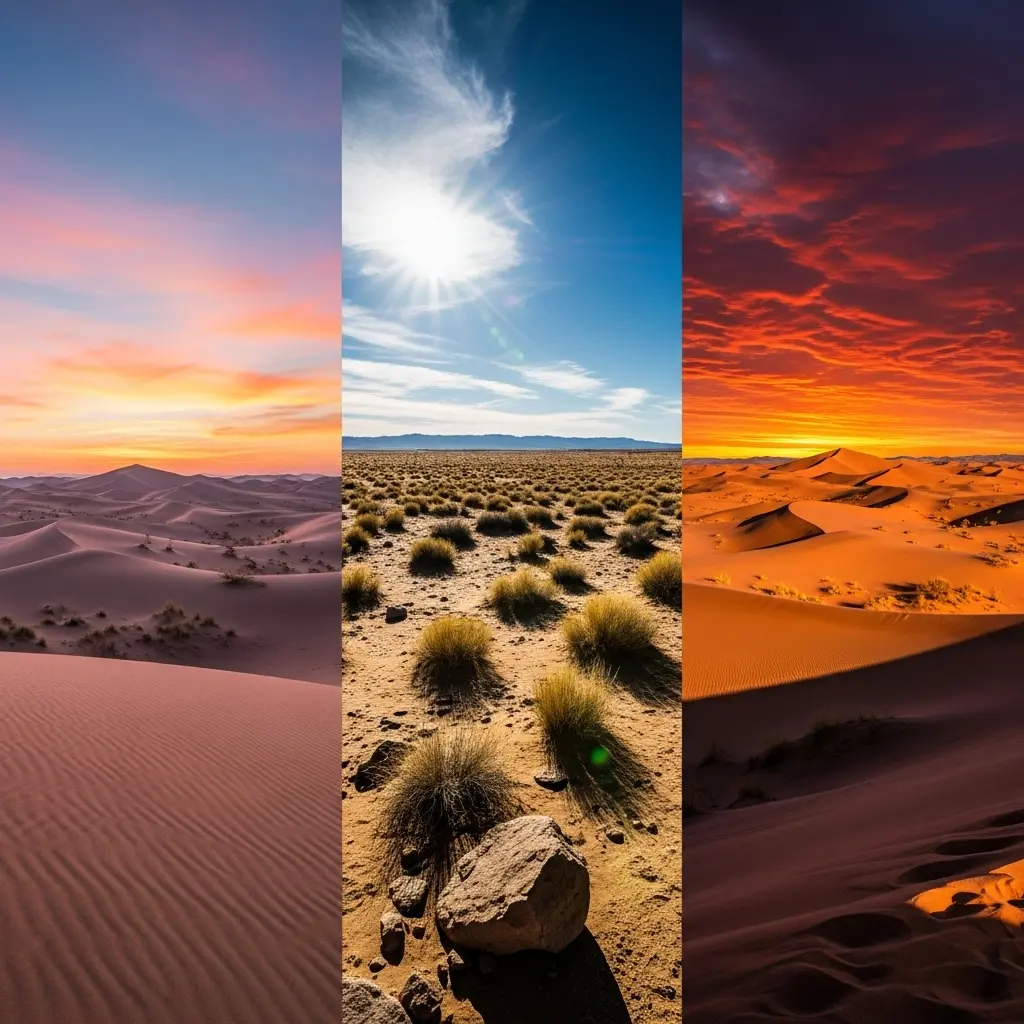
Feature Image Prompt Description
Prompt: A hyper-realistic wide-angle shot of a desert dune landscape split into three vertical sections showing different times of day. The left section shows dawn with cool blue and purple hues and soft mist. The middle section shows high noon with bright, blinding white-yellow sand and harsh blue sky. The right section shows sunset with deep fiery red and orange sand and long dramatic shadows. The texture of the sand ripples should be very detailed. No text on image.
Alt Text: Desert Colors Change concept showing dawn noon and sunset on sand dunes with varying light spectrums.
Practical Tips for Viewing
Sunglasses: Polarized sunglasses cut the glare. They increase saturation. They make the blue sky pop against the yellow sand. They are a filter for your eyes.
Clothing: Don’t wear beige. You will disappear. Wear red, blue, or white.
Positioning: Always stand with the sun to your side for texture. If the sun is behind you, the view is flat. If the sun is in front, you get silhouettes.
Patience: Don’t just take a photo and leave. Sit for 30 minutes at sunset. Watch the gradient shift. It happens fast.
The Role of Light Pollution
At night, the desert should be black.
But near cities like Dubai, it glows.
The city lights reflect off the dust in the air.
This creates an orange glow on the horizon.
This is artificial Desert Colors Change.
It ruins the stargazing.
But it creates a strange, eerie backdrop for night safaris.
Deep desert areas are protected from this.
Places like the Al Marmoom reserve try to keep it dark.
True darkness is rare.
When you find it, the starlight casts a silver sheen.
It is the final color of the day.
Silver and black.
Conclusion
The desert is not a static painting.
It is a moving movie.
It changes frame by frame.
The Desert Colors Change are a reminder of nature’s complexity.
Physics, geology, and biology collide to create beauty.
It is a show that plays every single day.
And the best part?
It is free to watch.
You just have to be there.
You have to look.
And you have to understand what you are seeing.
Next time you are on a dune, look at the shadow.
Look at the grain.
Appreciate the millions of years and the millions of miles of light that created that specific shade of gold.
Frequently Asked Questions
1. Why do Desert Colors Change so much during the “Golden Hour”?
The “Golden Hour” occurs shortly after sunrise and before sunset. During this time, the sun is low on the horizon. Sunlight must travel through a much thicker layer of the Earth’s atmosphere compared to when it is overhead. This journey scatters the shorter blue and violet wavelengths of light (Rayleigh scattering), allowing mostly the longer red, orange, and yellow wavelengths to reach the sand. This bathes the dunes in a warm, golden light. Additionally, the low angle creates long shadows that emphasize the texture of the ripples, adding depth and contrast that intensifies the perception of color saturation.
2. Is the sand actually red, or is it just the light?
It is a combination of both. The physical sand grains in many deserts, like the Empty Quarter or the dunes near Liwa, are coated in iron oxide. This is essentially rust, which has a natural reddish-orange pigment. However, the intensity of this red depends entirely on the light. Under a bright, blue-white midday sun, the red looks washed out and pale. Under a warm sunset light, the red spectrum of the light reflects off the red pigment of the sand, amplifying the color and making it appear like glowing fire.
3. Why does the desert look white at noon?
At noon, the sun is at its highest point (zenith). The sunlight travels through the least amount of atmosphere, so very little scattering occurs. The light that hits the ground is a full-spectrum white light (around 5500 Kelvin). Because the light is so intense and direct, it bounces off the silica crystals in the sand strongly. This creates a glare. Furthermore, the high angle means there are almost no shadows visible from eye level. Without shadows to provide contrast, the dunes lose their dimension and appear as a flat, bright, whitish-beige sheet.
4. How does dust affect the colors of the desert?
Dust particles suspended in the air act as a giant diffusion filter. When the air is dusty, it scatters light in all directions. During the day, this can wash out the blue sky, making it look pale or white. It reduces the contrast of the landscape, making the colors look muted or pastel. However, at sunrise and sunset, dust can enhance the colors. The particles scatter the red light across the sky, creating vibrant, fiery sunsets. A little bit of dust makes for beautiful photos; too much dust (a sandstorm) turns everything a dull monochromatic brown.
5. Why do my photos of the desert look different than what I saw?
Cameras and human eyes work differently. Your brain automatically adjusts “White Balance.” If you are in warm light, your brain corrects it slightly so you still recognize white objects. A camera sensor captures the raw data. Also, the dynamic range of the eye is much better. You can see details in the bright sun and the dark shadow simultaneously. A camera often has to choose. It might expose for the sand, making the sky look white, or expose for the sky, making the sand look black. Finally, the Purkinje effect at twilight changes how eyes perceive red/blue, which cameras don’t replicate.
6. What is the best time of day to see the most colors?
The absolute best time is the transition from late afternoon into sunset and twilight. If you start watching at 4:00 PM (in winter), you will see the Desert Colors Change from pale yellow to rich gold, then to deep orange, then to fiery red at sunset, and finally to purple and blue during twilight. This three-hour window offers the entire spectrum of the desert palette. It provides the most variety for photography and is the most emotionally moving time to be in the dunes.
7. How does the internal link https://htdesertsafari.com/ relate to this topic?
This link directs you to a service provider that organizes tours specifically timed to capture these changing colors. Safari companies know the science of light. They schedule their “Sunset Safaris” so that you arrive at the dunes exactly when the lighting is best. By using this link, you can book an experience that puts you in the center of this natural light show, rather than trying to navigate to a spot on your own and missing the critical window of the Golden Hour.
8. Why does the desert look blue in the early morning?
This is known as the “Blue Hour.” Before the sun breaks the horizon, the landscape is lit only by the ambient light of the atmosphere. The ozone layer and the gas molecules in the upper atmosphere scatter blue light down to the surface. Since there is no direct warm sunlight to counteract this, the shadows and the sand take on a cool, blueish-indigo tone. It is a very peaceful, low-contrast light that makes the desert look like a watercolor painting.
9. Do different deserts have different colors?
Yes, absolutely. The color depends on the geology.
Dubai/Sharjah: Gold to Reddish (Iron Oxide + Quartz).
Liwa (UAE): Deep Red (High Iron Oxide).
White Sands (USA): Pure White (Gypsum crystals).
Black Desert (Egypt): Black (Volcanic rock/Basalt).
Namib Desert: Apricot to Intense Red. The source rock that eroded to create the sand dictates the chemical color palette.
10. How does polarized sunglass wear affect the view?
Polarized sunglasses are a game-changer in the desert. Light reflecting off sand is often “polarized” (vibrating in one direction), which creates glare. Polarized lenses block this specific light wave. This eliminates the white glare on top of the dunes. As a result, you see the true color of the sand underneath. The colors appear deeper, richer, and more saturated. It also darkens the blue sky, creating a striking contrast against the orange sand. It is highly recommended for the best visual experience.
11. Can moonlight change the color of the sand?
Yes. Moonlight is just reflected sunlight, but it is much weaker. Under a full moon, the desert appears in shades of silver, grey, and charcoal. Our eyes rely on rod cells in this low light, which are not color-sensitive, so we see a monochromatic world. However, long-exposure photography can reveal that the sand still looks somewhat yellow/brown under moonlight, as the camera sensor can collect enough photons to register the color that our eyes miss.
12. Why is winter better for desert colors than summer?
Summer air in the Gulf region is often humid. Humidity puts water vapor in the air. Water vapor scatters light, creating a white haze that washes out colors and reduces visibility. The sky looks pale. Winter air is drier and cooler. This leads to better transparency. The sky is a deeper blue, and the view of the horizon is crisp. The lower angle of the sun in winter also means you get “longer” light and better shadows for more hours of the day compared to the overhead summer sun.
13. What is the psychological effect of these color changes?
Colors affect mood. The bright, bleached white of midday can induce anxiety or fatigue; it feels harsh and exposing. The warm golds and oranges of the afternoon induce feelings of warmth, comfort, and nostalgia. The blues and purples of twilight induce calm, silence, and introspection. Safari operators structure the flow of the tour to match this. They do the exciting dune bashing during the high-energy bright light and the relaxing dinner during the calming twilight.
14. How does https://royaldesertadventures.ae/ utilize these color changes?
Royal Desert Adventures creates itineraries based on the visual experience. They might offer “Morning Safaris” for those who want the fresh, crisp, high-contrast light of the dawn. They offer “Overnight Safaris” for those who want to see the sunset, the blue hour, and the starlight. By listing their specific tours, you can choose which “color palette” you want to experience. They act as the logistics partner to get you to the right place at the right time for the light you prefer.
15. What are “shadow dunes” and how do they affect color?
Shadow dunes are not a different type of sand, but a visual effect. When the sun is at a side angle, the leeward side of the dune falls into shadow. This creates a sharp line between the lit side (gold) and the unlit side (dark brown/blue). This duality creates a graphic, geometric look. It defines the sinuous curves of the desert. Without these shadows, the desert looks like a flat gradient. The shadows provide the “blacks” in the image that make the colors stand out.
16. Does pollution affect desert colors?
Yes. Light pollution from nearby cities creates an artificial orange glow on the horizon at night, drowning out the stars. Air pollution (smog) can make sunsets look muddier or more intense red, depending on the particles. In clean desert air, the gradient from yellow to blue at sunset is smooth. In polluted air, you might see distinct bands of grey or brown on the horizon. The further you go from the city (like with https://saharadesertsafaridubai.com/ tours), the cleaner the colors become.
17. How does the “Tyndall Effect” apply to the desert?
The Tyndall effect is the scattering of light by particles in a colloid or very fine suspension. In the desert, if there is very fine dust or smoke (from a campfire), you can see “beams” of light, similar to sunlight through trees in a forest. This effect makes the light rays visible. It adds a 3D quality to the light itself. At sunset, this can create “god rays” bursting through the clouds or over the edge of a dune, adding a dramatic, religious quality to the lighting.
18. Why does the horizon sometimes look silver?
This is usually due to a mirage or strong heat haze. The hot air near the ground bends the light rays from the sky upwards (refraction). When you look at the horizon, you are actually seeing a reflection of the sky on the ground. Because the sky is bright, this reflection looks like a pool of water or a silver mirror. It overrides the color of the sand. It creates the illusion that the desert ends in a sea of mercury.
19. How does the sand grain shape affect reflection?
Rounded grains (common in older deserts) scatter light more evenly, creating a matte or satin finish. Angular grains (younger sand) might sparkle more individually if they have flat crystal faces that catch the sun. However, most wind-blown sand is “frosted” or pitted from hitting other grains. This frosting diffuses the light, which is why sand usually glows softly rather than glittering like a disco ball. This diffusion is what gives the desert its soft, painterly look.
20. Why is “Desert Colors Change” a useful focus keyword?
It targets a specific curiosity. People who search for this are likely interested in photography, nature, or science, rather than just a quick thrill ride. It captures the “romantic” or “aesthetic” traveler. By optimizing for this, the blog attracts a higher-quality audience who is likely to book a premium or private safari to take photos. It positions the website as an authority on the natural beauty of the region, not just a ticket seller. It helps set expectations for what tourists will see.