Table of Contents
Desert Safari Camp Construction 7 Hidden Stages of Building in Sand
Building a house is hard.
Building a commercial facility in the middle of a shifting ocean of sand is harder.
Most tourists arrive at a camp and see the carpets.
They see the low tables and the stage.
They do not see the engineering miracle beneath their feet.
Desert Safari Camp Construction is a battle against nature.
The wind tries to tear the tents down.
The sand tries to swallow the foundations.
The sun tries to bleach and burn every material used.
To create a safe, comfortable haven in the middle of nowhere requires military precision.
It requires a deep understanding of geology.
It involves a logistical supply chain that would rival a small army.
We are going to break down how these oases are actually built.
We will look at the nuts, bolts, and sweat involved.
This is the technical reality of the desert tourism industry.
The Selection of the Site
You cannot just pick a spot because it looks pretty.
That is a recipe for disaster.
The first step in Desert Safari Camp Construction is reading the land.
Engineers look for “Sabkha” or harder ground beneath the dunes.
If you build on soft, shifting sand, the camp will sink.
It will move with the wind.
Surveyors go out into the deep desert.
They test the soil density.
They track the wind patterns for months.
You want a location that is shielded from the prevailing winds.
This is often in the bowl of a large dune formation.
However, you also need accessibility.
A camp that is too hard to reach will fail.
The supply trucks need to get there.
The water tankers need a route.
If the path is too steep, heavy trucks cannot make it.
So, the site is a compromise between beauty and logistics.
It must be isolated enough to feel wild.
But it must be accessible enough to be serviced daily.
The Legal and Permitting Labyrinth
Before a single shovel hits the sand, there is paperwork.
The desert is not a lawless land.
It is highly regulated by government bodies.
You need environmental clearances.
You need to prove that your camp will not harm local wildlife.
The Dubai Municipality has strict codes for Desert Safari Camp Construction.
Fire safety is the biggest concern.
You are building with fabric and wood in a hot, dry place.
The risk of fire is high.
So, the plans must include fire exits.
They must include sand buckets and extinguishers at specific intervals.
The Department of Tourism and Commerce Marketing (DTCM) also gets involved.
They set the standards for guest comfort.
They dictate the ratio of toilets to guests.
They set the hygiene standards for the kitchen.
Navigating this bureaucracy takes months.
It requires detailed architectural drawings.
It requires safety audits.
Only when the stamp is on the paper can the trucks roll.
Laying Foundations in a Fluid Landscape
How do you anchor a building to something that moves?
This is the core challenge of Desert Safari Camp Construction.
You cannot dig a traditional concrete trench foundation.
The sand is too unstable.
Instead, builders use a few ingenious methods.
One method is the deep pile system.
Long screws or poles are driven deep into the sand until they hit the harder layer.
These act as the anchors for the main structures.
Another method is the “floating foundation.”
This uses heavy concrete blocks buried under the sand.
The weight of the concrete holds the structure down.
The friction of the sand adds stability.
These blocks are interconnected with steel cables.
It creates a web of stability under the surface.
For the perimeter walls, they often use traditional materials.
They use palm tree trunks or heavy timber.
These are dug deep and cemented in place.
The goal is to create a structure that can flex.
If it is too rigid, the wind will snap it.
If it has some give, it survives the storms.
The Infrastructure of Power and Water
A camp needs to function like a small hotel.
But there are no power lines.
There are no water pipes.
Every watt of electricity and drop of water must be brought in.
This is the lifeline of Desert Safari Camp Construction.
Generator rooms are built first.
They are usually placed far away from the guest area.
This is to hide the noise and the smell of diesel.
Heavy-duty cables are buried under the sand to connect to the camp.
These cables must be armored.
Desert rodents love to chew on rubber insulation.
If a cable is cut, the camp goes dark.
Water storage is another massive undertaking.
Huge tanks are buried underground or hidden behind dunes.
These tanks hold thousands of gallons.
They feed the kitchen and the restrooms.
Pressure pumps are installed to ensure the taps work.
Then there is the issue of sewage.
It is the topic no one wants to talk about.
But it is vital.
Septic tanks must be installed deep underground.
They must be sealed perfectly to prevent leaks.
A leak would contaminate the site and smell terrible.
These tanks are pumped out regularly by service trucks.
Companies like https://htdesertsafari.com/ invest heavily in this invisible infrastructure.
They know that a failure here ruins the guest experience.
It is the unglamorous heart of the operation.
Choosing Materials for Extreme Heat
You cannot use standard building materials.
Drywall will crumble.
Standard plastic will melt or become brittle.
Desert Safari Camp Construction relies on durable, often natural materials.
Wood is treated with heavy oils.
This protects it from the sun and from termites.
The tents are made from specialized canvas.
This is not normal camping gear.
It is heavy-duty, fire-retardant fabric.
It is often layered.
The outer layer reflects the sun.
The inner layer provides insulation.
Between them, there is an air gap.
This keeps the inside cooler than the outside.
Flooring is usually concrete pavers or stone.
Carpets are laid on top.
But the base must be solid.
It must be easy to sweep.
Sand will get everywhere, so the design must allow for cleaning.
Barasti, or dried palm fronds, is a traditional material.
It is used for roofs and fences.
It allows air to flow through while blocking the sun.
It is an ancient technology that still works perfectly.
The Logistics of the Build Phase
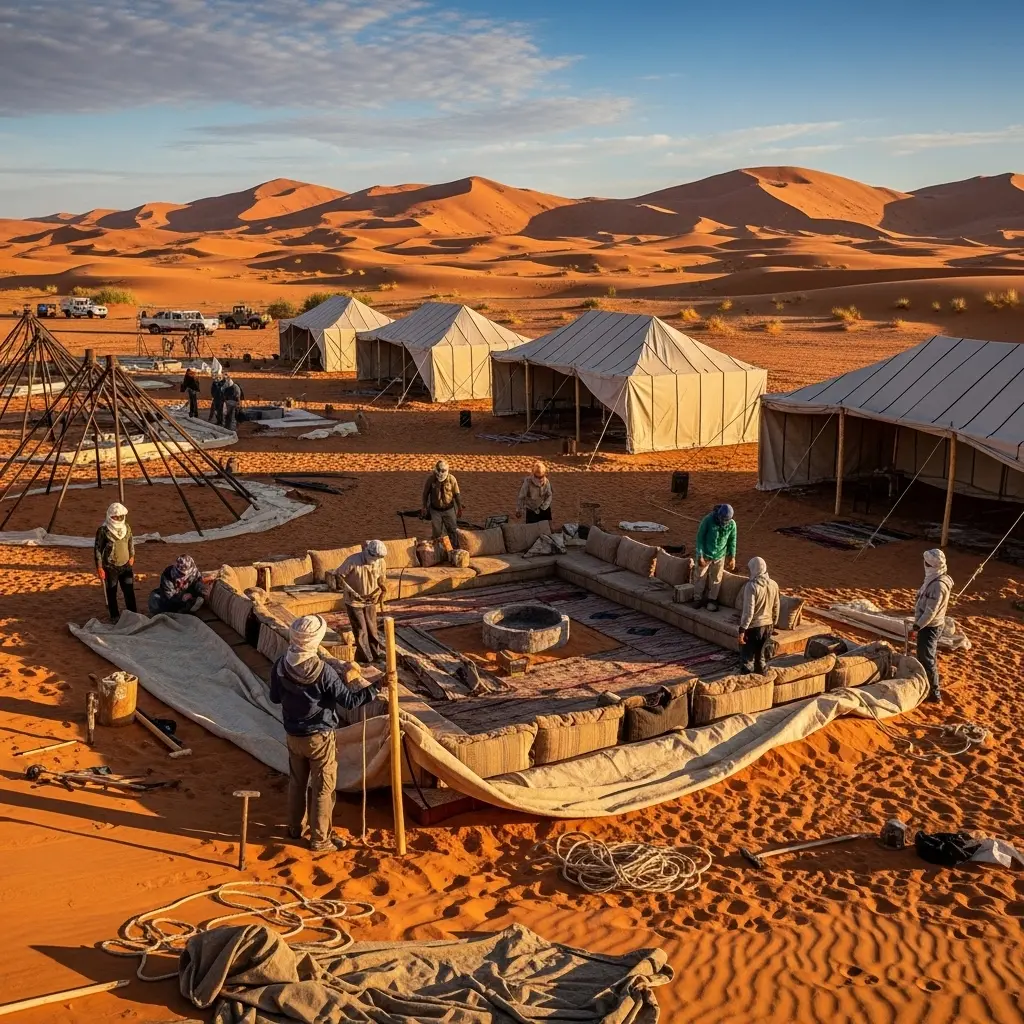
Imagine trying to get a cement mixer up a sand dune.
It sounds impossible.
But it happens during Desert Safari Camp Construction.
Contractors use specialized 6×6 trucks.
They deflate the tires of heavy construction vehicles.
Sometimes, they have to build a temporary road.
They lay down mats or wet the sand to compact it.
This allows the heavy equipment to reach the site.
The timing is crucial.
You cannot build in the middle of the summer day.
The tools become too hot to touch.
The concrete dries too fast and cracks.
So, much of the work is done at night or in the early morning.
Workers face extreme conditions.
Hydration and safety breaks are mandatory.
It is a slow process.
Moving materials takes three times longer than in the city.
Every nail, every plank, every toilet bowl has to be trucked in.
If you forget a tool, it is a two-hour round trip to get it.
Project management must be flawless.
Designing the Guest Flow
The layout of the camp is psychology.
It is designed to reveal the desert in stages.
The entrance is usually a narrow path.
It opens up into the main courtyard (The Majlis).
This creates a “wow” moment.
The stage is the focal point.
All seating is arranged around it.
But Desert Safari Camp Construction also considers privacy.
VIP sections are elevated.
They are separated by low walls or curtains.
The buffet area is placed to avoid congestion.
Lines can kill the mood.
So, the food stations are often double-sided.
The restrooms are tucked away, usually down a winding path.
They are accessible but out of sight.
The lighting design is subtle.
You do not want floodlights.
You want soft, warm light that mimics firelight.
This preserves the view of the stars.
Solar lights are becoming popular for pathways.
They charge during the day and glow at night.
The Kitchen Complex
The kitchen is the engine of the dinner service.
It cannot be a tent.
Health codes require a solid structure.
Usually, this is a prefabricated container or a block building.
It is clad in wood to look like part of the camp.
Inside, it is stainless steel.
It has gas lines and ventilation hoods.
Ventilation is critical in Desert Safari Camp Construction.
Heat from the cooking adds to the desert heat.
Powerful fans are needed to keep the chefs safe.
The floor must be non-slip.
Grease and sand are a slippery combination.
There must be separate areas for raw and cooked food.
Storage for dry goods must be pest-proof.
The desert is full of hungry creatures.
Foxes and insects will find any open food.
So, the pantry is sealed tight.
The Stage and Entertainment Zone
The center of the camp is the stage.
This needs to be a robust structure.
Belly dancers and Tanoura spinners need a smooth floor.
You cannot dance on uneven wood.
The stage is usually built on a concrete slab.
It is topped with smooth timber or tiling.
Under the stage, there is often storage.
Sound equipment is kept there.
The sound system installation is tricky.
Sand destroys speakers.
So, the audio gear used in Desert Safari Camp Construction is marine-grade.
It is the same gear used on boats.
It resists dust and moisture.
Cables are buried deep to prevent tripping.
The lighting rig for the show is mounted on poles.
These poles must be secured against high winds.
A falling light fixture is a major safety hazard.
Engineers calculate the wind load for every pole.
The Perimeter and Security
The desert is vast and dark at night.
You need to define the safe zone.
A perimeter fence or wall is essential.
It stops guests from wandering off and getting lost.
It stops wild camels from walking into the dinner.
The perimeter is often made of natural materials.
It blends in.
But it is solid.
Desert Safari Camp Construction includes security checkpoints.
The entrance needs a gate.
This is to control access.
Only booked guests and staff should enter.
Security cameras are now common.
They are powered by solar panels.
They monitor the site when it is empty.
Vandalism can happen in remote areas.
So, the camp is never truly abandoned.
There is always a watchman.
His quarters are part of the build.
Staff Accommodation and Welfare
The staff often live on-site.
Driving back to the city every night is not feasible.
So, a hidden village is built behind the guest camp.
This is for the drivers, chefs, and cleaners.
These quarters need to be comfortable.
They need air conditioning.
They need showers and a kitchen.
Desert Safari Camp Construction cares for the team.
If the staff is tired or hot, the service suffers.
Their living area is usually made of cabins.
These are insulated against the heat.
They are connected to the main generator.
This area is strictly off-limits to guests.
It allows the staff to relax and recharge.
It is a vital part of the operational success.
Fire Safety Systems
We touched on this, but it needs detail.
Fire in a tent camp is a nightmare scenario.
The canvas, the carpets, the wood – it is all fuel.
The wind can spread a spark instantly.
Therefore, the fire suppression system is aggressive.
Sand buckets are traditional but effective.
Fire extinguishers are placed every few meters.
But modern Desert Safari Camp Construction goes further.
Some camps have pressurized water hoses.
These are connected to a dedicated water tank.
This tank is only for fire.
It is never used for showers.
Fire retardant sprays are applied to the tents.
This chemical coating slows down the burn.
Electrical systems are equipped with circuit breakers.
If a short occurs, the power cuts instantly.
Staff are drilled on evacuation routes.
They know exactly how to guide guests out.
Waste Management Systems
A camp generates a lot of trash.
Food waste, plastic bottles, paper.
You cannot bury it in the desert.
That is illegal and unethical.
The design includes a waste sorting area.
This is usually a concrete pad behind the kitchen.
Bins are color-coded for recycling.
Compactors are sometimes used to reduce the volume.
This reduces the number of truck trips needed.
The Desert Safari Camp Construction plan includes this logistics loop.
Used cooking oil is collected.
It is sent to be recycled into biofuel.
Nothing is left behind.
The goal is to leave the sand as clean as it was found.
This requires discipline and good design.
If the bins are too hard to reach, staff might get lazy.
So, the waste area is placed strategically.
Sustainability and Green Tech
The trend is moving towards eco-friendly camps.
Generators are dirty and loud.
Solar power is the answer.
The desert has unlimited sun.
New Desert Safari Camp Construction projects prioritize solar.
Solar farms are built on nearby dunes.
They charge battery banks.
This runs the lights and the fridges.
Water recycling is also advancing.
Greywater from sinks is treated.
It is used to water local desert plants.
This greens the area without wasting fresh water.
Some camps are experimenting with wind turbines.
The desert wind is a resource.
Sustainable building materials are being sourced.
Bamboo is being used instead of slow-growing timber.
It is a shift towards a lighter footprint.
Resources like https://dubaidesertsafarie.com/ highlight these eco-camps.
They are becoming a selling point for tourists.
Renovation and Maintenance
The desert destroys everything.
A camp does not last forever.
Every summer, when the heat is unbearable, camps close for maintenance.
This is a mini Desert Safari Camp Construction phase every year.
Tents are replaced.
Wood is re-varnished.
Sand is cleared out of the machinery.
Generators are overhauled.
The wind blasts the structures with sand.
It acts like sandpaper.
Paint is stripped off.
Metal rusts surprisingly fast due to the salty humidity at night.
So, the budget for maintenance is high.
It is a constant battle against entropy.
If you stop maintaining for one month, the camp looks old.
It looks neglected.
Tourists notice this immediately.
The Cost of Building
How much does it cost?
It is not cheap.
The logistics double the price of everything.
A simple wooden structure costs twice as much as in the city.
Transport costs are the killer.
Water and fuel are recurring costs that are high.
The initial investment for a high-end camp is in the millions.
Desert Safari Camp Construction is a high-risk investment.
You are building on rented land.
You do not own the desert.
If the government changes the zone, you have to move.
So, the return on investment must be calculated carefully.
Operators need to fill the seats to pay for the build.
It is a volume game.
Or it is a high-price luxury game.
There is no middle ground.
Future Trends in Camp Building
The future is sci-fi.
We are seeing “glamping” pods.
These are geodesic domes.
They offer air-conditioned views of the stars.
They are prefabricated and dropped in by crane.
This reduces the construction time on site.
3D printing is being discussed.
Could we print structures using the desert sand?
It is a possibility.
Desert Safari Camp Construction is evolving.
Smart camps are coming.
Sensors will adjust the temperature automatically.
Apps will let guests order drinks to their tent.
But the core challenge will remain.
The sand, the wind, and the sun will always be the bosses.
Comparison: Traditional vs. Modern Camp Build
The Role of External Expertise
No single company does it all.
They hire specialists.
They hire structural engineers.
They hire interior designers who know Bedouin culture.
They hire solar experts.
It is a collaborative effort.
Companies like https://royaldesertadventures.ae/ work with the best contractors.
They know that quality construction equals safety.
They cannot afford a roof collapsing.
So, they pay for expertise.
This professionalization of the industry is good.
It raises the standards for everyone.
The days of slapping up a few tents are gone.
Now, it is a construction project.
Why This Matters to the Guest
Why should you care about Desert Safari Camp Construction?
Because your safety depends on it.
Because your comfort depends on it.
When you sit on that stage, you are sitting on engineering.
When you drink that cold water, you are drinking logistics.
It helps you appreciate the price of the ticket.
You are paying for a city to be built in a wasteland.
You are paying for the effort to keep you safe in a hostile environment.
It adds a layer of respect to the experience.
You look at the wooden beams differently.
You understand the work behind the magic.
Conclusion
The desert safari camp is a triumph of human will.
It is a temporary victory over the elements.
It requires money, science, and sweat.
Desert Safari Camp Construction is a hidden industry.
It operates in the shadows to create the light.
It turns the empty quarter into a bustling venue.
Next time you are there, look down.
Look at how the carpet meets the sand.
Look at the sturdy poles holding up the lights.
Remember the trucks that struggled up the dunes.
Remember the workers who braved the heat.
The camp is not just a place to eat.
It is a monument to persistence.
It is the stage for your memories.
And it is built on a foundation of hard, hidden work.
Frequently Asked Questions
1. What is the most difficult part of Desert Safari Camp Construction?
The most difficult part is undoubtedly the logistics of transport and the instability of the ground. Moving heavy construction materials like cement, steel, and timber into a desert environment without paved roads is a nightmare. Trucks frequently get stuck in soft sand, requiring recovery teams. Furthermore, building a stable foundation on shifting sand dunes requires specialized engineering techniques. You cannot simply dig and pour concrete like in a city; you have to use deep piling or floating foundations to ensure the structures don’t sink or tilt over time as the dunes move with the wind.
2. How do these camps get electricity without power lines?
Since desert camps are far off the municipal grid, they must generate their own power. The traditional method is using large, industrial-grade diesel generators. These are usually housed in soundproof rooms far from the guest area to minimize noise pollution. They run 24/7 to power the lights, refrigerators, and water pumps. However, modern Desert Safari Camp Construction is increasingly incorporating solar power. Large battery banks store energy collected during the day to run the camp at night, reducing the reliance on fossil fuels and making the operation quieter and more sustainable.
3. How do they handle sewage and waste in the middle of nowhere?
Sanitation is a critical but invisible part of the camp. Large septic tanks are buried deep underground during the initial construction phase. These tanks are sealed to prevent any leakage into the sand. All wastewater from toilets and kitchens flows into these tanks. They do not drain into the desert. Instead, specialized sewage tanker trucks visit the camp regularly (often daily or every other day) to pump out the waste and transport it to official sewage treatment plants in the city. This ensures hygiene standards are met and the environment is protected.
4. Are the tents used in the camps fireproof?
Yes, safety regulations strictly require that the materials used for tents and majlis seating areas be fire-retardant. The fabric is treated with chemicals that resist ignition and slow down the spread of flames. During Desert Safari Camp Construction, inspectors from the Civil Defense check these materials. Additionally, the camps are designed with fire breaks—spaces between structures—to prevent a fire from jumping from one tent to another. Fire extinguishers and sand buckets are placed strategically throughout the camp, and staff are trained in fire response protocols.
5. How long does it take to build a desert safari camp?
The timeline varies depending on the size and luxury level of the camp, but it generally takes between 4 to 8 months. The permitting phase alone can take 2 to 3 months, involving approvals from the Municipality, Tourism Department, and environmental agencies. The physical construction takes another 3 to 5 months. However, the work is slower than in the city because construction can often only happen during cooler hours of the day (early morning or night) to protect workers from heatstroke, and transporting materials takes significantly longer.
6. Do they use special wood for construction?
Yes, ordinary untreated wood would rot or be eaten by termites very quickly in the desert environment. Builders use pressure-treated timber that is resistant to pests and dry rot. They also use hardier woods like teak or treated pine for structural elements. A traditional material often used is “Barasti” (palm fronds) and palm trunks. These are naturally adapted to the environment, but even they are often treated or reinforced with modern materials to ensure they last longer and meet safety codes regarding structural integrity.
7. How do they keep the sand out of the food and kitchen?
Keeping sand out is a constant battle. The kitchen is never a simple tent; it is a sealed structure, often a modified container or block room with tight-sealing doors and windows. The ventilation systems use filters to trap dust before it enters the cooking area. In the dining area, buffet stations often have covers or “sneeze guards” that also act as dust shields. The flooring in food areas is usually solid (concrete or tile) rather than carpet, allowing it to be wet-mopped frequently to trap and remove dust particles before they become airborne.
8. Why is “Desert Safari Camp Construction” a focus keyword for this topic?
This keyword specifically targets the technical and industrial side of the tourism market. Most people search for “safari tickets,” but investors, researchers, and curious travelers search for how these places function. By using this keyword, we provide in-depth, authoritative content that explains the complexities of the business. It separates this blog from generic travel guides. It signals to search engines that we are experts in the operational details of the industry, not just ticket resellers. It builds niche authority for the website.
9. How does the mention of https://htdesertsafari.com/ fit into the context?
Mentioning this website provides a real-world example of an operator that likely manages these complex infrastructure challenges. It anchors the theoretical information to a tangible business. For readers looking to book a safari, it acts as a subtle endorsement of a company that understands the engineering and safety requirements needed to run a professional camp. It shows that there are established players who invest in the high-quality construction methods discussed in the article, distinguishing them from fly-by-night operators.
10. Can these camps be moved, or are they permanent?
Most desert camps are semi-permanent. The heavy infrastructure like septic tanks and concrete foundations are difficult to move. However, the tents, stages, and decorative elements can be dismantled. Sometimes, government zoning regulations change, or a site becomes overused, and an operator is forced to relocate. This is a massive undertaking called “de-commissioning.” They have to dig up the tanks, remove the concrete blocks, and restore the sand to its natural state before moving to a new location. It is expensive and avoided whenever possible.
11. What happens to the camp during a sandstorm?
A well-built camp is designed to withstand sandstorms. The tents are anchored deeply to prevent them from blowing away. However, operationally, the camp usually shuts down for guests during a severe storm. The staff will secure all loose cushions, carpets, and equipment, storing them inside the solid kitchen or storage structures. After the storm, a massive cleanup operation is needed. The “Desert Safari Camp Construction” design usually avoids shapes that trap wind, allowing the sand to blow over and around the structures rather than piling up against them.
12. How do they maintain the temperature inside the structures?
In winter, it gets cold, and in summer, it is incredibly hot. Traditional camps rely on airflow design, using the breeze to cool the shaded areas. However, modern luxury camps install full HVAC (Heating, Ventilation, and Air Conditioning) systems. These require significant power from the generators. The structures for these AC units must be insulated; otherwise, the cold air escapes instantly through the canvas. Double-layered fabrics and insulated panels are used in the construction of VIP majlis and enclosed dining areas to make climate control possible.
13. Is it legal to build anywhere in the desert?
No, it is strictly illegal to build without a permit. The desert is divided into zones: conservation reserves, military zones, oil and gas fields, and tourism zones. You can only build in specific tourism zones allocated by the government. Building outside these areas results in immediate demolition and heavy fines. The coordinates for the camp are fixed by the municipality. You cannot even expand the camp by a few meters outside your allotted plot without applying for a new permit and inspection.
14. What role do websites like https://royaldesertadventures.ae/ play in this ecosystem?
These websites are the digital front door to the physical structure. They market the experience that the construction enables. By linking to them, we connect the “hardware” (the camp build) with the “software” (the tour packages). These companies are the ones funding the construction and maintenance. They are the clients for the construction firms. Highlighting them shows who is responsible for maintaining the standards of safety and luxury described in the article. It verifies that the industry is active and professional.
15. How do they prevent the camp from being buried by shifting dunes?
This is a matter of site selection and maintenance. Engineers study the wind direction to avoid building in the “slip face” where sand accumulates rapidly. However, some accumulation is inevitable. Camps have small bulldozers or bobcats on-site (or on call). After a windy season, they physically push the encroaching sand dunes back. They might also install sand fences—simple wooden slat fences placed upwind—to slow down the wind and force it to drop its sand load before it hits the main camp area.
16. What is the lifespan of a desert camp?
The harsh environment significantly shortens the lifespan of materials. A canvas tent might last 3 to 5 years before the sun destroys the fibers. Wood needs treating annually. The heavy infrastructure (concrete/tanks) can last 10 to 15 years. However, from a business perspective, camps often undergo a major renovation every 5 to 7 years to stay competitive and fresh. If a camp is not maintained, it can become dilapidated and unsafe within just two years of neglect.
17. How do they get water for the swimming pools in some luxury camps?
Luxury camps with pools face a massive logistical challenge. The water must be trucked in via tankers, which is very expensive. Evaporation rates are huge, so the pool needs constant refilling. During construction, the pool shell must be incredibly strong to withstand the shifting ground pressure. Leaks are disastrous as the water would drain into the sand instantly. Filtration systems must be oversized to handle the dust and sand that inevitably blows into the water. It is the ultimate symbol of luxury because of the difficulty involved.
18. Why link to https://saharadesertsafaridubai.com/?
Linking to Sahara Desert Safari Dubai provides an example of a well-known operator in the region. It gives the reader a comparative option. By referencing multiple distinct companies (HT, Royal, Sahara), the blog post presents a balanced view of the industry rather than looking like a sponsored post for a single entity. It allows the user to explore different styles of camps—some might be more traditional, others more modern—and see the variety of construction styles that exist in the Dubai desert market.
19. Do the camps use concrete?
They use as little concrete as possible because it is hard to transport and remove. However, for hygiene areas like kitchens and toilets, concrete slabs are often necessary. Also, the “floating foundations” mentioned earlier use pre-cast concrete blocks. But you won’t see large concrete walls or multi-story concrete buildings. The aesthetic requirement is to blend with nature, so any concrete used is usually covered with wood, stone, or plaster to look like traditional mud-brick architecture.
20. How does the “Desert Safari Camp Construction” affect the ticket price?
There is a direct correlation. A camp built with cheap materials, no AC, and basic generators will offer cheap tickets. A camp built with solar power, high-end flush toilets, safety-certified stages, and fresh food kitchens costs millions to build and maintain. This high operational cost is passed down to the ticket price. When a tourist pays $100 instead of $30, they are paying for better architecture, better safety systems, and a cleaner, more sustainable environment. Understanding construction helps justify the cost of premium safaris.