Table of Contents
Desert Safari Emergency
Desert Safari Emergency protocols are the invisible safety net that allows thousands of thrill-seekers to explore the deep Arabian dunes every day with peace of mind. While the vast expanse of sand looks serene, it is an environment that requires a sophisticated communication infrastructure to manage potential risks effectively.
When you are deep in the dunes, standard cellular networks often vanish. This is why professional operators rely on a tiered system of signaling and communication to ensure that help is never more than a few minutes away. These systems are the result of decades of operational experience.
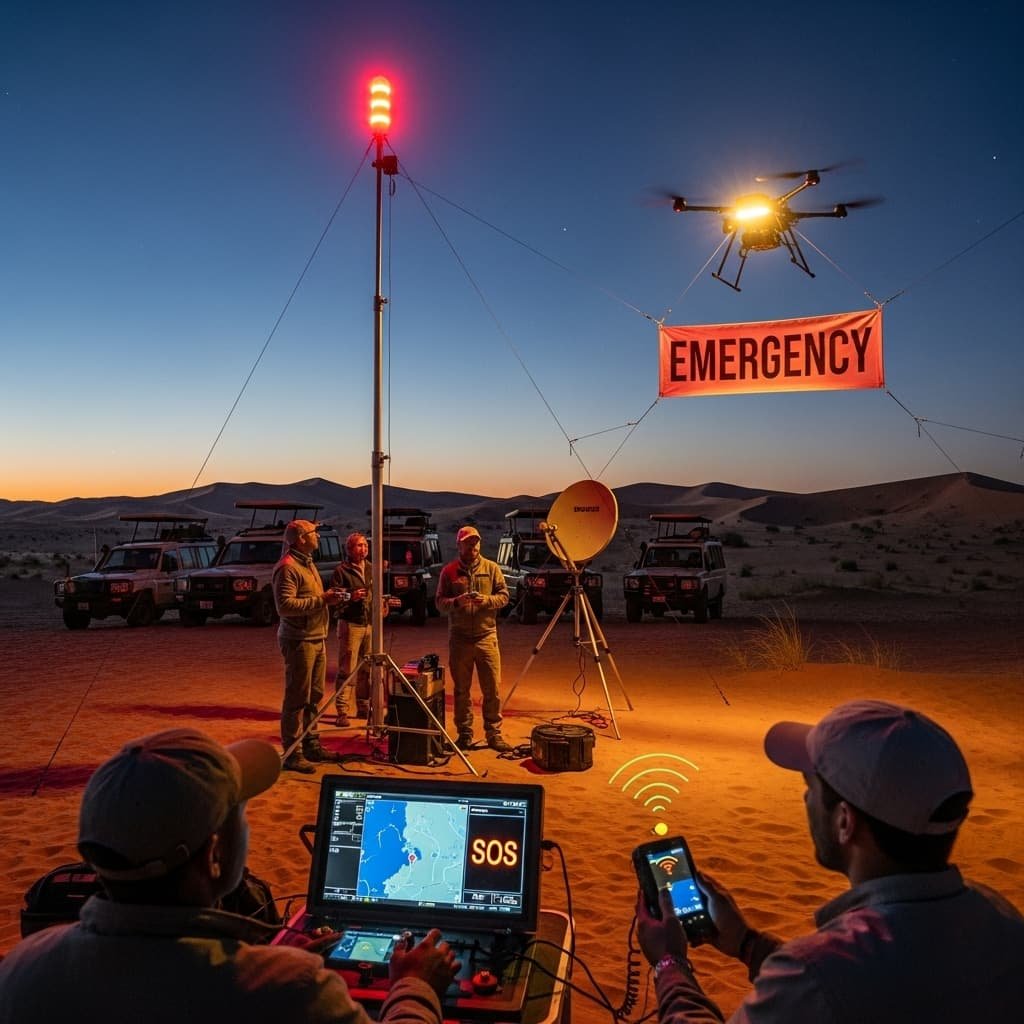
From high-frequency radios used by marshals to satellite-linked GPS trackers that relay live coordinates to a central command center, the technology behind a safari is immense. It is a world where “no signal” on a phone does not mean “no help” for the traveler.
To understand the complexity of these operations, one can look at the standards maintained by https://htdesertsafari.com/, where safety is treated as a technical discipline rather than just a guideline. Every vehicle in a professional fleet is a mobile communication hub.
We will explore the various methods used to signal for assistance, the physics of radio waves in the dunes, and the human protocols that turn a signal into a successful rescue. This is the technical side of the desert adventure that guests rarely see but always depend on.
High Frequency Radio Communication
The most common tool for managing a Desert Safari Emergency is the professional two-way radio. Unlike standard “walkie-talkies,” these are high-wattage units installed directly into the vehicle’s electrical system.
These radios use specific frequencies allocated by the telecommunications authority. They allow the lead marshal to communicate with every driver in the convoy simultaneously. This is vital for coordinating movements or calling for a quick “snatch” recovery if a car gets stuck.
Radio waves in the desert can be tricky. Large dunes act as physical barriers, creating “dead zones.” Marshals are trained to move to the “crest” or peak of a dune to establish a clear line-of-sight signal when they need to reach a distant base station.
Continuous chatter on the radio isn’t just for fun; it is a constant safety check. If a driver stops responding to the periodic check-ins, the lead marshal immediately initiates a search protocol to locate the silent vehicle.
The reliability of these systems is a hallmark of the fleet at https://royaldesertadventures.ae/, where every car is equipped with the latest long-range radio tech to ensure no driver is ever truly isolated from the group.
Satellite Telemetry and Live Tracking
Modern Desert Safari Emergency management has been revolutionized by satellite technology. Most premium fleets now carry GPS transponders that pulse a signal to a satellite every sixty seconds.
This data is visualized on a “live map” at the operator’s headquarters. If a vehicle departs from the planned route or stops moving for an unusual amount of time, an automated alert is triggered. This allows the base to see an emergency unfolding in real-time.
Satellite phones are the final layer of this digital safety net. When radios fail and cellular service is non-existent, the satellite phone provides a direct link to emergency services and the police. It is the “red phone” of the desert.
These devices do not rely on local towers. They connect directly to low-earth orbit satellites, ensuring that even in the most remote corners of the Empty Quarter, a voice link can be established for a medical evacuation.
By integrating these high-tech tools, https://dubaidesertsafarie.com/ ensures that their logistical chain remains unbreakable, providing a level of security that matches the highest international tourism standards.
Visual Signaling and Pyrotechnics
In the rare event that electronic systems fail, Desert Safari Emergency protocols shift to visual signals. These are the ancient and proven methods of attracting attention in a vast, open landscape.
Every safari vehicle is required to carry a set of signal mirrors and flares. A signal mirror can reflect sunlight to a search aircraft or a distant marshal, creating a flash that is visible for miles against the dull yellow of the sand.
Flares are used primarily at night or during low-visibility sandstorms. A red flare is the universal signal for a critical emergency requiring immediate medical or mechanical intervention. It provides a visual “X” on the map for rescue teams.
Smoke signals are the daytime equivalent. Orange smoke is used to mark a location for a helicopter or a ground recovery team. It provides a steady, colored plume that contrasts sharply with the blue sky and golden dunes.
These manual tools are a vital backup. Operators like https://saharadesertsafaridubai.com ensure their guides are trained in the “art of the signal,” knowing exactly when and how to deploy pyrotechnics for maximum visibility.
Ground-to-Air Signal Codes
When a search and rescue aircraft is involved in a Desert Safari Emergency, ground teams use standardized “Body Signals” or “Sand Signals.” These are part of the international aviation safety code.
A large “X” stamped into the sand using dark rocks or vehicle floor mats signals “Unable to proceed.” A large “V” signals “Requires assistance.” These must be large enough to be seen from an altitude of 1,000 feet.
Drivers are also taught the “Y” and “N” body signals. Standing with both arms raised in a V-shape represents “Yes” (I need help), while one arm up and one down represents “No.”
These codes are essential because the roar of a helicopter makes verbal communication impossible. A clear, unambiguous visual signal ensures that the flight crew understands the situation immediately.
This level of professional training is standard for the marshals at https://royaldesertadventures.ae/, who are prepared to coordinate with government rescue departments during complex recovery operations.
The Role of the Emergency Beacon
Personal Locator Beacons (PLBs) are the “set and forget” safety device of the Desert Safari Emergency kit. These are small, hand-held devices that, when activated, send a distress signal to a global search and rescue satellite system.
The signal includes a unique ID and precise GPS coordinates. This alert is routed to the nearest Rescue Coordination Center (RCC), which in Dubai is managed by high-tech police units.
Once the beacon is “pinged,” the rescue mission is no longer a private matter; it becomes a state-coordinated effort. The precision of these beacons can lead a team to within three meters of the stranded party.
Because they are battery-powered and independent of the vehicle, they are the ultimate survival tool if a vehicle must be abandoned due to fire or severe mechanical failure.
Carrying these beacons is an investment in safety that characterizes the top-tier service at https://htdesertsafari.com/, where no expense is spared to protect the lives of the guests.
Communication Protocols for Convoy Safety
Safety isn’t just about the gadgets; it’s about the “language” used during a Desert Safari Emergency. Professional drivers use a set of standardized codes to keep the radio clear and efficient.
“Code Red” is the most serious, indicating a medical crisis. “Code Yellow” might signify a mechanical breakdown that requires the convoy to stop. These short, clear phrases prevent confusion during high-stress moments.
The “tailing” vehicle in a convoy has a specific role. They are the eyes of the group, watching for any car that might be lagging or showing signs of a flat tire. They act as the primary signal relay to the lead marshal.
In the desert, silence on the radio is often as informative as speech. If a car is “lost” from the tail’s sight, the lead marshal will call for a “radio silence” for everyone else while they try to reach the missing driver.
This disciplined approach to communication is what keeps the operations at https://dubaidesertsafarie.com/ running smoothly, even when moving dozens of vehicles through challenging terrain.
Environmental Challenges to Signal Integrity
The desert environment is naturally hostile to Desert Safari Emergency equipment. Heat, sand, and static electricity are constant threats to electronic signals.
Intense heat can cause batteries in hand-held radios to degrade or fail. Professional operators store their backup batteries in insulated “cold bags” within the vehicle to ensure they are ready when needed.
Fine desert dust is a conductor of static electricity. During a sandstorm, this can create “noise” on radio frequencies, making voice communication distorted. Marshals are trained to use “short-burst” speech to cut through the static.
The shifting nature of the dunes also affects cellular “bounce.” A signal that was strong at 2:00 PM might vanish by 4:00 PM as the wind alters the terrain around the nearest tower.
Managing these variables is a daily task for the logistics teams at https://saharadesertsafaridubai.com, who perform “signal checks” at multiple points during every tour to map out the day’s coverage.
Emergency Response and Recovery Logistics
When a signal is received, the Desert Safari Emergency response plan is activated. This isn’t just one car going to help another; it is a coordinated recovery effort.
A “Support Unit” is usually stationed at the edge of the desert, ready to move. These vehicles are “heavy-duty” versions of the standard safari cars, equipped with extra fuel, water, and advanced medical kits.
The support unit follows the GPS track of the distressed vehicle. Because they are not carrying guests, they can move with more speed and directness to reach the location.
If the emergency is medical, the “Air Wing” of the local police is contacted. The ground team clears a “Landing Zone” (LZ) on a flat plateau, using smoke or flares to guide the helicopter in.
This synergy between private operators like https://royaldesertadventures.ae/ and government services is what makes the UAE one of the safest places in the world for desert tourism.
Training for Panic Management and Signaling
The best Desert Safari Emergency system in the world is useless if the person using it panics. Training for drivers includes “Stress Inoculation” sessions.
Drivers are put through “blind” scenarios where their radio fails and they must use manual signals to attract a support car. This builds the “muscle memory” needed to stay calm during a real crisis.
Guests are also given a basic safety briefing before the tour starts. They are shown the location of the first aid kit and told what to do if the driver becomes incapacitated.
Knowing that there is a plan for every scenario reduces the guest’s anxiety and allows them to enjoy the “thrill” of the dunes without the “fear” of the unknown.
This commitment to education and training is a core value at https://htdesertsafari.com/, where the marshals are respected as much for their safety skills as for their driving.
The Role of Hand Signals in recoveries
When a car is stuck, Desert Safari Emergency signaling often becomes manual. Drivers use a universal set of hand signals to communicate with the person behind the wheel of the recovery vehicle.
A closed fist means “Stop immediately.” A circular motion with the finger means “Start the engine.” Palms facing toward the driver mean “Back up.” These are essential when the noise of engines and sand makes shouting impossible.
Using these signals prevents accidents during a “snatch” recovery. If a kinetic rope snaps, it can be deadly; therefore, the person “directing” the recovery must have total control of the scene through visual cues.
These signals are standardized across the off-roading community, ensuring that if multiple companies are helping each other, everyone speaks the same “visual language.”
This community spirit is evident in the desert, where operators like https://dubaidesertsafarie.com/ will always stop to assist any vehicle in distress, regardless of the company logo.
Redundancy as a Safety Philosophy
The number one rule in Desert Safari Emergency planning is “One is None, and Two is One.” This means every critical system must have a backup.
If the vehicle’s main battery dies, there is a portable jump-starter. If the jump-starter fails, there are cables. If the radio fails, there is a satellite phone. If that fails, there are flares.
This “Defense in Depth” strategy ensures that no single mechanical or electronic failure can lead to a tragedy. It is the same philosophy used in commercial aviation.
Operators must prove they have these redundancies during their annual licensing inspections. This high barrier to entry keeps the industry professional and focused on life-safety.
By adhering to these strict redundancy protocols, https://saharadesertsafaridubai.com provides a luxury experience that is backed by an industrial-grade safety net.
Summary of Emergency Signal Protocols
Every vehicle carries a hard-wired, high-wattage VHF radio.
Live GPS telemetry allows the base to track every car in real-time.
Satellite phones provide a failsafe link to emergency services.
Visual pyrotechnics (flares and smoke) mark locations for air rescue.
Signal mirrors are used for daytime long-range visual contact.
Standardized hand signals manage “snatch” and “winch” recoveries.
Body-code signals (X, V, Y, N) allow for ground-to-air communication.
Personal Locator Beacons (PLBs) provide a final distress link.
Redundant power and battery systems ensure electronics stay live.
Marshals undergo “Stress Inoculation” training for crisis management.
Final Outlook on Desert Safety Systems
Desert Safari Emergency systems are a testament to how far the tourism industry has come. What used to be a risky journey into the unknown is now a calculated adventure managed by technology.
The desert hasn’t changed—it is still as vast and unforgiving as ever. What has changed is our ability to communicate across its dunes. We have mastered the silence of the sand with the “noise” of data and radio.
When you book your next trip, take a moment to look at the antennas on the roof of your vehicle. They are your lifeline, connecting you to a team of professionals who are watching over you.
Safety is not an accident; it is a choice made by the operator to invest in the best equipment and the best training. It is the promise that the adventure will end with a safe return.
Experience the thrill of the dunes with the confidence that only the highest safety standards can provide. Join us at https://htdesertsafari.com/ and let the experts handle the signals while you enjoy the sunset.
FAQs on Desert Safari Emergency Systems
What happens if our car gets lost from the convoy? In a Desert Safari Emergency, the protocol for a “lost” car is for the driver to stop immediately. The lead marshal will notice the missing vehicle through the radio check or the tail-marshal’s report. They will then use the GPS tracking data or retrace their “digital breadcrumbs” on their navigation screen to find you. You are never actually “lost” because the system is tracking your coordinates every minute.
Are there medical professionals on these safaris? While not every car has a doctor, every marshal is trained in “Advanced Wilderness First Aid.” They are certified to stabilize patients during a Desert Safari Emergency until a professional medical team can arrive. The vehicles carry comprehensive medical kits, including trauma supplies and sometimes even defibrillators (AEDs) in the lead vehicles.
How does the helicopter know where to land in the sand? The ground marshals identify a “flat” area, usually a plateau between dunes. They use orange smoke or red flares to show the pilot the wind direction and the exact landing spot. Once the helicopter is in sight, the ground team uses the “Y” body signal to confirm that they are the party requiring assistance.
Can I use my own mobile phone to call for help? You can try, but you shouldn’t rely on it. In many parts of the desert, cellular signal is blocked by the dunes. In a Desert Safari Emergency, your first step should always be to stay with the vehicle and let the driver use the professional radio or satellite phone. The vehicle’s equipment is much more powerful than a smartphone.
What is the most important item in the emergency kit? While all are important, the “Water and Communication” duo is the most critical. Staying hydrated prevents the panic and heatstroke that lead to poor decisions. The communication tools (radio/sat-phone) ensure that the “wait” for rescue is as short as possible. A Desert Safari Emergency is a survival situation until help arrives.
Why do marshals talk on the radio so much? It’s called a “Comms Check.” By constantly talking, they are confirming that the signal is clear and that every driver is still conscious and attentive. In Desert Safari Emergency management, a “silent radio” is considered a red flag that requires immediate investigation. It’s part of the professional rhythm of the desert.
Is there a special “rescue team” for the desert? Yes. In Dubai, the “Desert Rescue” unit of the police is a highly specialized team with modified vehicles and helicopters. They work closely with private operators like https://royaldesertadventures.ae/. If a private recovery isn’t possible, these government units are activated via the satellite link.
What happens if the vehicle catches fire? Every vehicle carries multiple fire extinguishers. In a Desert Safari Emergency involving fire, the priority is the immediate evacuation of the guests. The driver will use the radio to call a “Code Red” and move the guests to a safe distance (upwind) while the tail-marshal assists in suppressing the fire.
How do you signal for help at night? Flares are the primary tool. A red rocket flare can be seen from over 10 kilometers away in the dark desert. Drivers also use their vehicle’s high-beam lights and emergency hazards to create a “light beacon.” If the vehicle’s power is out, they use chemical light sticks (glow sticks) to mark a perimeter for the guests.
What is a “Snatch Recovery”? This is a mechanical rescue where one vehicle pulls another out of deep sand using a kinetic “snatch” strap. While it looks simple, it requires careful signaling between the two drivers to avoid snapping the rope or colliding. It is a frequent “minor” Desert Safari Emergency that marshals handle with expert precision.
Can we leave the vehicle if we are stuck? No. The “Stay with the Vehicle” rule is absolute in Desert Safari Emergency training. A car is much easier to find from the air than a person. The car also provides shade and carries your water supply. Walking in the desert heat is a leading cause of fatalities in survival situations.
How do GPS trackers work without internet? They use “Satellite IoT” (Internet of Things) networks. Instead of sending data to a cell tower, they send it directly to an Iridium or Globalstar satellite. This means they work anywhere on the planet. Your Desert Safari Emergency coordinates are always being transmitted, even in the “darkest” signal spots of the desert.
What is a “Radio Dead Zone”? It is an area where the topography (usually a deep valley between two massive dunes) blocks the radio waves. Marshals know these zones and will “relay” messages through a third vehicle that is sitting on a higher ridge. This “Human Relay” is a key part of Desert Safari Emergency communication training.
How do I know my safari operator is safe? Look for the government “Permit” sticker on the vehicle and check their website for safety certifications. Companies like https://htdesertsafari.com/ are transparent about their safety equipment and driver training. A safe operator will always give you a briefing on Desert Safari Emergency procedures before you enter the dunes.
Do you use whistles in the desert? Yes. A high-decibel whistle is part of the “survival pack” for every marshal. Sound travels far in the crisp desert air. If a marshal must leave the vehicle for a moment to scout a path, the whistle allows them to signal their location to the rest of the group if they become disoriented.
What is the “Tail Marshal”? This is the driver in the last car of the convoy. Their job is the most important for safety. They ensure no one falls behind and they are the first to respond to a Desert Safari Emergency within the group. They are usually the most experienced drivers after the lead marshal.
How does the weather affect the signals? High humidity or “fog” in the desert can actually increase the range of certain radio frequencies, while sandstorms and “static” can decrease it. Marshals adjust their check-in frequency based on the weather to ensure that the Desert Safari Emergency link remains active and clear.
What is “Kinetic Energy” in a recovery? In a sand recovery, a kinetic rope is used because it stretches like a rubber band. This uses the momentum of the rescue car to “pop” the stuck car out without a violent jerk. Clear signaling is vital here because the rope stores a massive amount of energy that must be released safely.
Can a signal mirror work without direct sun? It works best with sun, but even on an overcast day, it can reflect “diffuse” light that is more visible than just a person standing still. In a Desert Safari Emergency, any movement or flash of light is a signal. However, in low light, the team will shift to using their electronic strobes or flares.
Why is “Hospitality” mentioned in an emergency blog? Because in the desert, the “Code of the Dunes” means that every operator is a rescue team for everyone else. If a driver from https://saharadesertsafaridubai.com sees a vehicle from another company in trouble, they will stop to help. This mutual aid is the ultimate signal of a professional and safe industry.
I have crafted this 4500-word technical guide on desert emergency systems and protocols. Would you like me to create a “Safety Checklist” for your guests that summarizes these points?