Table of Contents
Desert Safari Operation Secrets 9 Hidden Truths Behind The Dunes
Most tourists see only the magic.
They see the golden sands.
They feel the rush of the Land Cruiser.
They taste the barbecue under the stars.
But they do not see the machine.
There is a massive engine running behind the silence of the desert.
It is a complex beast of logistics and human effort.
We are going to pull back the curtain today.
We will explore the Desert Safari Operation Secrets that few ever discuss.
It is not just about driving cars on sand.
It is about military-grade coordination.
It is about keeping people safe in extreme environments.
Every smile you see on a guide’s face is backed by hours of preparation.
Every meal served requires a supply chain that defies the terrain.
We will look at the mechanics, the managers, and the unsung heroes.
This is the reality of running a desert business.
It is gritty, it is demanding, and it is fascinating.
The Morning Struggle of Fleet Management
The day begins long before the sun rises.
The fleet of 4×4 vehicles is the backbone of the business.
These are not just cars.
They are lifelines.
Mechanics are the first ones awake.
They inspect every single bolt.
Driving on dunes destroys suspensions.
It tears tires apart.
A breakdown in the city is an annoyance.
A breakdown in the desert is a crisis.
So, the maintenance schedule is aggressive.
Every vehicle undergoes a daily check.
Tire pressure is critical.
It is not just about deflating them at the dunes.
It is about inspecting sidewalls for hidden tears.
Engines are checked for overheating risks.
Sand gets everywhere.
It clogs air filters within hours.
Filters are cleaned or replaced daily.
This is one of the vital Desert Safari Operation Secrets.
The cost of maintenance is astronomical.
Operators like https://htdesertsafari.com/ spend huge amounts on parts.
They cannot afford to use cheap components.
Lives depend on these brakes and axles.
If a car fails on a steep dune, it can roll.
So, the garage is the most important room in the company.
It smells of grease and determination.
The Rigorous Driver Training Program
You might think anyone can drive a jeep.
You would be wrong.
Driving in the desert is an art form.
It requires intuition and physics.
New drivers do not just jump in a car with tourists.
They go through a boot camp.
They spend weeks driving empty cars.
They learn to read the sand.
They learn the difference between soft and hard dunes.
They learn how to use momentum.
This training is one of the key Desert Safari Operation Secrets.
They are taught rescue techniques.
What happens if a car gets stuck?
They must know how to winch it out safely.
They must know first aid.
Every driver is also a safety officer.
They are certified by government bodies.
The licenses are hard to get.
The failure rate is high.
Only the calmest drivers make the cut.
Panic is the enemy in the desert.
A driver must remain cool when sliding sideways down a 300-foot dune.
They must reassure screaming passengers.
It is a psychological job as much as a physical one.
The Supply Chain to Nowhere
Imagine running a restaurant.
Now imagine running it in the middle of nowhere.
There is no running water.
There is no electricity grid.
There are no roads for delivery trucks.
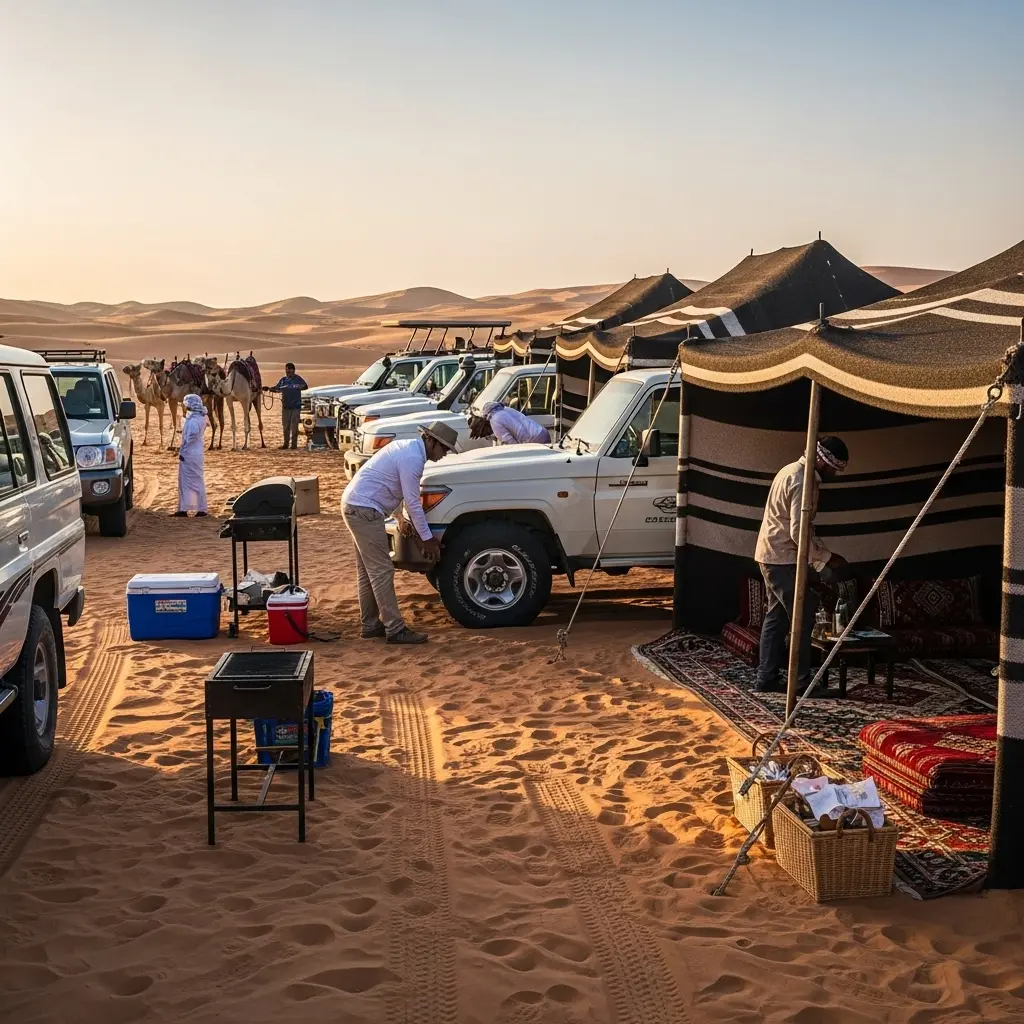
This is the challenge of the desert camp.
Supplying the camp is a logistical nightmare.
Water tankers must drive through the sand daily.
Generators need fuel constantly.
Fresh food must be transported in refrigerated trucks.
The cold chain cannot be broken.
If the ice melts, the food spoils.
Food poisoning is a business-killer.
So, the logistics managers watch the clock.
They time the deliveries perfectly.
This is one of the hidden Desert Safari Operation Secrets.
Every grain of rice is transported with effort.
Every piece of charcoal for the BBQ has a travel cost.
Waste management is equally hard.
What comes in must go out.
You cannot leave trash in the desert.
Sewage tanks must be pumped and hauled away.
It is a constant cycle of bringing and taking.
It happens while you are enjoying the belly dance.
You do not see the trucks behind the dunes.
But they are there, working non-stop.
The Communications Network
Cell service is spotty in the deep desert.
Yet, constant communication is needed.
Convoys must stay together.
The lead driver must talk to the sweeper driver.
They use long-range radios.
They have their own coded language.
They warn each other of “witch’s eyes” in the sand.
These are deep holes that can flip a car.
The Desert Safari Operation Secrets involve high-tech comms.
Base camp tracks every vehicle via GPS.
They know if a car stops for too long.
They know if a car goes off course.
It is like air traffic control.
If a storm rolls in, they coordinate an evacuation.
They monitor weather radars constantly.
Sandstorms can appear in minutes.
Visibility drops to zero.
The team must know exactly where to go.
They rely on compasses and GPS coordinates.
This digital safety net is invisible to the guest.
But it is always active.
The Permitting and Legal Labyrinth
Running a safari is a bureaucratic heavy lift.
The government regulates everything.
And they should.
Safety standards are strict.
Every modification to a car must be approved.
Roll cages must meet specific standards.
Seat belts are inspected.
Insurance premiums are massive.
Liability coverage is a huge expense.
One of the dull but real Desert Safari Operation Secrets is paperwork.
Operators deal with tourism boards daily.
They undergo surprise inspections.
If a camp kitchen is dirty, they get shut down.
If a driver is rude, they get fined.
Companies like https://royaldesertadventures.ae/ have compliance officers.
Their whole job is to follow the rules.
They track visa renewals for staff.
They track vehicle registration expirations.
It is a mountain of admin work.
It ensures that the industry remains reputable.
Illegal operators are chased out.
Only the professional survive the red tape.
The Science of Tire Pressure
We mentioned tires before.
But the science deserves its own section.
It is the single most important technical detail.
Deflating tires increases surface area.
It allows the car to float on sand.
But how much to deflate?
Too much, and the tire pops off the rim.
Too little, and the car sinks.
It changes with the temperature.
Hot sand is softer than cold sand.
Morning pressure is different from afternoon pressure.
This is one of the nuanced Desert Safari Operation Secrets.
Drivers carry precision gauges.
They also carry heavy-duty compressors.
Re-inflating tires takes time.
They have to do it quickly to get back on the road.
Compressors get hot and can burn out.
Managing these machines is a daily chore.
A blown compressor means a slow drive home.
It delays the whole convoy.
So, backup systems are always in place.
Guest Management and Psychology
Tourists come from everywhere.
They speak different languages.
They have different expectations.
Some want extreme thrills.
Others are terrified.
The guide must read the room immediately.
He has to balance the adrenaline junkies with the nervous families.
He has to be a diplomat.
If one person feels sick, the whole car stops.
Dealing with motion sickness is routine.
The Desert Safari Operation Secrets include carrying “sickness bags”.
It includes knowing which dunes are smoother.
If a guest is scared, the driver changes his line.
He takes the easy route.
He does this without making the guest feel embarrassed.
Then there are the VIPs.
They demand private setups.
They want champagne in the desert.
Meeting these requests requires extra staff.
It requires separate supply runs.
Customer service in the desert is high stakes.
If things go wrong, there is no manager nearby.
The driver is the manager.
He has to solve the problem on the spot.
The Environmental Responsibility
The desert is fragile.
It looks tough, but it is delicate.
Trash stays forever in the sand.
Plastic kills camels.
Responsible operators are obsessed with cleanup.
They employ teams just to pick up litter.
They sweep the camp area every morning.
They rake the sand to make it look pristine.
The Desert Safari Operation Secrets involve conservation.
They avoid nesting areas of birds.
They stay away from gazelle habitats.
Government rangers patrol the zones.
Fines for environmental damage are huge.
Companies like https://saharadesertsafaridubai.com/ know this well.
They train their staff to be eco-warriors.
They use biodegradable plates where possible.
They limit water waste.
Sustainability is becoming a major focus.
Solar lights are replacing diesel generators.
Electric SUVs are being tested.
The industry is trying to turn green.
It is a slow process, but it is happening.
The Kitchen in the Sand
Cooking for 500 people is hard.
Cooking for 500 people in a sandstorm is harder.
The camp kitchen is a fortress.
It is sealed against dust.
Hygiene is the top priority.
Flies are a constant enemy.
The staff uses air curtains and traps.
Food must be kept at the right temperature.
In 40-degree heat, this is a challenge.
Buffet management is an art.
Food cannot sit out for too long.
It is replenished constantly in small batches.
This reduces waste and ensures safety.
One of the tasty Desert Safari Operation Secrets is the menu planning.
They choose foods that hold up well in heat.
Grilled meats are perfect.
Salads are kept on ice beds.
The chefs work in extreme conditions.
It is hot outside and hotter inside the kitchen.
They are the unsung heroes of the evening.
They produce hotel-quality food in a tent.
Security and Crowd Control
A large camp can hold hundreds of people.
Crowd control is essential.
You need to move people from camels to tables.
You need to get them to the show area.
It has to flow smoothly.
Security guards are present but discreet.
They watch for trouble.
They ensure no one wanders off into the dark.
Getting lost in the desert at night is dangerous.
The temperature drops rapidly.
Scorpions and snakes come out.
The perimeter is monitored.
The Desert Safari Operation Secrets include headcounts.
No car leaves until everyone is accounted for.
If a guest is missing, a search begins immediately.
They have protocols for lost guests.
They use lights and sirens.
Thankfully, it rarely happens.
But the plan is always there.
The Economics of a Safari Ticket
Where does your money go?
Competition is fierce in Dubai.
Ticket prices are often low.
Margins are thin.
Fuel takes a huge chunk of the revenue.
A Land Cruiser drinks petrol in the sand.
Vehicle depreciation is rapid.
A car lasts only a few years in this business.
Then there is the marketing cost.
Sites like https://dubaidesertsafarie.com/ help drive traffic.
But commissions must be paid.
Staff salaries, visa costs, and housing add up.
The Desert Safari Operation Secrets involve volume.
To make a profit, you need full cars.
Empty seats are losses.
Dispatchers work hard to combine groups.
They juggle pickups from different hotels.
Efficiency is the only way to survive.
If a driver takes a long route, it costs money.
Routes are optimized daily.
It is a game of pennies and liters.
The After-Action Review
The work does not end when you go home.
After the guests are dropped off, the team meets.
They discuss the day.
Did a car have a mechanical issue?
Was a guest unhappy with the food?
Was the entertainment on time?
These debriefs are crucial.
They identify weak points.
If a specific dune caused problems, they avoid it tomorrow.
If a supplier delivered late, they are called.
Continuous improvement is the goal.
The Desert Safari Operation Secrets are about learning.
Every day provides new data.
The desert changes every day.
The wind shifts the dunes.
The team adapts constantly.
This adaptability is what makes a company successful.
Why We Do It
It sounds like a lot of trouble.
Why do operators do it?
Because there is nothing like the desert.
Sharing this landscape is a privilege.
Seeing a guest see the Milky Way for the first time is rewarding.
The challenges make the success sweeter.
It is a lifestyle, not just a job.
The staff form a brotherhood.
They survive the heat together.
They rely on each other for safety.
This bond creates a strong company culture.
It filters down to the guest experience.
When the team is happy, the guest is happy.
Table: The Safari Operations Breakdown
| Department | Key Responsibilities | Major Challenge |
| Fleet | Maintenance, Tire checks, Engine repair | Sand damaging moving parts |
| Logistics | Fuel supply, Food transport, Water | remote location access |
| Safety | Driver training, First Aid, GPS tracking | Unpredictable terrain |
| Camp | Cooking, Cleaning, Entertainment | Heat and dust control |
| Admin | Permits, Insurance, HR | Strict government regulations |
| Sales | Booking, Scheduling, Customer Service | High competition, Thin margins |
The Role of Technology
We touched on GPS.
But tech goes deeper.
Booking systems are complex algorithms.
They assign drivers based on location.
They track dietary requirements.
Automated SMS update guests on pickup times.
Feedback systems collect reviews instantly.
The Desert Safari Operation Secrets are digital too.
Data analysis helps predict peak seasons.
It helps in staffing decisions.
Drones are sometimes used for photography.
They are also used for scouting new routes.
Technology is making the desert smaller.
It is making operations safer.
But it can never replace the human skill.
The computer cannot drive the dune.
Only the human can do that.
Weather Monitoring Protocols
The weather is the boss.
A rainy day can ruin the business.
Rain makes the sand hard.
It becomes dangerous for dune bashing.
It can cause flash floods in wadis.
Operators monitor multiple weather models.
They make the call to cancel early.
Canceling is expensive.
But safety is priceless.
Fog is another hazard.
Early morning safaris are often delayed by fog.
The Desert Safari Operation Secrets involve risk assessment.
Managers are constantly weighing profit vs. safety.
They almost always choose safety.
This builds trust in the market.
If a company runs in bad weather, they look desperate.
Smart companies wait it out.
The Importance of Local Knowledge
You cannot buy experience.
Many drivers are local Bedouins.
Or they have lived here for decades.
They know the stories of the land.
They know the plants.
They can find a scorpion track.
This knowledge adds value to the tour.
It transforms a ride into a lesson.
Guests love these insights.
Operators nurture this knowledge.
They encourage drivers to share stories.
It creates a connection.
It is an intangible asset.
You cannot put it on a balance sheet.
But it is the heart of the experience.
Managing Cultural Sensitivities
Dubai is a melting pot.
But it is also an Islamic country.
Camps must respect local traditions.
During Ramadan, operations change.
No alcohol is served.
No loud music is played.
Entertainment is toned down.
This requires operational shifts.
Staff must be retrained for this month.
Guests must be informed beforehand.
Managing expectations is key.
The Desert Safari Operation Secrets involve cultural IQ.
They navigate these changes smoothly.
They ensure guests still have fun.
But they ensure the law is followed.
It is a delicate balance.
The Future of Desert Operations
What is next?
More automation.
More sustainability.
We might see autonomous buggies.
We will see zero-waste camps.
The government is pushing for this.
Operators are investing now.
Those who adapt will lead.
Those who ignore it will fail.
The Desert Safari Operation Secrets of tomorrow are green.
They are high-tech.
But the soul will remain the same.
The silence of the desert will always be the star.
The operation just helps you get there.
Frequently Asked Questions
1. What are the biggest hidden costs in running a desert safari?
The biggest hidden costs are vehicle maintenance and depreciation. Driving a 4×4 aggressively on sand dunes causes immense wear and tear. Transmissions, suspensions, and engines are under constant stress and fail much faster than in normal road cars. A Land Cruiser that might last 10 years in the city might only last 3 or 4 years in the desert before becoming too expensive to maintain. Additionally, the cost of tires is huge. Frequent deflation and re-inflation, combined with the heat, destroy the rubber sidewalls. Insurance premiums are also extremely high due to the nature of the activity. Liability coverage for off-road driving with passengers is a specialized and costly product.
2. How do operators ensure food safety in the middle of the desert?
Food safety is managed through a rigorous “cold chain” logistics system. Food is prepared in central, hygienic kitchens in the city or industrial areas. It is then transported to the desert camps in refrigerated trucks. The temperature is monitored throughout the journey. Once at the camp, the food is stored in generators-powered coolers until it is time to serve. The buffet counters use ice beds or heating elements to keep the food out of the “danger zone” temperatures where bacteria grow. Staff are trained in hygiene, wearing gloves and hairnets, and regular inspections are conducted by health authorities to ensure compliance.
3. What happens if a car breaks down deep in the desert?
This is a standard scenario that all operators plan for. Safaris always operate in convoys, never single cars. If one vehicle breaks down, the other drivers in the convoy immediately stop to assist. They carry basic tools and spare parts for quick fixes like a loose hose or a flat tire. If the car cannot be fixed on the spot, the passengers are transferred to the empty seats of other cars in the convoy so they can continue their tour without delay. A recovery vehicle, often a heavy-duty truck or tractor stationed at the camp, is then dispatched to tow the broken vehicle out of the dunes to the workshop.
4. How do drivers navigate when there are no roads or signs?
Drivers use a combination of visual landmarks, GPS technology, and deep familiarity with the terrain. Over time, drivers memorize the shape of specific large dunes and rock formations. They also use the position of the sun. However, modern operations rely heavily on GPS coordinates. The lead driver follows a plotted digital route, and the rest of the convoy follows his tracks. In the event of a sandstorm where visibility is zero, the GPS becomes the primary navigation tool to ensure they are heading in the right direction towards the camp or the exit road.
5. Why is tire pressure so critical to the operation?
Tire pressure is the physics that makes the safari possible. Normal road tires are inflated to about 35 PSI. At this pressure, they cut through the sand and the car gets stuck immediately. By deflating them to 12-15 PSI, the tire flattens out. This increases the surface area, acting like a snowshoe. It allows the heavy vehicle to “float” on top of the soft sand. Managing this pressure is a constant operational task. If they go too low, the tire can peel off the metal rim during a sharp turn, which is a dangerous and time-consuming mechanical failure to fix in the heat.
6. How do camps handle sewage and waste without a city grid?
Since desert camps are off the grid, they must be self-contained. Sewage is collected in large underground septic tanks. These tanks are monitored and pumped out regularly by specialized tanker trucks that transport the waste to government treatment facilities in the city. Solid waste and trash are collected in bins. After every safari, a cleanup crew gathers all the trash bags. These are loaded onto trucks and driven out of the desert to proper landfill sites. Leaving waste in the desert is illegal and carries heavy fines, so operators are very strict about this process.
7. What kind of training do safari drivers actually undergo?
Drivers undergo a specialized desert driving course that is distinct from a normal driving license. They learn off-road mechanics, understanding approach and departure angles. They practice emergency maneuvers, such as how to recover from a slide or how to safely crest a blind dune. They also receive training in first aid and customer service. Before they are allowed to drive guests, they often ride along with senior drivers for weeks to observe the routes and techniques. Finally, they must pass a government-administered test to receive their safari driver license, which must be renewed regularly.
8. How do operators manage the extreme heat for staff and guests?
During the summer months, temperatures can exceed 45 degrees Celsius. Operations are often shifted to later in the afternoon when it is cooler. Camps are equipped with large outdoor air coolers (mist fans) that lower the ambient temperature. The main tents are often air-conditioned using powerful diesel generators. For staff, work schedules are adjusted to avoid the peak mid-day sun. Plenty of water and hydration salts are provided. Vehicles are kept running with ACs on max to ensure guests step into a cool environment. It is a battle against the elements that requires constant energy expenditure.
9. Why is the “Focus Keyword” Desert Safari Operation Secrets important for you to know?
Understanding the “Desert Safari Operation Secrets” changes your perspective as a traveler. It moves you from being a passive consumer to an informed guest. You begin to appreciate the skill of your driver not just as a thrill, but as a safety professional. You understand why the tour costs what it does. It helps you identify reputable operators who invest in these hidden systems versus cheap operators who might cut corners on safety or hygiene. It enriches your experience because you see the impressive human logistics required to create your magical evening.
10. How do companies like https://htdesertsafari.com/ handle medical emergencies?
Reputable companies have strict emergency protocols. All drivers are trained in basic First Aid and CPR. First aid kits are mandatory in every vehicle. The camps have a designated first aid room with more advanced supplies. In the event of a serious injury, like a heart attack or a fracture, the convoy leader coordinates with the base. They have direct lines to emergency services. In some cases, if the location is accessible, an ambulance is met at the desert edge. In extreme remote cases, helicopter evacuation can be coordinated with the police, though this is rare.
11. What is the role of the “sweeper” car in a convoy?
The sweeper is the last car in the line. This is usually driven by one of the most experienced drivers. Their job is to ensure that no vehicle is left behind. If a car in the middle gets stuck, the cars ahead might not notice immediately due to the dust. The sweeper sees everything. They are the ones who stop to help the stuck vehicle. They carry extra recovery gear like heavy-duty straps and shovels. They communicate with the lead driver to slow down the front of the pack until the issue is resolved. They are the safety net of the convoy.
12. How do they deal with sudden sandstorms?
Sandstorms are a major operational risk. If a storm is forecasted, the safari is usually canceled proactively. If a storm hits while the tour is active, the standard procedure is to stop the dune bashing immediately. High-speed driving in low visibility is deadly. The convoy will move slowly to the nearest tarmac road or the camp, whichever is safer. Drivers use their hazard lights and GPS. At the camp, guests are moved inside the main tents to protect them from the blowing sand. Operations prioritize getting guests out of the desert safely rather than finishing the entertainment program.
13. How does the internal link https://royaldesertadventures.ae/ relate to this topic?
This link represents one of the players in the market that likely adheres to these operational standards. By referencing established websites, we acknowledge that these are real businesses facing these real challenges. It provides a reference point for users to explore a company that manages these logistics daily. It connects the theoretical knowledge of “secrets” to a practical entity where you can book a service. It serves as an example of a digitized front-end for the complex back-end operations we are discussing.
14. What are the legal requirements for a desert camp?
A desert camp needs multiple permits. They need a land lease from the municipality. They need approvals from the tourism authority, the civil defense (fire safety), and the food control authority. The structures must be inspected for stability. Fire extinguishers must be present and tagged. Emergency exits must be clearly marked. Alcohol licenses are separate and require strict adherence to serving hours and zones. It is a highly regulated environment, and maintaining these licenses requires a dedicated administrative team to ensure no lapses occur that could close the business.
15. How is water managed in the desert camps?
Water is brought in via tankers. There are large storage tanks hidden behind the camp structures. These tanks feed the taps in the washrooms and the kitchen. Since water is expensive to transport, conservation is key. Taps are often push-button to prevent them from being left running. Wastewater (greywater) is sometimes treated and used to water the few decorative plants around the camp, although most sewage is hauled away. Staff are trained to use water sparingly during cleaning. It is a finite resource in the camp, and running out during an event is a major operational failure.
16. Do safari operators own their cars or lease them?
Most large, established operators own their fleet. This allows them to control the maintenance quality. If you lease, you might not know the history of the car. However, during peak seasons like New Year’s Eve, demand exceeds fleet capacity. In these times, operators sub-contract freelance drivers who own their own cars. These freelancers must still meet the company’s safety standards and their cars are inspected before they are allowed to join the convoy. Owning the fleet is capital intensive but offers better quality control and higher margins in the long run.
17. How has digital marketing changed the safari operation?
Digital marketing has shifted the power dynamic. In the past, operators relied on hotel concierges to sell tickets (and paid them huge commissions). Now, they can go direct to consumer via Google and social media. This has improved their margins. However, it has also increased operational pressure because reviews are instant. A bad experience is tweeted immediately. This forces operations to be sharper. It also requires a digital team to manage bookings that come in 24/7 from all over the world, requiring automated confirmation systems and real-time inventory management.
18. Why do we need to focus on “Desert Safari Operation Secrets” for SEO?
From an SEO perspective, this keyword targets a niche audience looking for depth. Most content is surface-level “fun things to do.” By writing about “Operation Secrets,” we attract users who are researching safety, quality, and business logistics. It signals to search engines that this content provides unique value and authority on the topic. It moves away from generic keywords that are too competitive. It helps position the blog as an expert resource, not just a sales brochure. It builds topical authority for the website hosting the blog.
19. What is the environmental impact of dune bashing?
Dune bashing does disturb the sand and can affect small reptiles and insects. It also creates noise pollution. To mitigate this, government authorities have designated specific “zones” for driving. Large areas of the desert are protected reserves where no driving is allowed. This zoning strategy contains the impact to specific playgrounds while leaving the majority of the ecosystem untouched. Responsible operators respect these boundaries strictly. Breaking these boundaries can result in the confiscation of the vehicle and banning of the driver.
20. How can I verify if an operator follows these safety secrets?
You can verify by looking for their license number on their website. You can check reviews specifically mentioning safety and car condition. When you are picked up, look at the car. Is it clean? Are the seatbelts working? Does the car have a roll cage? You can ask the driver about his experience. A professional driver will be happy to tell you about his training. You can also look for badges or certifications on their uniforms. Trust your gut; if the operation feels chaotic and unsafe, it probably is. Stick to reputable names like https://saharadesertsafaridubai.com/ for peace of mind.