
Table of Contents
Desert Safari Tire Tech and the Science of Moving Through Sand
Desert Safari Tire Tech is the most underrated aspect of every high-adrenaline trip into the Arabian dunes. When most passengers climb into a luxury 4×4, they focus on the leather seats or the powerful engine roar. However, the true hero of the journey is the four patches of rubber that keep the vehicle moving across the shifting silk of the desert.
The Arabian desert presents a unique mechanical challenge. Unlike mud, which is often sticky, or rocks, which provide high friction, sand is a fluid-like solid. It behaves differently depending on the moisture content and the wind. To master this, engineers and tour operators rely on highly specialized Desert Safari Tire Tech to prevent sinking and maintain forward momentum.
In this deep dive, we will explore the intricate world of tire compounds, tread patterns, and the critical physics of deflation. Understanding these elements transforms your perspective on how these massive vehicles manage to “float” on surfaces that would swallow a standard car whole.
The Principle of Flotation in Sand Environments
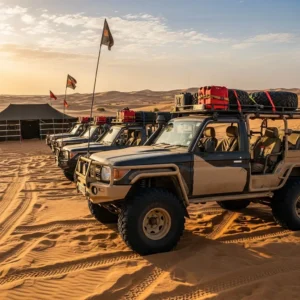
The core of Desert Safari Tire Tech is the concept of flotation. On a paved road, tires are designed to have a small contact patch to reduce rolling resistance and improve fuel economy. In the desert, a small contact patch is a recipe for disaster. It exerts too much pressure on the sand, causing the tire to dig in and the vehicle to bottom out.
By using specific tire designs, engineers aim to spread the vehicle’s weight over the largest possible area. This is why wide-body SUVs are the preferred choice for safari operators. A wider tire naturally offers a larger footprint, which allows the vehicle to stay on the surface of the dunes rather than cutting through them.
For those interested in the vehicles used in these tours, https://htdesertsafari.com/ offers a look at how professional fleets are managed. The tech involved here isn’t just about the rubber itself but how that rubber interacts with the granular structure of the Arabian sand particles.
Managing PSI and the Art of Deflation
No discussion on Desert Safari Tire Tech is complete without mentioning tire pressure. Under normal conditions, a Toyota Land Cruiser or Nissan Patrol runs at about 30 to 35 PSI. Before a single dune is climbed, the driver will manually deflate these tires to between 12 and 18 PSI.
This drastic reduction in pressure allows the tire sidewalls to bulge outward. The result is a contact patch that is significantly longer and wider. It effectively turns the tire into a mini-caterpillar track. This increased surface area is the primary reason why Desert Safari Tire Tech works so effectively in soft, “sugar” sand.
However, running low pressure comes with risks. If the pressure is too low and the driver makes a sharp turn, the tire could unseat from the rim. This is why experienced guides must find the perfect balance between traction and safety.
The Evolution of Tread Patterns for Dunes
You might think that deep, aggressive mud-lugs are best for the desert, but Desert Safari Tire Tech actually favors a more balanced approach. Extremely aggressive tread can sometimes act like a shovel, digging a hole faster than it can provide forward grip.
Many professional operators prefer All-Terrain (AT) tires over Mud-Terrain (MT) tires. The AT patterns provide a smoother surface that packs the sand slightly rather than churning it up. The goal is to create friction without destroying the integrity of the sand crust.
| Tire Type | Sand Performance | Durability | Best Use Case |
| All-Terrain | High | Excellent | Daily Safari Tours |
| Mud-Terrain | Medium | High | Rugged Rocky Trails |
| Sand Paddles | Maximum | Low | Dedicated Dune Drag Racing |
| Highway Terrain | Poor | Low | Paved Roads Only |
Heat Dissipation in High-Temperature Rubber
The UAE desert can reach temperatures well above 40 degrees Celsius. When you add the friction of tires spinning in the sand, the rubber can become incredibly hot. Desert Safari Tire Tech involves the use of heat-resistant compounds that don’t become too soft when the mercury rises.
If a tire compound is too soft, the tread blocks can actually tear off during high-speed dune bashing. Manufacturers specifically test their tires in the Middle East to ensure the “vulcanization” process holds up under extreme thermal stress. This is a critical safety factor when you are kilometers away from the nearest service station.
External resources like https://dubaidesertsafarie.com/ and https://royaldesertadventures.ae/ often showcase the types of vehicles that utilize these high-performance tires. Without these thermal-resistant properties, a tire could suffer a “de-lamination” failure, where the tread separates from the internal steel belts.
Beadlock Wheels and Lateral Stability
In the higher tiers of Desert Safari Tire Tech, you will often see “Beadlock” wheels. These are not just for looks. A beadlock wheel features an outer ring that is bolted directly to the rim, clamping the tire bead in place.
This allows a driver to run extremely low pressures—sometimes as low as 5 PSI—without any fear of the tire popping off the rim. During high-speed “side-sloping,” where the vehicle is driving horizontally across the face of a steep dune, the lateral forces on the tires are immense.
Beadlocks provide the mechanical security needed to perform these maneuvers safely. While common in private off-road builds, they are increasingly becoming a staple in premium safari tours offered by companies like https://saharadesertsafaridubai.com. They represent the peak of desert-specific wheel engineering.
Sidewall Reinforcement and Puncture Resistance
The desert isn’t just sand; it’s also home to sharp rocks, dry shrubs, and hidden debris. Desert Safari Tire Tech requires tires with “3-ply” sidewalls. These reinforced layers protect the tire from being punctured when compressed against a hard object at low pressure.
When a tire is deflated, the sidewall is more exposed and vulnerable. A standard passenger car tire has a thin sidewall that would easily slice open in the desert. Professional safari tires use high-tensile cords and thicker rubber layers to ensure that a stray rock doesn’t end the tour prematurely.
Furthermore, the “shoulder” of the tire—the area between the tread and the sidewall—often has its own small tread blocks. This provides extra “bite” when the tire is submerged in deep sand, helping the vehicle climb out of ruts.
The Role of Weight Distribution and Tire Size
Larger tires are a staple of Desert Safari Tire Tech. By increasing the overall diameter of the tire, you increase the ground clearance of the vehicle. This prevents the “belly” of the 4×4 from scraping against the crest of a dune, a situation known as high-centering.
33-inch Tires: The standard for most modified safari SUVs.
35-inch Tires: Used for more extreme, deep-desert expeditions.
37-inch Tires: Reserved for specialized “monster” dune buggies.
However, larger tires also put more strain on the vehicle’s drivetrain and brakes. Professional mechanics at places like https://royaldesertadventures.ae/ must re-gear the differentials to compensate for the larger rolling diameter. This ensures the engine stays in its “power band” while navigating steep inclines.
Sand Tires vs. Conventional Off-Road Rubber
There is a common misconception that all off-road tires are the same. Desert Safari Tire Tech proves otherwise. A tire designed for the wet, muddy trails of Europe will perform poorly in the dry, powdery sands of the Rub’ al Khali.
True sand tires often have a more rounded profile. This helps the tire “roll” over the sand particles rather than pushing a wave of sand in front of the tire. This reduced rolling resistance is crucial for maintaining the momentum needed to crest massive 50-meter dunes.
In some extreme cases, “sand paddles” are used. These are tires with large rubber vanes that act like the paddles on a steamboat. While incredible for sand, they are illegal on roads because they offer almost no grip on asphalt and can damage the road surface.
Maintenance and the Life Cycle of Safari Tires
The life of a tire in a professional fleet is short. Between the extreme heat, the constant deflation/inflation cycles, and the abrasive nature of sand, Desert Safari Tire Tech components must be replaced frequently.
Operators must inspect tires daily for “dry rot”—cracks in the rubber caused by intense UV exposure. They also check for sand ingress between the tire bead and the rim, which can cause slow leaks. A tire that fails in the middle of a dune bash isn’t just a nuisance; it’s a significant safety risk.
The abrasive sand also wears down the tread much faster than asphalt. While a road tire might last 50,000 kilometers, a safari tire might be retired after just 15,000 kilometers of hard dune use. This is a significant operational cost that ensures passenger safety is never compromised.
The Future of Desert Safari Tire Tech
As we look toward the future, Desert Safari Tire Tech is becoming more intelligent. Some modern vehicles are equipped with Central Tire Inflation Systems (CTIS). This allows the driver to change tire pressure from inside the cabin with the press of a button.
While currently expensive and heavy, CTIS technology is the “holy grail” for desert exploration. It allows for instant transitions between road and sand. Additionally, manufacturers are experimenting with “non-pneumatic” or airless tires that cannot be punctured and don’t require pressure management.
These innovations will continue to push the boundaries of where we can go in the desert. The Arabian sands are a testing ground for some of the most rugged automotive technology on the planet, and tires will always be at the forefront of that evolution.
Why Quality Rubber Matters for Your Experience
When you book a tour, you are trusting the Desert Safari Tire Tech to keep you safe. A vehicle with cheap, worn-out tires is more likely to get stuck, which can turn a fun afternoon into a frustrating multi-hour recovery mission in the heat.
Reputable companies invest heavily in premium brands like BFGoodrich, Cooper, or Mickey Thompson. These brands have decades of off-road racing heritage and have perfected the art of desert traction. It is this investment in quality that allows the drivers to perform those gravity-defying slides with total confidence.
Always look for vehicles that appear well-maintained. The condition of the tires is usually a very good indicator of the overall safety standards of the tour operator. A clean, properly inflated (or correctly deflated) tire shows that the guide understands the science of their craft.
Sand Textures and Tire Interaction
Not all sand is the same, and Desert Safari Tire Tech must adapt. The “Red Dunes” of Lahbab are known for being very fine and soft. This requires lower pressures and a very gentle throttle foot. In contrast, the coastal sands near the sea are often firmer and saltier.
A local guide knows how to “read” the sand by its color and the way the wind ripples across the surface. They know that after a rare rainstorm, the sand becomes heavy and “sticky,” providing incredible grip. Conversely, during a heatwave, the sand loses all its moisture and becomes “liquid,” making it much harder to traverse.
The tire’s ability to “self-clean”—ejecting sand from the tread as it spins—is vital in these changing conditions. If the tread becomes packed with sand, it effectively becomes a slick tire, losing all traction. The design of the grooves in Desert Safari Tire Tech ensures that centrifugal force keeps the rubber clean.
The Impact of Wheel Offset and Width
Beyond the tire itself, the “offset” of the wheel plays a role in Desert Safari Tire Tech. A wheel with a negative offset pushes the tires further out from the body of the car. This creates a wider “track width,” which significantly improves the lateral stability of the SUV.
When a vehicle is leaning at a 30-degree angle on a dune, a wider track prevents it from tipping over. This wider stance also allows for larger tires to be fitted without them rubbing against the internal wheel arches or suspension components during deep compression.
However, this puts extra stress on the wheel bearings. Professional fleets at https://htdesertsafari.com/ have to replace these bearings more often to ensure the wheels don’t seize up. It is a constant trade-off between the performance gains of a wide stance and the mechanical wear on the chassis.
Environmental Considerations for Tire Choice
There is a growing movement in Desert Safari Tire Tech to consider the environmental impact. Aggressive tires can “scar” the desert floor, destroying the fragile microbial crust that prevents dust storms.
Modern “Eco-friendly” off-road tires are being developed with sustainable rubber sources and designs that minimize soil disturbance. By using tires that stay on top of the sand rather than digging in, safari operators can reduce their impact on the desert ecosystem.
Responsible tourism also means ensuring that old, retired tires are recycled properly rather than being dumped in the desert. Many UAE-based companies are now participating in “circular economy” initiatives to turn old safari tires into rubber flooring for playgrounds or recycled asphalt for roads.
Comparing Global Sand Tech vs. Dubai Standards
While Australia and the USA have huge off-road cultures, Desert Safari Tire Tech in Dubai is unique because of the specific “bowl” dunes found here. In Australia, the dunes are often long, straight ridges. In Dubai, the dunes are circular and unpredictable.
This requires a tire that can handle “multi-directional” stress. You aren’t just driving straight; you are constantly turning, climbing, and descending simultaneously. The sheer height of the dunes in the UAE also means the tires are under load for much longer periods than in other parts of the world.
This has led to the UAE becoming a global hub for desert vehicle testing. If a tire can survive a summer season in the Dubai dunes, it can survive anywhere. Manufacturers often send prototype Desert Safari Tire Tech here for “torture testing” before they are released to the global market.
Conclusion: The Foundation of Every Safari
Ultimately, Desert Safari Tire Tech is the foundation upon which every desert adventure is built. It is the silent science that enables the thrills we all love. From the moment the driver lets the air out of the valves to the moment they are re-inflated at the end of the day, the tires are working at their absolute limit.
The combination of pressure management, heat resistance, and structural reinforcement makes these tires some of the most specialized pieces of equipment in the automotive world. They turn a heavy, lumbering SUV into a nimble desert dancer.
So, the next time you feel the vehicle “float” over a massive sand wall, remember the engineering beneath you. It is the result of years of refinement and a deep understanding of the Arabian sands. With the right tires, the desert isn’t an obstacle; it’s a playground.
Frequently Asked Questions
Why do you have to deflate tires for a desert safari?
Deflating tires increases the surface area of the rubber touching the sand. This “flotation” prevents the vehicle from sinking and provides much better traction in soft dunes.
What is the best tire pressure for sand driving?
For most 4×4 vehicles, a pressure between 12 and 18 PSI is ideal. For extremely soft sand or recovery situations, some drivers go as low as 8-10 PSI.
Can I use normal road tires for a desert safari?
No. Road tires have thin sidewalls and tread patterns that are not designed for sand. They are much more likely to get stuck or suffer a puncture from desert debris.
What are beadlock wheels and why are they used?
Beadlock wheels mechanically clamp the tire to the rim. This allows the vehicle to run very low tire pressures without the risk of the tire popping off during sharp turns.
How long do tires last on a professional desert safari vehicle?
Due to the extreme heat and abrasive sand, tires on professional vehicles usually last between 15,000 and 20,000 kilometers, much less than on a standard car.
Are wide tires better than thin tires in the sand?
Yes. Wider tires provide a larger footprint, which is essential for “floating” on top of the sand rather than digging in.
What is “high-centering” and how do tires prevent it?
High-centering is when the middle of the car gets stuck on a dune peak. Larger tires provide more ground clearance, which helps prevent the vehicle’s underbody from touching the sand.
How do drivers re-inflate their tires after the safari?
Professional guides carry portable air compressors or use “air stations” located at the edge of the desert to bring the tires back up to road-safe pressures.
Is it dangerous to drive on the road with deflated tires?
Yes. Deflated tires have very poor handling on asphalt and will overheat quickly at high speeds, which can lead to a blowout. Always re-inflate before hitting the highway.
Do different types of sand require different tire tech?
Yes. Soft, fine sand requires lower pressures and “flotation” tires, while firmer, wet sand provides more grip and can be handled with slightly higher pressures.
What is the “sidewall” of a tire and why is it important in the desert?
The sidewall is the side of the tire. In the desert, tires need reinforced “3-ply” sidewalls to prevent punctures from rocks and shrubs when the tire is compressed at low pressure.
What brands of tires are best for a desert safari?
Brands like BFGoodrich, Mickey Thompson, and Cooper are highly regarded for their off-road performance and durability in desert conditions.
Can I drive on sand in 2WD if I have good tires?
It is extremely difficult. Even with the best tires, 4WD is essential for sand driving because it distributes the power to all four wheels, reducing the chance of any single wheel spinning and digging in.
What is a “sand paddle” tire?
A sand paddle is a specialized tire with large rubber vanes. It provides massive traction in the sand but cannot be used on paved roads.
How does heat affect tires in the desert?
Extreme heat makes the rubber softer and more prone to damage. Desert Safari Tire Tech uses special compounds that can withstand the thermal stress of hot sand and friction.
What should I do if my tire pops off the rim in the desert?
You will need a jack, a high-capacity air compressor, and sometimes a “starting fluid” trick to reseat the bead, though this should only be done by professionals.
Why do some safari vehicles have two spare tires?
In deep desert expeditions, the risk of multiple punctures is high. Carrying two spares ensures the group isn’t stranded if they encounter a patch of sharp rocks.
Does tire size affect fuel consumption?
Yes. Larger, wider tires create more rolling resistance and weight, which increases the amount of fuel the engine needs to move the vehicle.
What is an All-Terrain tire?
An All-Terrain (AT) tire is designed to perform well both on-road and off-road. It is the most common choice for desert safari fleets in Dubai.
Can I use a pressure gauge to check my tires in the desert?
Yes, every off-road driver should carry a reliable low-pressure tire gauge to ensure their PSI is exactly where it needs to be for the current sand conditions.
Exploring the dunes is a masterpiece of engineering and skill. The Desert Safari Tire Tech that makes it possible is a fascinating blend of physics and practical experience. Next time you see those tracks in the sand, you’ll know exactly what went into making them.
The desert is a beautiful but demanding teacher. By respecting the technology and the environment, we can enjoy its wonders for years to come. Whether you are a casual tourist or a hardcore off-roader, the rubber on your wheels is your most important connection to the Arabian heartland.
Always prioritize safety and quality when choosing your desert adventure. The right tech doesn’t just make the ride better; it makes it possible. Enjoy the dunes, trust the tires, and embrace the spirit of discovery that defines the UAE.
Would you like me to create a comparison of the top 5 tire brands used specifically by Dubai safari operators?