Table of Contents
Desert Animal Survival 15 Amazing Ways Species Beat The Heat
The sun is a relentless enemy.
In the deep desert, it does not negotiate.
Temperatures can soar above 50 degrees Celsius.
The sand becomes hot enough to cook an egg.
Water is nonexistent for miles.
Yet, look closely.
The desert is alive.
It is teeming with creatures.
They are not just surviving.
They are thriving.
Desert Animal Survival is one of the greatest stories of evolution.
It is a masterclass in biological engineering.
How do they do it?
How does a fox live without water?
How does a lizard run on burning sand?
The answers are hidden in their genes.
They are hidden in their behaviors.
We are going to dissect these strategies.
We will look at the kidneys, the ears, and the blood.
We will uncover the secrets of life in the furnace.
The Strategy of Avoidance
The best way to beat the heat is to hide from it.
The sun cannot kill what it cannot find.
This is the first rule of Desert Animal Survival.
Most desert animals are nocturnal.
They sleep during the day.
They wake up when the sun goes down.
The temperature difference is massive.
At noon, it might be 45°C.
At midnight, it might be 20°C.
By shifting their schedule, they avoid the thermal stress.
Jerboas are a perfect example.
These small rodents stay underground.
Their burrows are deep.
The temperature underground is stable.
It stays cool even when the surface is scorching.
They plug the entrance with sand.
This keeps the hot air out.
It keeps the moisture in.
They only emerge when the stars are out.
This is behavioral adaptation.
It requires no special organs.
It just requires a change in clock.
Scorpions do the same.
They hide under rocks.
They hide in crevices.
They wait for the cool darkness to hunt.
This simple switch saves their lives.
It preserves their water.
It is the foundation of the desert ecosystem.
The Engineering of the Camel
The camel is the icon of the desert.
But do you know how it actually works?
It is a walking biological machine.
Its hump is not water.
It is fat.
Storing fat in one place is brilliant.
If fat was spread over the body, it would trap heat.
Like a winter coat.
By concentrating it on the back, the rest of the body is lean.
This helps heat escape.
Desert Animal Survival often involves heat management.
The camel can let its body temperature rise.
Most mammals keep a steady temperature.
If we get too hot, we sweat.
Sweating loses water.
The camel lets its temperature go up to 41°C during the day.
It stores the heat in its body.
Then, at night, it releases it.
This means it does not need to sweat.
It saves gallons of water this way.
Its nose is also a marvel.
It has a counter-current heat exchanger.
When it breathes out, it cools the air.
It traps the moisture in its nose.
The water drips back into its throat.
It recycles its own breath.
This is extreme efficiency.
The Ears of the Fennec Fox
The Fennec Fox is tiny.
But its ears are huge.
They are 6 inches long.
This is not just for hearing.
They are radiators.
Blood vessels run close to the skin in the ears.
As the blood circulates, heat is released into the air.
This cools the blood.
The cool blood goes back to the body.
It acts like an air conditioning system.
This is a structural adaptation for Desert Animal Survival.
Elephants use the same trick.
But the Fennec Fox does it in a tiny package.
It also has fur on its paws.
Most dogs have bare pads.
The sand would burn bare pads.
The fur acts as a shoe.
It allows the fox to run on hot dunes.
It also provides traction.
Without this fur, the fox would be stuck.
It would burn its feet and die.
Every inch of this animal is designed for the environment.
The Water Independent Oryx
The Arabian Oryx is a legend.
It is the unicorn of the desert.
It is a large antelope.
It lives in the open.
It cannot hide in a burrow.
So, how does it drink?
It often doesn’t.
It gets water from food.
It eats grasses and bulbs.
It grazes at night when plants have dew on them.
The dew increases the water content of the plant.
This is a critical tactic for Desert Animal Survival.
The Oryx kidneys are super-efficient.
They filter the blood aggressively.
They reabsorb almost every drop of water.
Their urine is highly concentrated.
It is thick and syrupy.
Their feces are dry pellets.
They waste nothing.
They can go weeks without a drink.
They can sense rain from miles away.
They will migrate to find fresh grass.
They follow the storms.
They are nomadic survivalists.
The Reptilian Armor
Lizards and snakes are built for heat.
Their skin is key.
Mammals have porous skin.
We lose water through it constantly.
Reptiles have scales.
Scales are made of keratin.
They are waterproof.
They seal the moisture inside the body.
This is why you see so many reptiles in the desert.
Their armor is perfect for Desert Animal Survival.
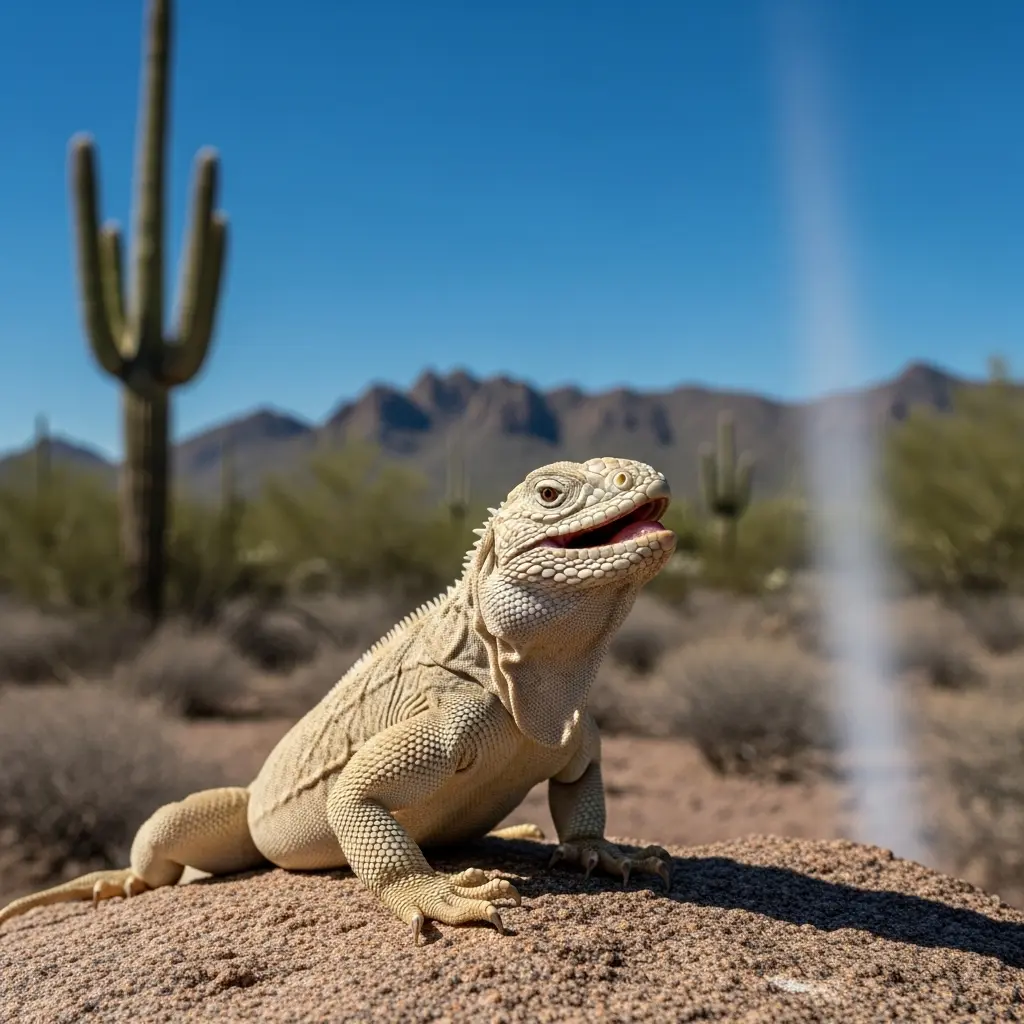
The Spiny-Tailed Lizard (Dhub) is a local expert.
It is cold-blooded.
This means it uses the sun to warm up.
But it has to be careful.
If it gets too hot, it dies.
So it engages in “shuttling.”
It runs into the sun to warm up.
Then it runs into the shade to cool down.
It dances back and forth all day.
It maintains its temperature manually.
It changes its color too.
In the morning, it is dark.
Dark colors absorb heat.
At noon, it turns pale.
Pale colors reflect heat.
It is a living solar panel.
The Insect Exoskeleton
Insects are small.
Small things dry out fast.
They have a large surface area compared to their volume.
This is a risk.
But insects have an exoskeleton.
It is a hard shell.
It is coated in wax.
This wax layer is the secret.
It makes them watertight.
The Darkling Beetle is a genius of Desert Animal Survival.
It lives in the Namib, but similar species are in Dubai.
It collects water from fog.
It stands on its head on a dune.
It faces the wind.
Mist condenses on its back.
Water droplets form.
They roll down grooves in its shell.
They roll right into its mouth.
It drinks the air.
This behavior allows it to live where there is no rain.
It turns the morning humidity into life.
Scorpions also have this waxy coating.
They can lose less than 0.01% of their water per hour.
They are sealed units.
Metabolic Water Production
Some animals make their own water.
This sounds like magic.
It is chemistry.
When the body breaks down carbohydrates, water is a byproduct.
This is called metabolic water.
The Jerboa relies on this.
It eats dry seeds.
The seeds have almost no water.
But when it digests the starch, it creates water molecules.
For every gram of starch, it gets 0.6 grams of water.
This is enough to survive.
Desert Animal Survival depends on this chemical reaction.
They literally eat dry food to get a drink.
Kangaroo rats in America do this too.
They can live their whole life without ever seeing a puddle.
Their entire hydration comes from digestion.
It is the ultimate independence.
They are not tethered to a water hole.
They are free to roam the driest sands.
The Sandfish Skink
This lizard is a submarine.
It swims through the sand.
Its skin is polished smooth.
Friction creates heat.
By being smooth, it reduces friction.
It moves effortlessly.
It dives to escape the surface heat.
Under the sand, it is cooler.
Its eyes are protected.
It has clear scales over its eyes.
Like goggles.
Its nostrils are small slits.
This prevents sand from entering its lungs.
Desert Animal Survival requires specialized anatomy.
The Sandfish has fringed toes.
These fringes act like paddles.
They help it push through the loose grains.
It senses vibrations.
If a beetle walks above, it knows.
It bursts from the sand like a shark.
It grabs the prey and dives back down.
It is an ambush predator.
It uses the environment as a cloak.
Bird Adaptations
Birds have a problem.
They fly.
Flying generates huge amounts of heat.
And they are covered in feathers.
Feathers are insulation.
Usually, this keeps them warm.
But in the desert, it keeps the heat out.
Just like Bedouins wear robes.
The feathers trap a layer of air.
This air acts as a buffer against the sun.
But how do they cool down?
They pant.
They flutter their throat muscles.
This is called gular fluttering.
It evaporates water from the throat.
It cools the blood going to the brain.
Desert Animal Survival for birds involves behavioral tricks too.
Sandgrouse are famous.
The male flies to a water hole.
He soaks his belly feathers.
His feathers are like a sponge.
He carries the water back to the nest.
He flies miles with a wet belly.
The chicks drink from his feathers.
It is a water delivery service.
Without this, the chicks would die in the nest.
The Importance of Estivation
Hibernation is sleeping through winter.
Estivation is sleeping through summer.
Some desert animals just check out.
When it gets too hot and dry, they go to sleep.
Desert hedgehogs do this.
Some reptiles do this.
They find a deep, cool burrow.
They slow their heart rate.
They slow their breathing.
Their metabolism drops to almost zero.
They do not eat.
They do not drink.
They wait.
This is a gamble for Desert Animal Survival.
They must have enough fat stored.
If they wake up too early, they starve.
If the rain doesn’t come, they die.
But it is a way to skip the worst months.
It allows them to survive periods that would kill an active animal.
They essentially pause their life.
When the first rain falls, they wake up.
They emerge hungry and ready to breed.
Predator vs. Prey Dynamics
The heat affects the hunters too.
Predators cannot chase for long.
Running generates heat.
If a cheetah runs too long, its brain overheats.
So, desert chases are short.
Ambush is the preferred method.
Vipers bury themselves in the sand.
Only their eyes show.
They wait for a mouse to pass.
Strike.
It takes one second.
This conserves energy.
This conserves water.
Desert Animal Survival is an arms race.
The prey must be alert.
The Hare has huge ears.
It can hear the viper sliding.
It has powerful legs.
It zigzags when it runs.
This forces the predator to work harder.
The predator gives up quickly.
The energy cost is too high.
In the desert, wasting energy is fatal.
Every calorie counts.
Every drop of water counts.
The Role of Coloration
Look at desert animals.
They are all beige.
They are fawn, tan, or white.
This is camouflage.
It helps them hide from predators.
But it is also thermal control.
Light colors reflect sunlight.
Dark colors absorb it.
A black beetle heats up faster than a white one.
However, some desert beetles are black.
Why?
It is a debate in science.
Some say it helps protect against UV rays.
Some say it helps them warm up in the morning.
But for mammals, pale is the rule.
The Arabian Sand Gazelle is almost white in summer.
In winter, it gets darker.
It adjusts its coat for Desert Animal Survival.
Nature is flexible.
It changes the wardrobe with the season.
This helps maintain a stable body temperature.
Thermal Inertia and Size
Size matters.
Large animals heat up slowly.
But they also cool down slowly.
Small animals heat up fast.
But they cool down fast.
A camel is large.
It has high thermal inertia.
It can stand in the sun all day.
It takes a long time for its massive body to heat up.
By the time it is critical, the sun sets.
A lizard is small.
It heats up in minutes.
So it must hide.
Desert Animal Survival strategies depend on your mass.
Large animals must endure.
Small animals must evade.
You rarely see medium-sized animals.
It is a land of giants and dwarfs.
Evolution pushes species to the extremes.
This maximizes their survival chances.
Blood Circulation Tricks
We mentioned the Fennec Fox ears.
But many animals use blood flow.
The legs of birds have a special system.
The arteries and veins run next to each other.
Warm blood from the body warms the cold blood from the feet.
This keeps the feet cold but the core warm.
Or in the desert, vice versa.
Ostriches have naked legs.
They are huge radiators.
They pump blood to their legs to dump heat.
Desert Animal Survival is about plumbing.
The cardiovascular system is a cooling loop.
Some lizards have a “parietal eye.”
It is a third eye on top of their head.
It senses light and heat.
It tells the brain when to seek shade.
It regulates the hormones.
It is a built-in thermometer.
It prevents them from cooking themselves.
Evolution in Action
The desert is not static.
It is getting hotter.
Climate change is pushing the limits.
Animals are evolving fast.
Birds are getting smaller.
Smaller bodies shed heat better.
Some animals are shifting their ranges.
They are moving to higher ground.
Or they are becoming more nocturnal.
Desert Animal Survival is an ongoing test.
Those who cannot adapt will die.
We are seeing natural selection in real-time.
The ones with the best kidneys survive.
The ones with the longest ears survive.
It is a brutal filter.
But it creates incredible species.
Every animal you see in the dunes is a winner.
They are the champions of resilience.
They have beaten the odds.
The Impact of Humans
We change the game.
We bring water.
We plant trees.
This attracts birds that don’t belong here.
Pigeons and Mynas invade.
They compete with local species.
We build fences.
This stops the Oryx from migrating.
We drive cars.
This kills the snakes and lizards.
Desert Animal Survival is now harder because of us.
We disrupt the delicate balance.
Light pollution confuses the nocturnal animals.
They think it is day.
They stay hidden and starve.
Or they get eaten by predators who use the streetlights.
Conservation is vital.
We must protect the habitats.
We must minimize our footprint.
Sites like https://htdesertsafari.com/ educate tourists.
They teach us to respect the residents.
To watch without touching.
To leave no trace.
Conclusion
The desert looks empty.
But it is a crowded house of specialists.
Every grain of sand hides a story of survival.
From the fog-drinking beetle to the heat-storing camel.
Desert Animal Survival is a miracle of adaptation.
It shows that life is stubborn.
It finds a way.
Even in the most hostile place on Earth.
When you visit, look closer.
Don’t just see the view.
See the life.
Respect the struggle.
Understand the science that keeps them alive.
It makes the safari experience so much richer.
You are walking among biological superheroes.
Frequently Asked Questions
1. How do desert animals get water if it never rains?
Many desert animals never drink standing water. They obtain moisture from their food. Herbivores like the Arabian Oryx and gazelles eat grasses and succulents that contain water, especially during the night when dew forms on the leaves. Carnivores like foxes and snakes get water from the blood and tissues of their prey. Rodents like the Jerboa create “metabolic water” as a byproduct of digesting dry seeds. Their bodies are so efficient at recycling this water that they don’t need external sources.
2. Why are most desert animals active at night?
This is the primary strategy for Desert Animal Survival called nocturnality. The temperature difference between day and night in the desert can be over 20 degrees Celsius. By sleeping in deep, cool burrows during the scorching day, animals avoid the risk of overheating and dehydration. They emerge at night when the air is cooler and humidity is slightly higher. This behavioral adaptation allows them to hunt and forage without battling the sun.
3. Do camels store water in their humps?
No, this is a common myth. Camel humps store fat, not water. This fat is an energy reserve that allows them to go for long periods without food. The survival advantage is that by concentrating body fat in one area (the hump), the rest of the body has less insulation. This allows heat to escape more easily from the sides and belly, helping the camel cool down. If the fat were spread out like in humans, the camel would overheat.
4. What is the Fennec Fox’s secret to staying cool?
The Fennec Fox uses its enormous ears as radiators. The ears are packed with blood vessels close to the skin’s surface. As hot blood from the body circulates through the ears, the heat is released into the cooler air. This cooled blood then returns to the core, lowering the animal’s body temperature. Additionally, their large ears provide exceptional hearing, allowing them to locate prey moving underground in the silence of the desert.
5. How do insects survive without drying out?
Insects like the Darkling Beetle and scorpions have a hard exoskeleton coated in a waxy substance. This wax layer makes them waterproof, preventing moisture from evaporating out of their bodies. This is crucial because small animals have a large surface area relative to their volume, making them prone to rapid dehydration. The exoskeleton acts like a sealed suit, locking in their body fluids effectively for Desert Animal Survival.
6. Can desert animals handle getting hot?
Yes, some have evolved “hyperthermia tolerance.” The camel, for example, allows its body temperature to rise to 41°C (106°F) during the day. By letting its body get hot, it avoids the need to sweat to cool down. Sweating loses water. By storing the heat and releasing it at night when the air is cold, the camel saves massive amounts of water. This ability to fluctuate body temperature is rare in mammals.
7. How does the Sandfish Skink move in the sand?
The Sandfish Skink moves by “swimming” rather than walking. It retracts its limbs and wiggles its body in a wave-like motion. Its skin is extremely smooth and polished, which reduces friction against the sand grains. It has specialized fringed toes that help push the sand. It creates a fluid motion that allows it to dive deep quickly to escape predators or surface heat. Its nose is wedge-shaped to slice through the sand effortlessly.
8. What is “Estivation”?
Estivation is similar to hibernation, but it happens in the summer. When the desert gets too hot and dry, some animals, like desert hedgehogs and certain tortoises, enter a state of dormancy. They find a deep burrow, slow down their heart rate and metabolism, and sleep for weeks or months. This allows them to skip the most dangerous time of the year. They wake up only when the conditions improve, usually after a rain.
9. How do birds keep their eggs cool?
Desert birds face a challenge because eggs can cook in the sun. Some birds, like the Sandgrouse, nest in the shade of bushes. But often, the parent bird must shade the eggs with its own body. They stand over the eggs, spreading their wings to create a parasol. They also use “gular fluttering” (panting) to cool themselves down while they perform this duty. If they leave the nest for even a few minutes, the embryos could die from the heat.
10. Why are desert animals usually pale in color?
Pale colors like tan, cream, and white reflect solar radiation. Dark colors absorb it. By having a light coat, desert animals like the Addax or the Sand Cat reduce the amount of heat their bodies absorb from the sun. This thermal regulation helps them stay cooler. It also serves as camouflage, blending them in with the sand and rocks, which protects them from predators or allows them to sneak up on prey.
11. Do desert predators drink water?
Most desert predators like the Sand Cat or Rueppell’s Fox obtain all their hydration from their prey. Fresh meat contains a high percentage of water (about 70%). By eating rodents, birds, and reptiles, they ingest enough fluid to survive. They rarely need to visit a water hole. This independence from standing water allows them to live in the deep desert, far from oases, expanding their territory for Desert Animal Survival.
12. How does the internal link https://royaldesertadventures.ae/ help us learn?
This operator offers nature-focused safaris. Their guides are trained to spot wildlife tracks. Instead of just driving fast, they stop to show you the lizard holes or the fox dens. They explain the ecosystem. By booking with an eco-conscious provider, you get an educational experience. You see the animals discussed in this article in their natural habitat. It turns a fun trip into a learning journey about biology and adaptation.
13. What is unique about the Arabian Oryx’s blood?
The Oryx has a specialized cooling system for its brain called the carotid rete. The arteries carrying hot blood to the brain pass through a network of veins carrying cool blood from the nose. The heat transfers from the arteries to the veins. This cools the arterial blood before it reaches the brain. This ensures that even if the Oryx’s body temperature is dangerously high, its brain remains cool and functional. It is a biological heat exchanger.
14. How do scorpions survive for a year without food?
Scorpions have an incredibly low metabolic rate. They do not burn energy to keep warm (they are cold-blooded). They do not move much unless hunting. This efficiency allows them to survive on very little food. A single meal can sustain them for months. In extreme cases, some desert scorpions can slow their metabolism down so much that they can survive over a year without eating. This is the ultimate adaptation for a place where food is scarce.
15. Why do desert hares have such long legs?
The Cape Hare has very long legs for two reasons. First, it lifts its body higher off the hot ground. The air temperature is cooler a few inches up than it is directly on the sand. Second, the legs act as radiators, similar to the fox’s ears. The large surface area helps dissipate body heat. Speed is also crucial for escaping predators in the open terrain where there are few places to hide.
16. How does https://dubaidesertsafarie.com/ promote conservation?
By promoting the desert as a wildlife destination, they raise awareness. When tourists realize there are rare animals living in the dunes, they are more likely to support conservation efforts. The revenue from tourism gives the land economic value beyond just oil or development. This encourages the government to create protected areas like the Dubai Desert Conservation Reserve, which are vital for the continued Desert Animal Survival of species like the Oryx.
17. What is the “Fog Basking” beetle?
This beetle, found in coastal deserts, uses its body to harvest water from the air. In the early morning, thick fog rolls in. The beetle climbs to the top of a dune and does a “headstand.” Its back is textured with hydrophilic (water-loving) bumps. The fog condenses on these bumps into droplets. When the droplet gets heavy enough, it rolls down a hydrophobic (water-repelling) trough straight into the beetle’s mouth. It is high-tech surface engineering.
18. How do desert plants help animals survive?
Plants are the foundation. They provide shade, which is a lifesaver. A temperature difference of 10 degrees can exist under an Acacia tree versus in the sun. This microclimate is where lizards and insects hide. Plants also provide moisture. Succulents store water in their leaves. Herbivores eat these plants not just for calories, but for the water content. Without the specific desert vegetation, the animal food web would collapse.
19. Do snakes die if they stay in the sun?
Yes, very quickly. Snakes are ectotherms; they cannot cool themselves by sweating. If a desert viper is stuck on the hot sand at noon, it will overheat and die within minutes. This is why they are strictly nocturnal or crepuscular (active at dawn/dusk). During the day, they must be buried in the sand or hidden in rock crevices. Their survival depends entirely on behavioral avoidance of the direct sun.
20. Why is “Desert Animal Survival” the focus of this article?
Understanding survival mechanisms gives us a deeper appreciation of the desert. It is not a dead wasteland; it is a laboratory of evolution. It teaches us about efficiency, water conservation, and resilience. For the traveler, knowing these facts changes what they see. A hole in the ground becomes a home. A track becomes a story. It enriches the safari experience and connects us to the intricate web of life that manages to flourish in the fire.